
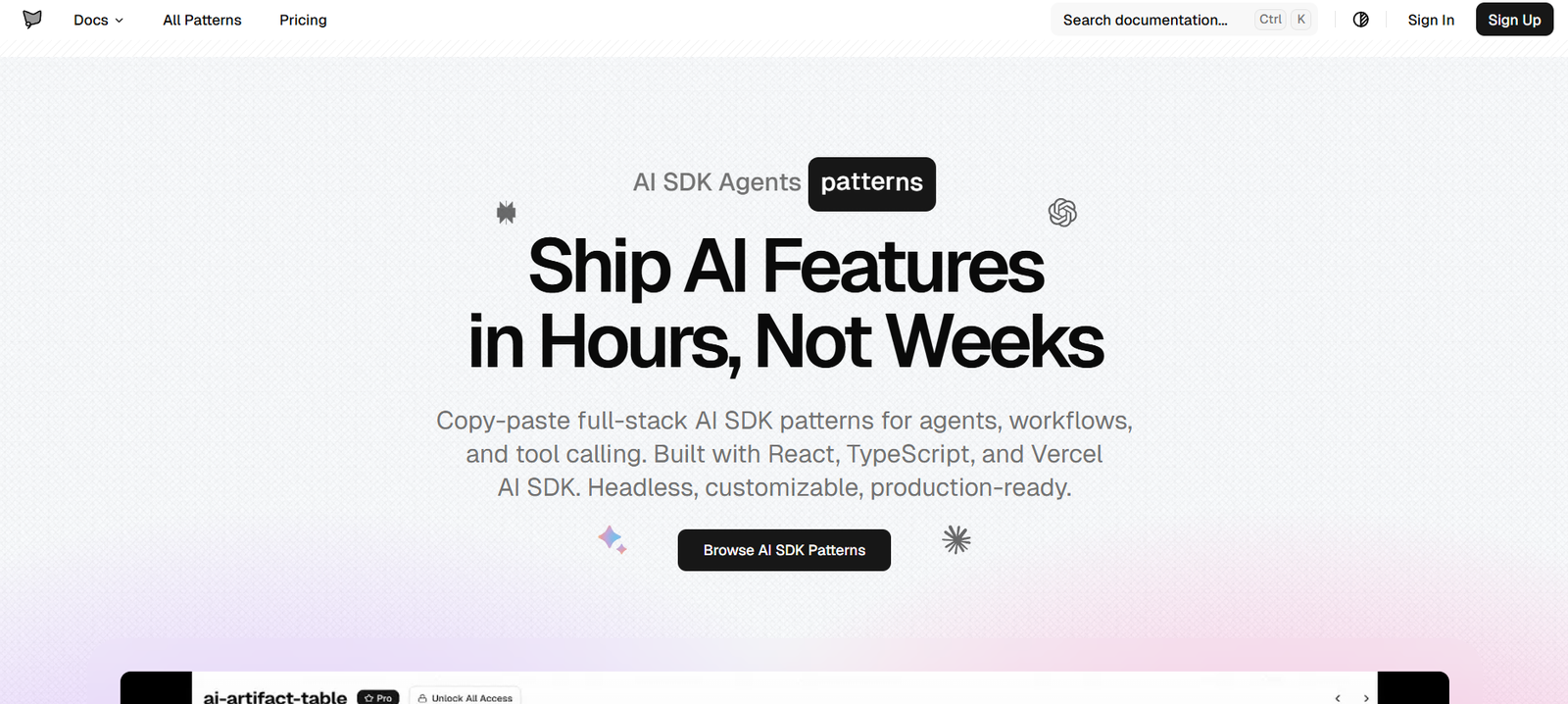
AISDK Agents is a platform built for developers, engineers, and builders who want to create and deploy AI agents that can autonomously complete tasks by making real-time API calls, invoking tools, and maintaining memory. It allows users to move beyond static LLM chatbots by introducing programmable, autonomous agents capable of dynamic interactions with external services. The platform offers a development environment for building agents that are not only context-aware but also functionally capable of executing complex sequences of operations using live API integrations and persistent memory.
AISDK Agents is aimed at a technical audience looking to use AI in a more powerful, programmable way. Rather than relying solely on conversational outputs, the agents created on AISDK can be wired into actual business logic, tools, and workflows. The result is an architecture where agents behave less like chatbots and more like digital teammates that can act, learn, and adapt based on real-time data and environmental triggers.
Features
AISDK Agents provides a unique combination of memory, tools, and autonomy. Memory enables agents to maintain context across sessions, which makes it possible to build agents that improve their responses and decisions over time. Tool use gives agents the power to make real API calls, retrieve data, send requests, and take action across software systems. Autonomy allows agents to operate independently, make decisions, and move toward goals without human prompting at each step. The agents are built with code-first customization in mind, making them flexible and powerful for developers who want to move past prompt engineering and into real AI system building.
One of the core features is the ability to define tools that an agent can call. These tools can be custom APIs, services, or functions that extend the capabilities of the base model. Developers define what these tools are, what inputs they require, and what outputs they return. Once configured, agents can invoke these tools during runtime when needed. The platform supports chaining actions together, allowing agents to perform multi-step reasoning and task execution.
The memory system is not a simple history buffer. It is designed to persist across agent lifecycles and can be structured to reflect relevant business logic, preferences, or historical interactions. This memory persistence allows agents to behave intelligently even across long time frames or asynchronous workflows. AISDK Agents also supports multiple models, giving developers flexibility to choose the right foundation for their use case, whether it’s OpenAI, Anthropic, or other supported LLMs.
How It Works
Building with AISDK Agents starts by defining an agent and configuring its memory, tools, and behaviors. Developers use the SDK or API to program the agent’s logic, define its access to tools, and establish how it should interact with memory. The agent’s memory can include structured data, preferences, or records of previous actions that are stored and retrieved during runtime. Tools are defined as callable functions that the agent can invoke to interact with external systems.
Once set up, the agent operates in an autonomous loop. It evaluates its current state, determines what action or tool to invoke next, calls that tool via API, and then uses the result to inform its next step. This architecture allows for agents that behave more like software services than passive assistants. Developers can also create goals or trigger conditions that prompt the agent to begin work or change behavior based on new data.
The platform is built to be extensible and modular. Developers can integrate their agents into existing systems through the AISDK API, ensuring that agents work within their own product stack. Whether embedded in SaaS apps, internal tools, or automation workflows, agents can be customized to fit specific operational environments. This approach allows developers to create scalable, maintainable, and truly useful autonomous systems.
Use Cases
AISDK Agents can be applied across a wide range of technical and operational use cases. In customer support, an agent can use memory and tools to look up customer details, retrieve order history, and issue refunds or updates through API calls to backend systems. In internal operations, a workflow automation agent could monitor data inputs, trigger alerts, and update internal systems like CRMs, ERPs, or project management platforms based on conditions it detects.
For product teams, AISDK Agents can be used to create AI-driven assistants embedded directly into SaaS platforms that assist users in navigating features, making configurations, or performing routine actions. DevOps teams can configure agents to monitor logs, analyze issues, and trigger remediation actions based on live system data. Knowledge management is another area where agents can store and retrieve business logic and answer questions based on evolving data sets over time.
Startups and technical founders can leverage the platform to prototype AI products without building from scratch, while enterprise teams can integrate autonomous agents into business processes for efficiency, scalability, and resilience. These use cases highlight the versatility of AISDK Agents when paired with strong APIs and business logic.
Pricing
As of now, AISDK Agents offers early access to its platform. Pricing information is not publicly listed on the homepage, indicating that the product is still in private beta or limited release. Users interested in trying the platform are encouraged to request early access through the website. Once accepted, developers can begin building agents and integrating them with their existing systems. Early access participants may benefit from direct communication with the product team, as well as the ability to influence feature development during this early phase.
The absence of published pricing suggests the team is currently focused on refining the developer experience and platform capabilities. For companies evaluating AISDK for serious deployment, signing up for early access will provide the most accurate information about available plans, usage limits, and future pricing tiers.
Strengths
AISDK Agents offers a powerful set of capabilities for developers who want to build intelligent, autonomous systems. Its combination of memory, tools, and autonomy allows for the construction of agents that are significantly more capable than typical LLM chat interfaces. The ability to make real API calls gives agents real-world utility, while memory persistence allows them to adapt and personalize responses over time. The architecture promotes modularity and integration, making it suitable for embedding in products, internal workflows, or operations systems.
The developer-first approach ensures that the platform appeals to builders who are already familiar with APIs and software development. It removes the limits of prompt-only workflows and opens up true AI engineering. The agents are designed to be goal-oriented, context-aware, and capable of running asynchronously or in the background. This makes them highly suitable for real-time automation, monitoring, and decision-making systems.
AISDK Agents also shows strength in its vision. It is not trying to be another chatbot builder or workflow orchestrator. Instead, it focuses on enabling the next generation of autonomous agents that can act intelligently, reason through problems, and operate in software ecosystems with minimal human intervention.
Drawbacks
Because AISDK Agents is still in early access, there are some practical limitations. The lack of public pricing or detailed documentation on the homepage may be a barrier for some teams evaluating options. Onboarding and setup likely require some development experience, and the platform is clearly targeted at a technical audience. Non-technical users may find the learning curve steep, especially if they are unfamiliar with APIs, agent design, or memory architecture.
The reliance on API integrations means that the usefulness of an agent is heavily dependent on the quality and availability of external services. If a tool’s API changes or fails, it can impact the agent’s functionality. As with any early-stage product, platform stability, documentation depth, and long-term support are important factors that potential users will need to evaluate as the product matures.
Comparison with Other Tools
AISDK Agents stands apart from no-code or low-code AI platforms that focus primarily on chat UI or static prompts. Tools like LangChain or AutoGPT offer similar autonomous behavior but often require more configuration and don’t always provide built-in persistence or API management. Compared to chatbot builders like Dialogflow or Botpress, AISDK Agents is more developer-oriented and built for backend logic rather than frontend conversations.
Its unique value lies in combining runtime memory, tool invocation, and autonomy in one agent framework. While some agent frameworks offer similar modularity, few integrate as tightly with APIs and memory in a way that is practical for production workflows. AISDK Agents is a solution for builders who want more than scripted conversations — they want AI systems that can think, remember, and act.
Customer Reviews and Testimonials
At this time, AISDK Agents does not publicly list customer testimonials or reviews on its website. This is consistent with early access platforms that are still refining their product before wider rollout. However, the language and positioning of the site make it clear that the platform is being shaped with direct input from developers and early adopters. Those joining early may be part of a feedback loop that helps guide the evolution of the product, ensuring that it meets the needs of technically proficient teams looking to implement agent-based automation.
Conclusion
AISDK Agents is a forward-looking platform for developers who want to move beyond passive chatbots and into fully autonomous AI systems. By combining memory, tool invocation, and autonomous behavior, the platform offers a framework for building AI agents that can operate within real-world systems and complete complex tasks without constant supervision. Its code-first, API-driven architecture makes it ideal for teams with technical expertise who want to extend the power of LLMs into production workflows.
While still in early access, AISDK Agents presents a compelling vision for how AI agents will be built and used in the future — not just as conversational interfaces, but as intelligent actors capable of reasoning, adapting, and executing with purpose. For developers, startups, and forward-thinking teams, AISDK Agents is worth exploring as a foundation for building powerful, autonomous digital workers.


