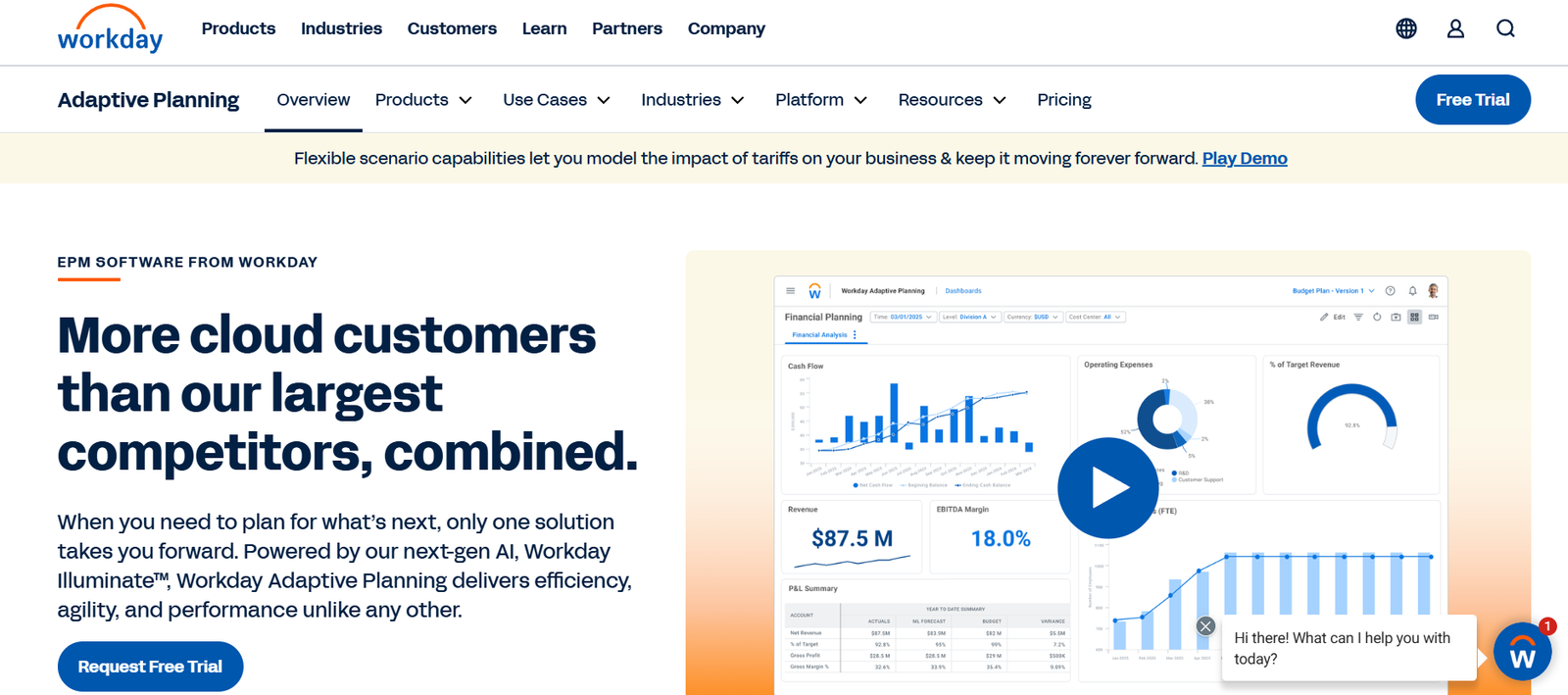
Workday is a leading cloud-based enterprise platform that delivers human capital management (HCM), financial management, and business planning solutions. Designed for medium to large organizations, Workday helps businesses manage their workforce, streamline finance, and plan for growth—all within a single system.
Founded in 2005, Workday has grown into one of the most trusted platforms for enterprise applications, used by thousands of global companies across industries. With its AI-driven architecture and continuous innovation, Workday enables businesses to adapt quickly to change, optimize talent management, and drive financial insights.
Whether managing payroll, forecasting budgets, or developing workforce strategies, Workday delivers real-time data, automation, and analytics to support better decisions.
Features
Workday offers a comprehensive suite of features that cover HR, finance, planning, and analytics.
Human Capital Management (HCM)
Centralized employee data and organizational charts
Talent acquisition, onboarding, and performance management
Compensation planning and workforce development
Diversity, equity, and inclusion analytics
Financial Management
General ledger, accounts payable, and asset management
Expense and procurement solutions
Revenue recognition and compliance tools
Real-time financial reporting
Workforce Planning
Headcount and cost planning
Modeling and forecasting for workforce needs
Scenario analysis for organizational planning
Recruiting and Talent Optimization
AI-powered talent insights and job matching
Skills tracking and career development paths
Internal mobility tools to retain top talent
Payroll and Time Tracking
Global payroll solutions and compliance tools
Time and attendance tracking
Integration with benefits and compensation modules
Analytics and Reporting
Embedded analytics with real-time dashboards
Predictive analytics using machine learning
Custom reports and KPIs for all departments
Integration and Extensibility
Open APIs and Workday Extend for custom apps
Seamless integration with ERP, CRM, and productivity tools
Mobile access and intuitive user interface
How It Works
Workday operates as a unified cloud platform, bringing together HR, finance, planning, and analytics into a single system of record. Built on a flexible architecture, Workday enables organizations to manage core operations through a centralized and connected platform.
The system starts by aggregating employee, financial, and operational data into a consistent framework. AI and machine learning models analyze this data to provide recommendations, automate workflows, and surface insights. For example, HR teams can use AI to match internal candidates to open roles, while finance teams can use predictive analytics for forecasting and budget planning.
Workday’s unified platform ensures real-time updates and eliminates data silos. Users across departments can access the same data simultaneously, with role-based permissions ensuring security and compliance.
The platform is accessible via web and mobile, and it supports extensibility through Workday Extend, allowing organizations to build custom applications and integrations tailored to their specific needs.
Use Cases
Workday supports a wide range of enterprise use cases across different departments and industries.
Human Resources
Streamline the employee lifecycle from hire to retire
Optimize performance management and workforce engagement
Finance Teams
Automate accounting, close books faster, and gain real-time visibility into spend
Simplify compliance and risk management with built-in controls
Recruiting and Talent Acquisition
Attract, assess, and hire top talent using AI-driven tools
Improve candidate experience and reduce time-to-fill
Workforce Planning
Align workforce planning with business goals
Use predictive analytics to model workforce changes and cost implications
Higher Education
Manage student workers, faculty contracts, and budgeting
Support strategic planning and financial oversight
Healthcare
Track certifications and credentialing for healthcare professionals
Manage unionized workforces and complex shift patterns
Retail and Hospitality
Handle seasonal workforce changes, time tracking, and payroll
Improve employee retention through development programs
Technology and Services
Support global operations with unified HR and finance systems
Enable agile planning and workforce optimization
Pricing
Workday does not publicly disclose standard pricing on its website. Pricing is customized based on several factors including:
Organization size and number of employees
Selected modules (HCM, finance, planning, etc.)
Deployment scale and implementation needs
Level of support and training required
Industry-specific configurations
To get a tailored quote, companies must contact Workday’s sales team. Workday often provides live demos and consultations during the evaluation process. Third-party sources estimate that Workday HCM subscriptions can start from around $40 to $100+ per employee per month, but actual pricing varies widely.
Strengths
Workday delivers several key benefits that make it a leader in enterprise cloud applications.
Unified platform for HR, finance, and planning
AI-driven insights for smarter decision-making
Strong user interface with mobile-friendly design
Scalable and secure for global enterprises
Real-time analytics and dashboards
Highly configurable with low-code development tools
Trusted by Fortune 500 companies and leading institutions
Frequent updates with minimal disruption due to cloud-native architecture
Drawbacks
Despite its robust capabilities, Workday may present challenges for certain organizations.
Higher upfront cost compared to SMB-focused platforms
Implementation can take several months and often requires consultants
Steep learning curve for first-time users or small HR teams
Customization can be complex without expert support
Not ideal for very small businesses or startups due to cost and scale
Comparison with Other Tools
Workday competes with enterprise platforms such as Oracle Cloud HCM, SAP SuccessFactors, ADP, and Ceridian.
Compared to Oracle and SAP, Workday is often praised for its more modern interface and ease of use. Unlike ADP, which focuses more on payroll and workforce administration, Workday delivers a broader set of enterprise planning and financial tools.
Workday also stands out for its unified architecture, whereas other platforms may rely on integrations between separately developed systems. This unified model helps avoid data inconsistencies and enables real-time planning across departments.
For mid-size businesses, Workday may be overpowered compared to tools like BambooHR or Gusto, but for large enterprises, it remains one of the most comprehensive cloud-native platforms available.
Customer Reviews and Testimonials
Workday has received strong reviews across enterprise software review sites such as G2, Gartner Peer Insights, and TrustRadius.
Customers consistently praise the platform for its flexibility, scalability, and the ability to centralize HR and finance in one system. HR professionals highlight improved employee experiences and efficient onboarding processes. Finance teams appreciate the real-time reporting and compliance capabilities.
Workday’s customer base includes major brands such as Netflix, Target, Salesforce, and Bank of America. Case studies on the official website demonstrate improved forecasting, reduced manual work, and better alignment between HR and financial planning after adoption.
However, some customers mention challenges with customization and the need for specialized training during the initial implementation phase. Still, most reviews indicate high satisfaction once the system is live and in use.
Conclusion
Workday is a robust, cloud-native platform that unifies HR, finance, and planning functions under one intelligent system. Its strength lies in combining enterprise-grade performance with modern usability, supported by AI and real-time analytics.
For organizations looking to eliminate silos, increase operational efficiency, and future-proof their workforce and financial planning, Workday offers a comprehensive solution. Although the platform may require significant investment in both time and resources, the long-term ROI and organizational agility it provides are often well worth it for large and complex businesses.