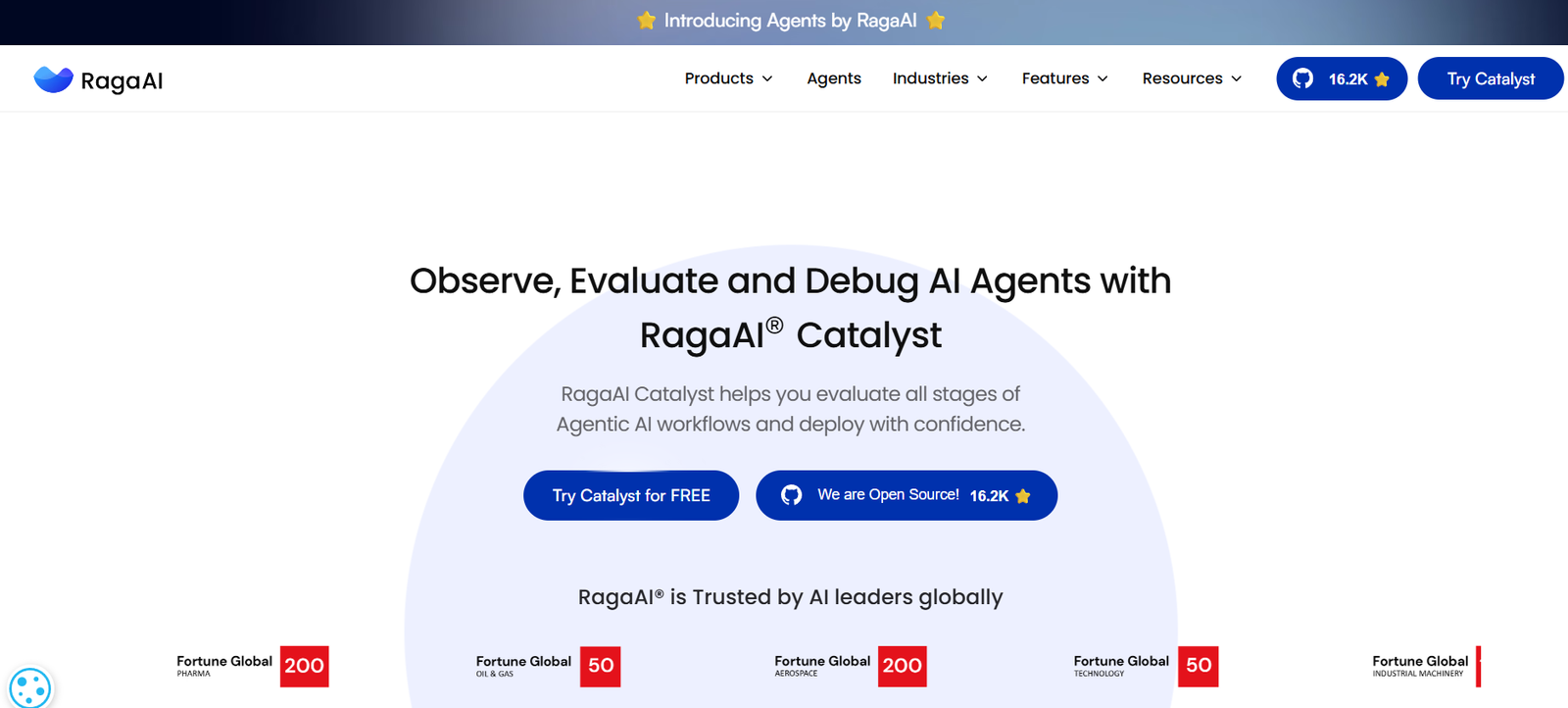
RagaAI is an AI testing and evaluation platform designed to help developers and organizations ensure their AI models are safe, reliable, and ready for real-world deployment. It enables users to detect, diagnose, and fix issues across the entire AI lifecycle, helping companies build trustworthy AI systems at scale.
With growing adoption of AI in mission-critical applications, ensuring model accuracy, fairness, robustness, and explainability has become essential. RagaAI addresses this by offering a systematic, automated approach to AI model testing—similar to how software engineering relies on unit testing and QA.
RagaAI is used by AI and ML teams in industries such as finance, healthcare, autonomous vehicles, and retail to rigorously test their models for errors, bias, and vulnerabilities before and after deployment.
Features
RagaAI provides a suite of tools and capabilities focused on comprehensive AI model testing, evaluation, and monitoring.
The platform supports structured testing across over 300 types of AI-specific tests. These tests cover dimensions such as accuracy, robustness, fairness, explainability, data quality, drift, and security vulnerabilities.
Users can perform automated testing on different stages of the model pipeline—including training data, preprocessing, model outputs, and in-production performance.
RagaAI allows users to generate test reports with actionable insights. These reports help teams identify which tests failed, why they failed, and how to resolve them.
The platform supports integration with popular ML frameworks and tools such as TensorFlow, PyTorch, Hugging Face, and ONNX, allowing seamless testing of various model architectures and data pipelines.
Built-in explainability tools help users understand model decisions and trace back to sources of error or bias.
RagaAI also offers model monitoring for live systems, alerting teams when models drift, underperform, or behave unpredictably in real-world environments.
It is designed with collaboration in mind, providing dashboards, documentation tools, and team workflows to ensure model testing is aligned across product, compliance, and engineering teams.
How It Works
RagaAI works by plugging into the model development and deployment pipeline to provide end-to-end testing coverage.
Users start by uploading their models and datasets into the platform. RagaAI then runs a series of diagnostic tests to evaluate the model across dimensions such as performance metrics, robustness to edge cases, and bias detection.
Each test evaluates a specific attribute—for example, a robustness test may expose how a model behaves with noisy or perturbed inputs, while a fairness test checks for output disparities across demographic groups.
Based on test results, RagaAI generates a comprehensive report with findings, visualizations, and prioritized recommendations for improvement.
As models are updated or retrained, RagaAI allows for re-testing and continuous validation, ensuring changes don’t introduce regressions or new errors.
In production, users can enable model monitoring features to detect issues like drift, anomalies, or performance degradation based on real-world data.
The platform offers API access and SDKs for integration with MLOps workflows, CI/CD pipelines, and model registries.
Use Cases
RagaAI serves teams building AI systems across a wide range of high-stakes and data-driven applications.
In healthcare, RagaAI is used to validate diagnostic models and ensure predictions are fair and robust, especially across different patient groups or input conditions.
Financial institutions rely on RagaAI to test models for credit scoring, fraud detection, and risk assessment. Testing for fairness and bias is critical in regulated environments.
Autonomous vehicle companies use the platform to evaluate perception and decision models under adversarial conditions, ensuring safety and robustness.
E-commerce and retail businesses apply RagaAI to test recommendation engines and personalization systems for performance consistency, explainability, and ethical alignment.
Enterprise ML teams use RagaAI to integrate model testing into their development lifecycle, enabling better governance, faster iteration, and fewer production incidents.
AI research labs and universities use RagaAI to benchmark and validate experimental models before publication or real-world deployment.
Pricing
RagaAI does not list public pricing details on its website. Pricing is customized based on the size of the organization, number of models, volume of data, and deployment needs.
The platform offers enterprise plans with support for scalable testing, team collaboration, and dedicated onboarding.
Interested users can request a demo or contact the RagaAI team directly for tailored pricing, deployment options, and technical onboarding.
As RagaAI is designed for enterprise-grade AI systems, pricing is expected to reflect its advanced capabilities in risk mitigation, compliance support, and testing automation.
Strengths
RagaAI provides a much-needed layer of quality assurance in the AI lifecycle, helping teams move from experimentation to deployment with greater confidence.
Its ability to test models across hundreds of criteria gives teams full visibility into weaknesses, performance gaps, and compliance risks.
The platform’s compatibility with multiple frameworks and architectures makes it flexible and widely applicable.
It supports continuous testing and monitoring, enabling organizations to implement responsible AI practices without slowing down development.
RagaAI helps align cross-functional teams—from data science to legal and compliance—by making model risks transparent and measurable.
Drawbacks
RagaAI is currently designed for mid-sized to large organizations that have mature AI pipelines. Smaller teams or startups may find its enterprise-grade scope more than they need.
Since pricing is custom and not publicly listed, it may be difficult for teams to assess cost upfront without a sales consultation.
The platform requires some setup and integration effort, particularly for teams without established MLOps infrastructure.
As with most AI governance tools, interpreting and acting on complex test results may require some domain expertise in AI/ML.
Comparison with Other Tools
Compared to generic MLOps platforms like MLflow or Neptune, RagaAI is specialized in testing, quality assurance, and risk assessment—not model development or deployment.
Against fairness libraries like AIF360 or What-If Tool, RagaAI offers broader coverage across more test types, plus automated testing pipelines and production monitoring.
While some observability platforms like Arize AI or Fiddler AI provide post-deployment monitoring, RagaAI extends deeper into pre-deployment testing and test-driven model development.
Its testing philosophy is comparable to unit testing in software, making it a standout platform for organizations adopting more rigorous AI engineering practices.
Customer Reviews and Testimonials
RagaAI is gaining recognition among AI leaders for its contribution to safer, more reliable AI systems. Although still emerging, early adopters have praised its ability to identify edge cases, highlight hidden biases, and prevent expensive deployment mistakes.
Users appreciate the detailed, actionable nature of the test reports and the ability to reproduce issues consistently across data and model versions.
AI governance teams report that using RagaAI has helped them align development processes with internal policies and upcoming regulations.
While public reviews are still limited, case studies and demos shared by RagaAI showcase successful deployments in sectors like fintech, healthcare, and AI safety.
Conclusion
RagaAI is a pioneering platform in the growing space of AI testing, risk mitigation, and governance. As AI becomes increasingly integrated into high-stakes business operations, ensuring models are accurate, fair, and robust is no longer optional—it’s critical.
By automating model evaluation, surfacing hidden issues, and enabling continuous monitoring, RagaAI empowers organizations to build trustworthy AI systems that meet both user expectations and regulatory requirements.
For teams looking to bring the discipline of software testing into the world of AI development, RagaAI offers the tools and insights needed to build AI you can trust.