
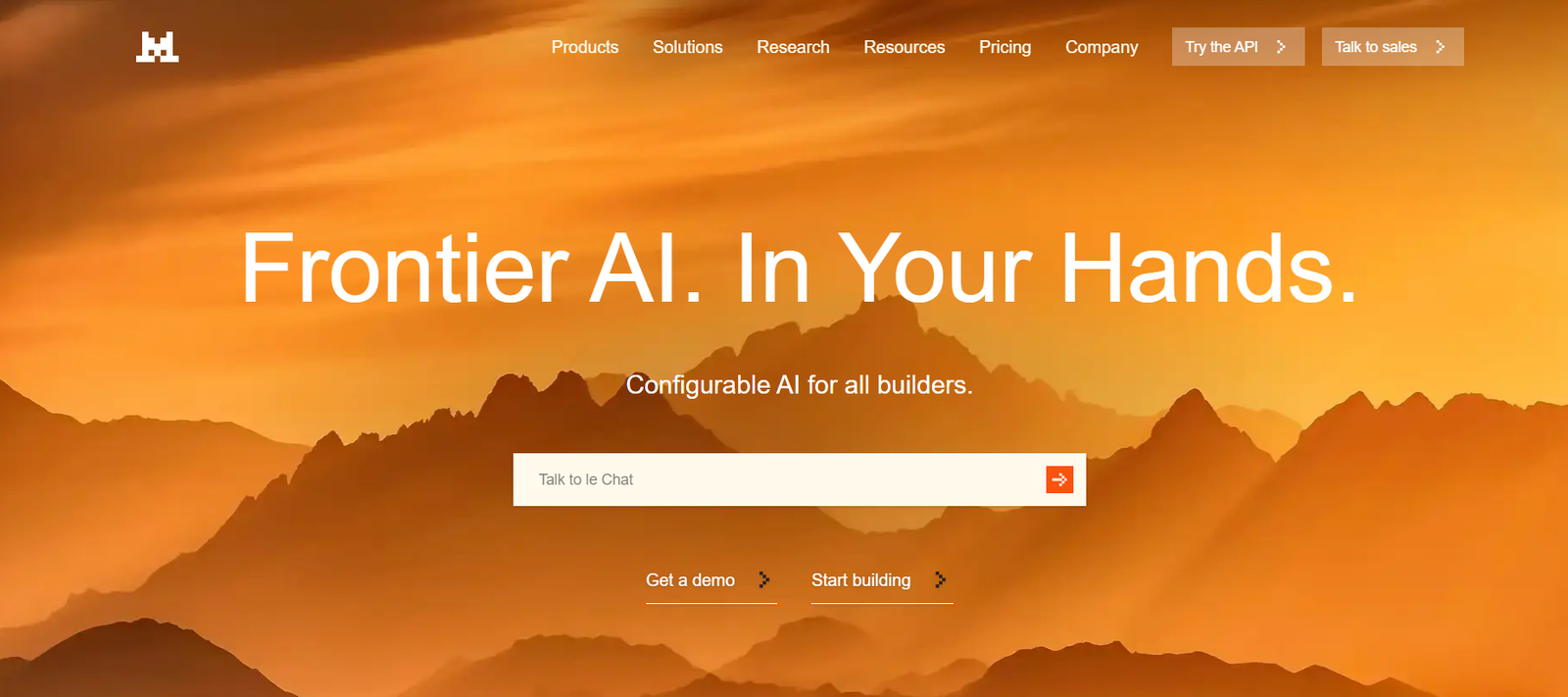
Mistral is a leading AI research and deployment company focused on building open-weight, high-performance large language models (LLMs) for developers, enterprises, and the broader AI ecosystem. Founded in 2023 and headquartered in Paris, Mistral aims to democratize AI by releasing open-access models that combine top-tier performance with transparency and customization flexibility.
The company is known for its commitment to open science and its contributions to foundational model development. Unlike closed AI systems, Mistral offers open-weight models that allow developers and organizations to run, fine-tune, and integrate them without restrictive licenses. Its offerings serve a wide range of applications, from chatbots and coding assistants to enterprise knowledge search and creative generation.
Mistral is seen as a European alternative to proprietary AI models, providing high-performance AI tooling without locking users into a single ecosystem.
Features
Mistral delivers advanced capabilities through its open-weight LLMs and inference platform.
Its models are designed to be compact yet powerful, optimized for fast inference and deployment on a wide variety of hardware setups.
The company has released multiple models under permissive licenses, including Apache 2.0, enabling developers to use and customize them for both research and commercial purposes.
Mistral models support instruction tuning, chat-based formats, and can be integrated into various downstream tasks, including natural language understanding, text generation, and summarization.
The models are capable of long-context processing and are efficient in memory usage, making them suitable for resource-constrained environments.
Mistral also provides a hosted inference API for users who prefer managed services over self-hosted infrastructure.
The product ecosystem includes Mistral-7B, Mixtral (a mixture-of-experts model), and the new Mistral Large model available via API.
How It Works
Mistral’s language models are trained on large-scale datasets using transformer-based architectures and cutting-edge optimization techniques.
The open-weight models, like Mistral-7B and Mixtral, can be downloaded from repositories such as Hugging Face and integrated into local or cloud environments. These models are designed for efficient inference, and Mixtral’s mixture-of-experts design ensures high throughput without compromising on quality.
For those using the hosted API, developers can call the models using RESTful endpoints with simple payloads, enabling low-latency access to state-of-the-art language understanding and generation.
Mistral also provides chat templates and tokenizers for smoother integration into custom applications.
Whether developers choose to run Mistral models on their own infrastructure or through the company’s API, the focus is on speed, openness, and customization flexibility.
Use Cases
Mistral’s models serve a wide variety of AI-powered applications across industries.
Startups and product teams use Mistral models to build intelligent chatbots, search tools, and personalized assistants that can understand and respond in natural language.
Enterprises apply these models to internal knowledge bases, automating document search, summarization, and decision support.
In software development, Mistral models can power coding assistants that generate, explain, or debug code snippets in various programming languages.
Academic researchers and AI enthusiasts leverage the models for fine-tuning and experimentation in tasks like sentiment analysis, content classification, and text transformation.
Government and public institutions are beginning to explore open-weight models like Mistral to ensure transparency, auditability, and data sovereignty.
Pricing
Mistral offers both open-source models and a pay-as-you-go inference API.
The open-weight models, such as Mistral-7B and Mixtral, are available for free under permissive licenses like Apache 2.0. These can be downloaded and run on local infrastructure or cloud platforms without any usage fees.
For cloud inference, Mistral has partnered with platforms like Hugging Face and Azure. The pricing varies depending on the provider and the model size. As of now, detailed public pricing for Mistral’s own hosted API is limited on the official site.
However, the hosted model “Mistral Large” is available through third-party APIs such as Le Chat and Hugging Face, typically billed by token usage.
For enterprise contracts, Mistral offers custom pricing and support depending on the scale, data residency needs, and usage volume.
Strengths
Mistral is known for its commitment to openness. The release of high-performing models under permissive licenses enables unrestricted innovation and integration.
Its models are highly optimized, providing fast inference speeds and competitive performance compared to larger, closed models.
Developers appreciate the flexibility to run models locally, reducing dependency on third-party APIs and enhancing data privacy.
Mistral’s approach is ideal for organizations concerned about vendor lock-in, data control, or long-term scalability.
The company also has a strong research foundation, with models designed by a world-class team of machine learning experts.
Drawbacks
While open-weight models are powerful, they require technical expertise to deploy and maintain, especially when self-hosted.
Documentation and support resources are still growing, and some users may find the ecosystem less mature than that of established platforms like OpenAI or Anthropic.
The hosted inference API is not as extensively documented or integrated as APIs from other providers, potentially slowing onboarding for less experienced teams.
Enterprises requiring comprehensive SLAs, fine-tuning services, or ecosystem tools may find current offerings limited unless they engage directly with Mistral’s team.
Comparison with Other Tools
Mistral is often compared to platforms like OpenAI, Meta AI (LLaMA models), and Anthropic.
Compared to OpenAI’s GPT-4 or Anthropic’s Claude, Mistral stands out for its open-weight strategy. Users can download and run the models themselves, giving full control over performance, privacy, and cost.
Meta’s LLaMA models are also open-weight but often come with more restrictive licensing for commercial use. Mistral’s models are more permissively licensed, allowing broader use in business applications.
Compared to GPT models, Mistral models are generally smaller but offer surprisingly competitive performance due to architectural efficiency and expert routing in models like Mixtral.
Teams looking for fast, local deployment with no usage restrictions typically prefer Mistral over closed APIs. However, those needing broader tooling, fine-tuned models, or integrated ecosystems may lean toward OpenAI or Google.
Customer Reviews and Testimonials
Mistral has received strong early feedback from the open-source AI community. On platforms like Hugging Face, its models have been downloaded hundreds of thousands of times.
Developers praise the performance-to-size ratio and ease of integration into existing ML workflows. Many community users have benchmarked Mistral models favorably against proprietary models, particularly in coding and chat applications.
In forums like Reddit and Hacker News, Mistral is often highlighted as a “refreshing open alternative” to the increasingly closed AI model landscape.
Some users have expressed the need for improved documentation and easier access to fine-tuning guides, especially for enterprise-level deployments.
Conclusion
Mistral is redefining what’s possible with open-weight AI by delivering powerful, efficient language models that developers can use without restrictions. Its commitment to open science, combined with a focus on performance and flexibility, makes it a top choice for teams looking to deploy generative AI on their own terms.
Whether you’re building an AI assistant, powering a search engine, or deploying AI inside regulated environments, Mistral offers a compelling mix of openness, control, and capability.
As the ecosystem around open-weight models continues to mature, Mistral is well-positioned to become a foundational layer in the next generation of AI applications.


