
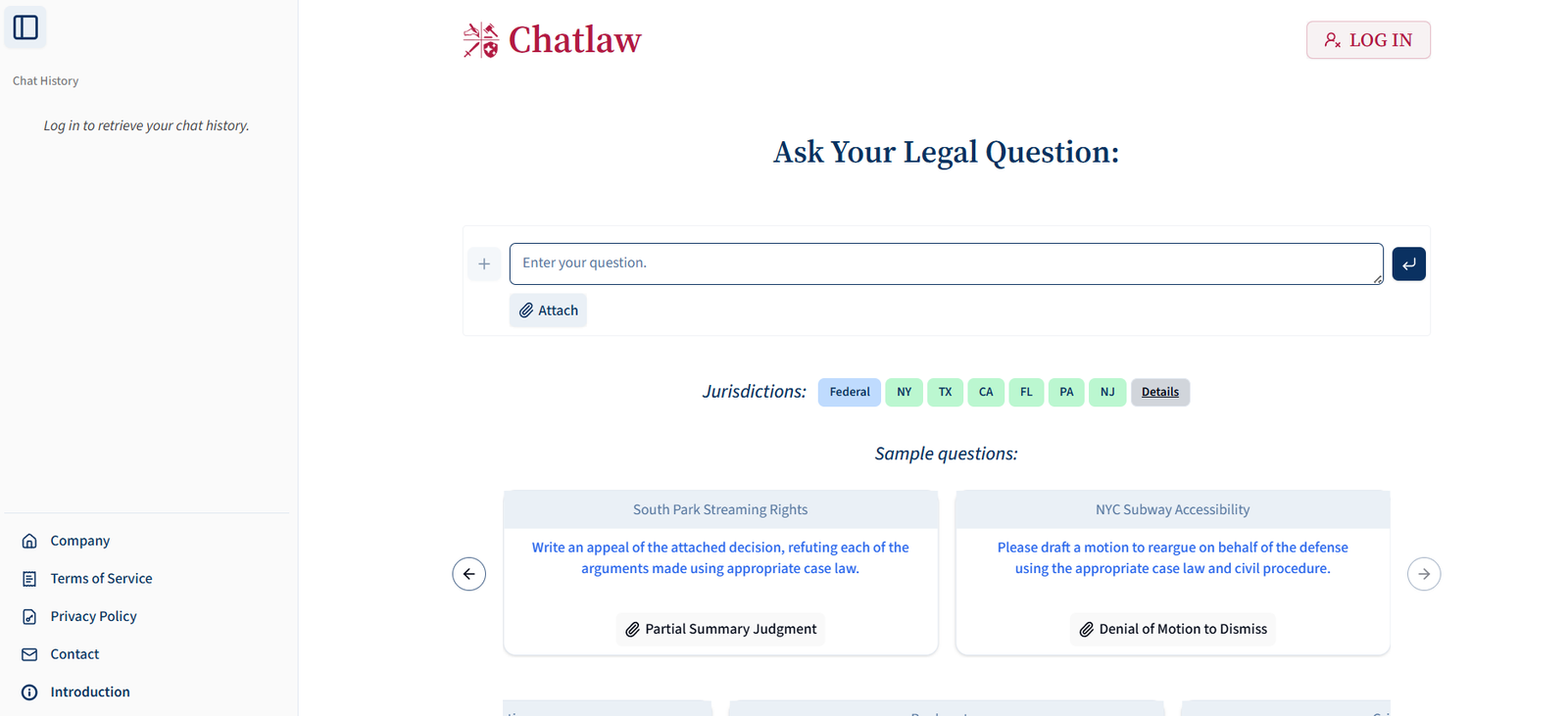
ChatLaw is an open-source, AI-powered legal assistant designed to help users research and understand U.S. law. Built on advanced language models and trained using actual U.S. legal texts—including Supreme Court cases, federal statutes, and legal definitions—ChatLaw makes legal knowledge more accessible to legal professionals, researchers, and everyday users.
Unlike general-purpose chatbots or search engines, ChatLaw is fine-tuned specifically for the American legal system. It allows users to ask complex legal questions and receive responses based on real case law, making it a valuable tool for law students, attorneys, paralegals, and the general public seeking deeper legal insight.
Features
ChatLaw offers a range of powerful, law-specific features designed to make legal research faster and easier:
Trained on U.S. Legal Texts – Includes a corpus of U.S. Supreme Court opinions, federal statutes, and constitutional content.
Conversational Legal Q&A – Ask legal questions in plain English and receive answers contextualized by case law and statutes.
Open Source – Completely free and open-source, allowing developers and institutions to customize and self-host the tool.
Legal Citation Support – Provides references to relevant U.S. legal cases and principles, improving research transparency.
No Registration Required – Users can immediately interact with the AI tool without account creation or login.
Fast and Lightweight – Hosted as a web application with minimal latency and accessible UI.
Developer-Friendly Deployment – Can be run locally or on a private server using provided GitHub repositories.
Privacy-Conscious – No tracking or data collection for users who deploy or interact with self-hosted versions.
How It Works
ChatLaw combines legal datasets with powerful language models in a streamlined web interface:
Ask a Legal Question – Enter a legal query (e.g., “What are the limits of free speech under the First Amendment?”).
AI Processes Input – The system uses a fine-tuned large language model (LLM) trained on legal texts to understand and respond.
Receive Response with Legal Reasoning – The answer includes an explanation grounded in legal principles and, when possible, cites relevant Supreme Court cases or statutes.
Explore Further – Users can refine their questions or dive deeper into related legal topics.
Because the platform is open-source, users and developers can modify the model, update training data, or adapt the interface for institutional use.
Use Cases
ChatLaw serves a broad range of users and legal research needs:
Law Students – Simplifies the study of case law and constitutional principles.
Legal Researchers – Speeds up analysis of Supreme Court rulings and federal statutes.
Public Legal Education – Helps non-lawyers understand the foundations of U.S. law without legal jargon.
Solo Practitioners & Paralegals – Provides quick references and summaries to aid in legal work.
Developers & Legaltech Teams – Use or extend the open-source tool for custom legal AI applications.
Journalists & Policy Analysts – Rapidly understand and cite legal context behind news or policy issues.
Pricing
ChatLaw is completely free and open-source. There are no paid plans, subscriptions, or usage fees. Users can:
Access ChatLaw via the Web – Use the live demo hosted at chatlaw.us for instant Q&A.
Self-Host via GitHub – Download and deploy the full project locally or on your own server using the official GitHub repository (ChatLaw GitHub).
This makes ChatLaw one of the most cost-effective and flexible AI legal assistants available.
Strengths
ChatLaw provides numerous advantages, especially for legal education and open legal access:
Free and Open Source – No cost or barrier to entry; ideal for students, educators, and developers.
Trained on Authoritative Legal Sources – Responses are based on real legal data, improving relevance and reliability.
No Login or Tracking – Respects user privacy with minimal data handling.
Customizable and Extendable – Users can adapt the codebase for their own legal systems or internal tools.
Built for Legal Q&A – Outperforms general-purpose AI models in legal comprehension and accuracy.
Drawbacks
Despite its strengths, there are a few limitations to be aware of:
Not a Substitute for Legal Advice – ChatLaw is an educational and research tool, not a licensed legal service provider.
Limited to U.S. Federal Law – Currently focused on U.S. Supreme Court rulings and federal statutes; not trained on state law or other jurisdictions.
Lacks Full Case Management Features – Does not support document uploads, redlining, or workflow tools like those in legal practice platforms.
Limited Ongoing Support – As an open-source project, updates may depend on community contribution and maintenance.
Accuracy May Vary – While trained on legal texts, responses are still generated by AI and should be reviewed by legal professionals.
Comparison with Other Tools
ChatLaw compares to a few other legal AI platforms but offers unique benefits:
vs. ChatGPT (General Model)
ChatLaw is trained specifically on legal data, offering higher precision for legal questions compared to ChatGPT, which is general-purpose.
vs. Westlaw or LexisNexis
Those are commercial legal research platforms with comprehensive databases and editorial support. ChatLaw is a free, lightweight alternative focused on conversational answers.
vs. DoNotPay
DoNotPay focuses on consumer legal actions (e.g., small claims, parking tickets). ChatLaw is geared toward legal understanding and education.
vs. CaseText (CoCounsel)
CaseText offers AI-powered legal drafting and research for professionals, often at a cost. ChatLaw offers free access with an open-source model suitable for learning and development.
Customer Reviews and Testimonials
As a community-driven and developer-friendly tool, early feedback has been largely positive:
“ChatLaw makes legal research accessible in seconds—ideal for students.”
“Love the open-source model. We’re adapting it for our university’s law department.”
“Not perfect, but amazing for quick legal overviews and case understanding.”
The legal community has praised its transparency, specificity, and potential as an educational resource.
Conclusion
ChatLaw is an impressive, AI-powered legal research assistant designed specifically for understanding U.S. law. With its open-source foundation, focus on Supreme Court and federal law, and commitment to accessibility, it’s a powerful tool for students, researchers, and legal professionals seeking a conversational way to interact with legal information.
While it’s not intended for use in active legal cases or client representation, ChatLaw serves as an excellent educational and exploratory platform—putting legal knowledge within reach for anyone.
For those interested in the future of legal AI or seeking a trustworthy research companion, ChatLaw is an innovative and reliable starting point.


