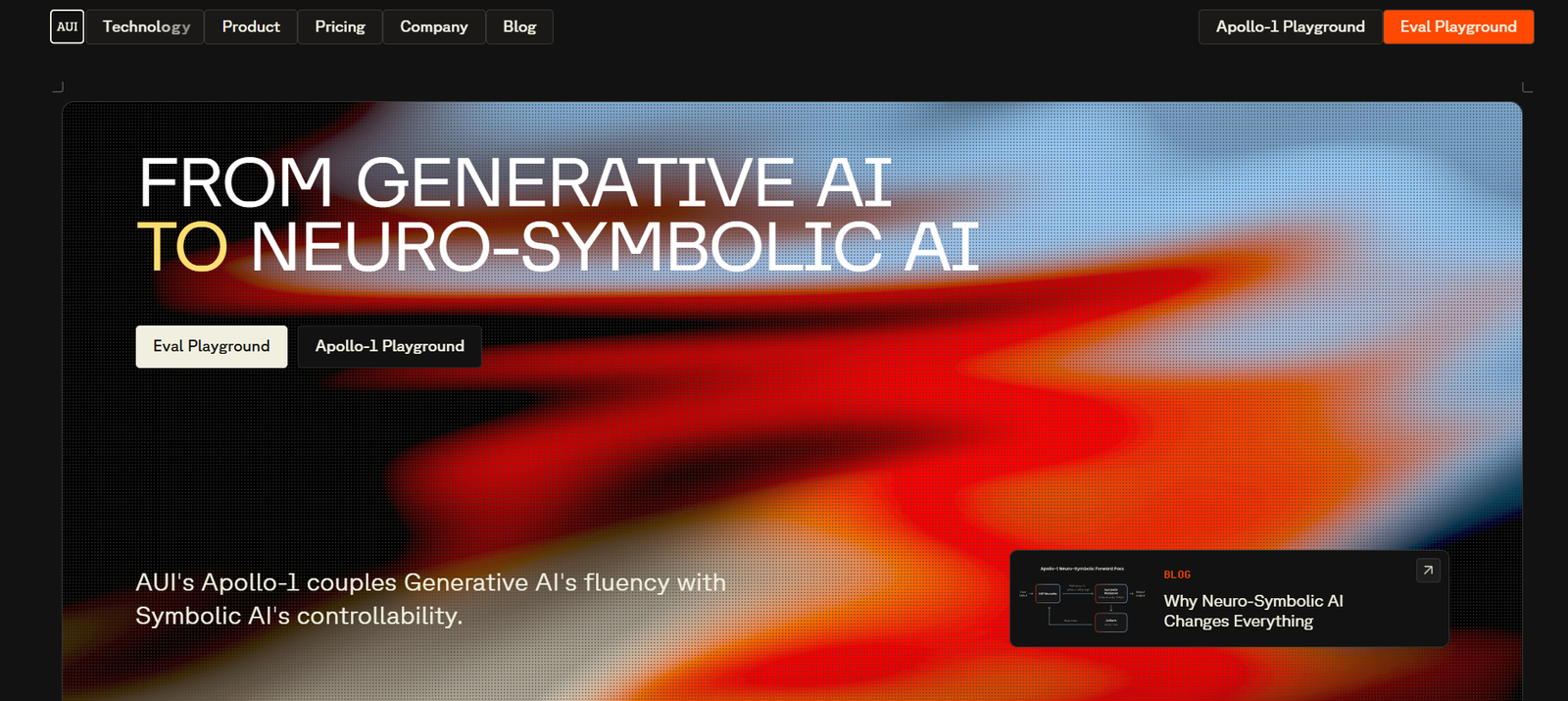
AUI (Applied Understanding Intelligence) is a pioneering AI company focused on building safe, explainable, and structured machine reasoning systems. Unlike black-box large language models (LLMs) that rely purely on statistical pattern-matching, AUI develops AI architectures grounded in understanding, logic, and alignment—with the goal of creating systems that are not only capable of completing tasks but also able to explain why and how they arrived at their outputs.
AUI’s approach is rooted in cognitive science and formal semantics, prioritizing structured reasoning and clarity over opaque generative processes. The company is working to enable next-generation AI assistants and agents that are trustworthy, interpretable, and aligned with human values and enterprise needs.
Features
AUI is building a platform that departs from traditional LLMs by incorporating features designed for reliability, traceability, and cognitive understanding:
Reasoning-Based AI Architecture
Uses structured models of knowledge, causality, and logic to simulate true understanding rather than statistical approximation.Explainability by Design
Every output includes a clear, traceable explanation of how and why the answer was generated.Alignment and Safety First
Built-in constraints and logic layers help ensure that AI outputs align with human goals, ethics, and safety protocols.Semantic Memory
Leverages long-term structured memory that understands relationships, concepts, and user-specific contexts.Modular AI Systems
AUI designs AI that can be decomposed into interpretable modules—ideal for enterprise applications requiring compliance or auditability.Interactive Understanding Agents
Designed for dialog, planning, and decision support with agents capable of holding multi-step, logically coherent conversations.Task-Specific Reasoning Models
Supports use cases like planning, problem-solving, technical troubleshooting, and multi-agent coordination through structured logic trees.
How It Works
Input Understanding
AUI’s system parses user input into a structured representation of meaning—identifying intent, relationships, and dependencies.Reasoning and Inference
The AI applies formal logic, domain knowledge, and semantic rules to derive answers, plans, or next steps.Traceable Output Generation
Rather than generating free-form responses, AUI produces output supported by a logical explanation and provenance.Alignment and Verification
All responses are filtered through safety layers and alignment mechanisms to ensure that they are ethically and factually sound.Interaction and Iteration
The AI can engage in back-and-forth dialogue to clarify, revise, or co-create plans based on user feedback and contextual understanding.
Use Cases
AUI’s structured reasoning architecture is suitable for a wide range of high-stakes or logic-intensive applications:
Enterprise Planning and Decision Support
AI agents that help executives analyze scenarios, evaluate options, and reason through trade-offs.Technical Problem Solving
Assistants that can walk users through troubleshooting tasks with causal reasoning, not just language completion.Legal, Policy, and Compliance Support
Systems that can explain regulatory rules, apply them to cases, and justify the resulting decisions.Multi-Agent Systems Coordination
Logic-driven agents that can delegate, sequence, and manage tasks with traceable reasoning paths.Education and Tutoring
Learning assistants capable of explaining complex topics step-by-step with logical coherence and pedagogical structure.AI Ethics and Alignment Research
AUI’s platform serves as a research testbed for building aligned AI systems grounded in formal semantics and interpretability.
Pricing
As of now, AUI is in an advanced development and early adoption phase. The platform is not publicly available for self-serve access, and pricing is customized based on:
Enterprise use case complexity
Deployment and integration requirements
Agent customization and training needs
Alignment and safety features required
Research collaboration or co-development options
Interested organizations can request early access or partnerships via the official website.
Strengths
Groundbreaking approach to AI explainability and alignment
Moves beyond black-box LLMs with interpretable reasoning systems
Ideal for regulated industries or mission-critical decisions
Structured AI enables better control, governance, and safety
Built to be modular and traceable from the ground up
Strong focus on human-AI alignment principles
Drawbacks
Still in early access—limited availability for general users
Not designed for general-purpose, high-volume generative tasks like LLMs
May require domain-specific customization and integration
Currently best suited for enterprises or research institutions
Comparison with Other Tools
Unlike generative models such as GPT-4, Claude, or Gemini, AUI does not rely on stochastic language prediction. Instead, it introduces a semantic reasoning engine that prioritizes logic, interpretability, and safety.
In comparison to prompt-engineered LLM-based agents (e.g., CrewAI or AutoGen), AUI offers a fundamentally different architecture that is not prompt-reliant. This makes it uniquely positioned for use cases where explainability, precision, and trust are non-negotiable.
While most AI tools offer power, AUI is focused on purposeful, explainable intelligence.
Customer Reviews and Testimonials
Due to the platform’s early access stage, public reviews are not yet available. However, AUI is collaborating with leading research organizations, enterprises, and alignment experts to test and refine the system in real-world environments.
Key highlights from its approach include:
Trusted by partners in AI ethics, safety, and reasoning research
Used in exploratory applications for decision support, logic-based planning, and safe AI agent design
Noted for its commitment to structured understanding and safety-by-design
More updates and case studies will be available as the platform expands into production environments.
Conclusion
AUI (Applied Understanding Intelligence) is redefining what it means for AI to “understand.” Rather than mimicking intelligence through pattern prediction, AUI builds AI systems that can reason, explain, and align with human logic and values. For enterprises and researchers looking to go beyond black-box models and toward safe, interpretable, and reasoning-based AI, AUI offers a fundamentally new and promising path.