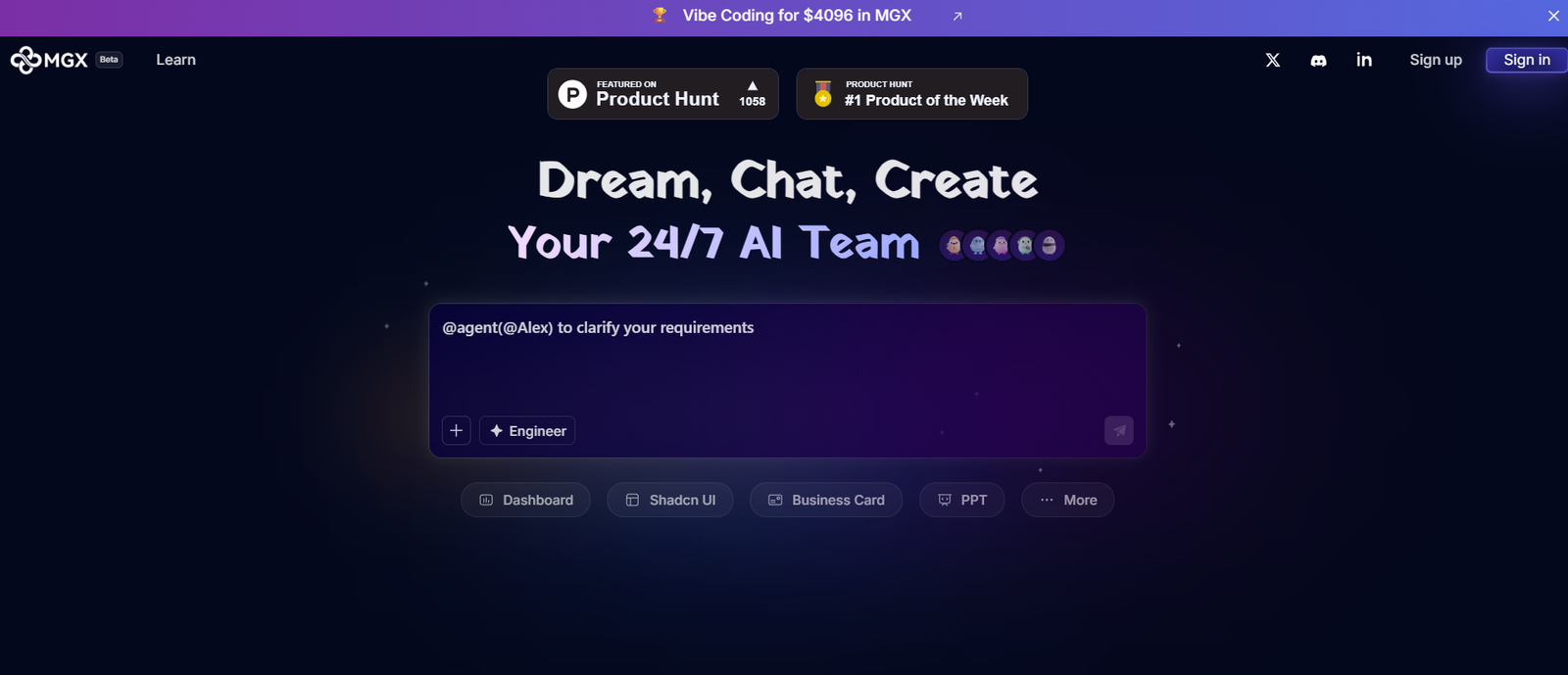
MGX is an open-source framework that enables developers to build and manage multi-agent systems powered by AI. Built on top of large language models (LLMs) and inspired by the growing trend of autonomous agents, MGX provides a robust architecture for designing, testing, and deploying AI-powered workflows across various domains.
Unlike single-agent chatbots or isolated tools, MGX is designed to support agent collaboration and task orchestration in complex systems. Whether you’re developing AI research tools, process automation, or scalable digital workers, MGX helps bridge the gap between theory and application by making multi-agent systems more accessible and programmable.
With full customization, plugin extensibility, and support for tool integrations, MGX is particularly valuable for developers, AI researchers, startups, and organizations building AI-first products.
Features
Multi-Agent Orchestration
MGX allows you to define and manage multiple AI agents with distinct roles, personalities, and responsibilities. These agents can collaborate on shared goals or operate in parallel across tasks.
Built-in Agent Memory
Each agent in MGX is equipped with contextual memory, enabling them to retain knowledge from previous interactions and conversations. This makes task execution more coherent and continuous.
Tool and Plugin Support
Agents in MGX can use external tools such as web browsers, file managers, APIs, or databases. Custom plugins can be developed to extend their capabilities further.
Open-Source and Self-Hostable
MGX is completely open-source and available on GitHub, giving developers full control over hosting, customization, and deployment. It can run locally or be deployed on a private server.
Web UI and Terminal Interface
MGX includes both a browser-based graphical interface and a terminal interface for interacting with and debugging agents.
Workflows and Task Routing
Users can define structured workflows where agents perform sequences of tasks or delegate actions to one another. This enables coordination in complex pipelines.
LLM Agnostic
MGX supports multiple foundation models, including OpenAI GPT-4, Anthropic Claude, Google Gemini, and local models via LM Studio or Ollama. This flexibility allows teams to choose based on performance, cost, or data privacy needs.
Agent Personas and Prompts
Developers can define agent “personas” using structured prompts and configurations, enabling reusable agents that specialize in research, development, summarization, writing, or analysis.
YAML-Based Configurations
MGX supports configuration of agents and workflows using readable YAML files, making the system easy to version control and share.
API and Webhook Support
MGX can trigger external actions or connect to third-party services using API calls and webhooks as part of a workflow.
How It Works
MGX operates as a modular framework where users define one or more agents and assign them tasks through a central coordination system. Here’s a general workflow:
Define Agents
Using configuration files or the UI, users define agents with specific goals, tools, LLM backends, and personality traits.Assign Tasks
Users can input tasks manually via the interface or feed them through APIs. Agents receive tasks, determine next actions, and may collaborate with other agents.Use Tools and Plugins
During task execution, agents can use tools like search engines, code runners, or custom plugins to complete tasks more efficiently.Communicate and Collaborate
Agents communicate via shared memory and routing rules. One agent can delegate part of a task to another agent and integrate the result.Generate Outputs
Final results are returned to the user through the interface or API. All steps are logged for transparency and auditing.
This model simulates a team of digital workers, each with defined roles and abilities, working together on a project or objective.
Use Cases
AI Research and Prototyping
Researchers can use MGX to prototype experimental agent systems and simulate autonomous collaboration in fields like AI alignment, robotics, or human-AI interaction.
Workflow Automation
Organizations can use MGX to build AI agents that automate routine tasks such as document generation, report analysis, or software QA processes.
Technical Writing and Summarization
Teams can create specialized writing agents that research, outline, draft, and edit content collaboratively using MGX’s memory and task routing capabilities.
Software Development Assistants
MGX can be configured to run agents for code review, documentation, refactoring, and testing—providing developer assistance in collaborative workflows.
Data Analysis and Reporting
Multi-agent systems can automate the extraction, analysis, and summarization of datasets for internal reporting or customer insights.
Productivity Bots
Freelancers and small teams can configure personal AI assistants to manage tasks like inbox triage, meeting summaries, or knowledge management.
Pricing
MGX is currently free and open-source. There are no license fees, usage costs, or subscriptions required to use the core platform.
Key points:
Free to download from GitHub
Self-hosted; run locally or on your own cloud server
Uses external LLMs (OpenAI, Claude, Gemini) which may incur separate API usage fees
Plugin and tool development are open and community-supported
This makes MGX an ideal choice for developers and teams looking to experiment or scale without vendor lock-in or high costs.
Strengths
Fully open-source and customizable
Designed specifically for multi-agent collaboration
Flexible integration with major LLM providers and local models
YAML configuration makes it easy to manage and replicate workflows
Active development with frequent updates and plugin support
Self-hosting provides complete control over data and security
Ideal for developers, researchers, and power users
Drawbacks
Not beginner-friendly; initial setup requires some technical familiarity
Lack of pre-built templates or guided onboarding compared to commercial platforms
Requires management of LLM API keys and third-party tool access
Still evolving; some features may be experimental or in active development
Comparison with Other Tools
While other platforms such as AutoGPT, AgentGPT, and LangChain offer support for agent workflows, MGX focuses on structured multi-agent orchestration with a strong emphasis on openness, modularity, and plugin support.
MGX distinguishes itself by offering:
Better configuration and versioning through YAML
Native multi-agent collaboration
Full local hosting capability
Web UI and terminal interface support
Compared to commercial no-code agent builders, MGX provides greater depth, control, and developer flexibility at the cost of a steeper learning curve.
Customer Reviews and Testimonials
As an emerging open-source project, MGX does not yet have formal reviews on platforms like G2 or Capterra. However, it has gained attention in the AI developer community and on GitHub for its practical approach to agent design.
Feedback from developers and early adopters includes:
“MGX makes building serious multi-agent applications actually manageable.”
“I’ve been able to prototype workflows that would take weeks with LangChain in just a day.”
“I love the YAML config system—it makes deploying workflows easy to track and tweak.”
To stay updated or contribute, users can join the MGX Discord community or follow the team’s updates on https://mgx.dev.
Conclusion
MGX is a powerful open-source framework for building multi-agent AI systems. Designed with developers and AI researchers in mind, it offers full flexibility for orchestrating complex agent workflows using LLMs and custom tools.
With strong support for real-world use cases like automation, writing, and technical development, MGX represents a significant step forward in practical agent-based AI. It’s not a plug-and-play solution for beginners, but for those ready to invest in a configurable platform, MGX delivers the tools to create sophisticated autonomous systems.