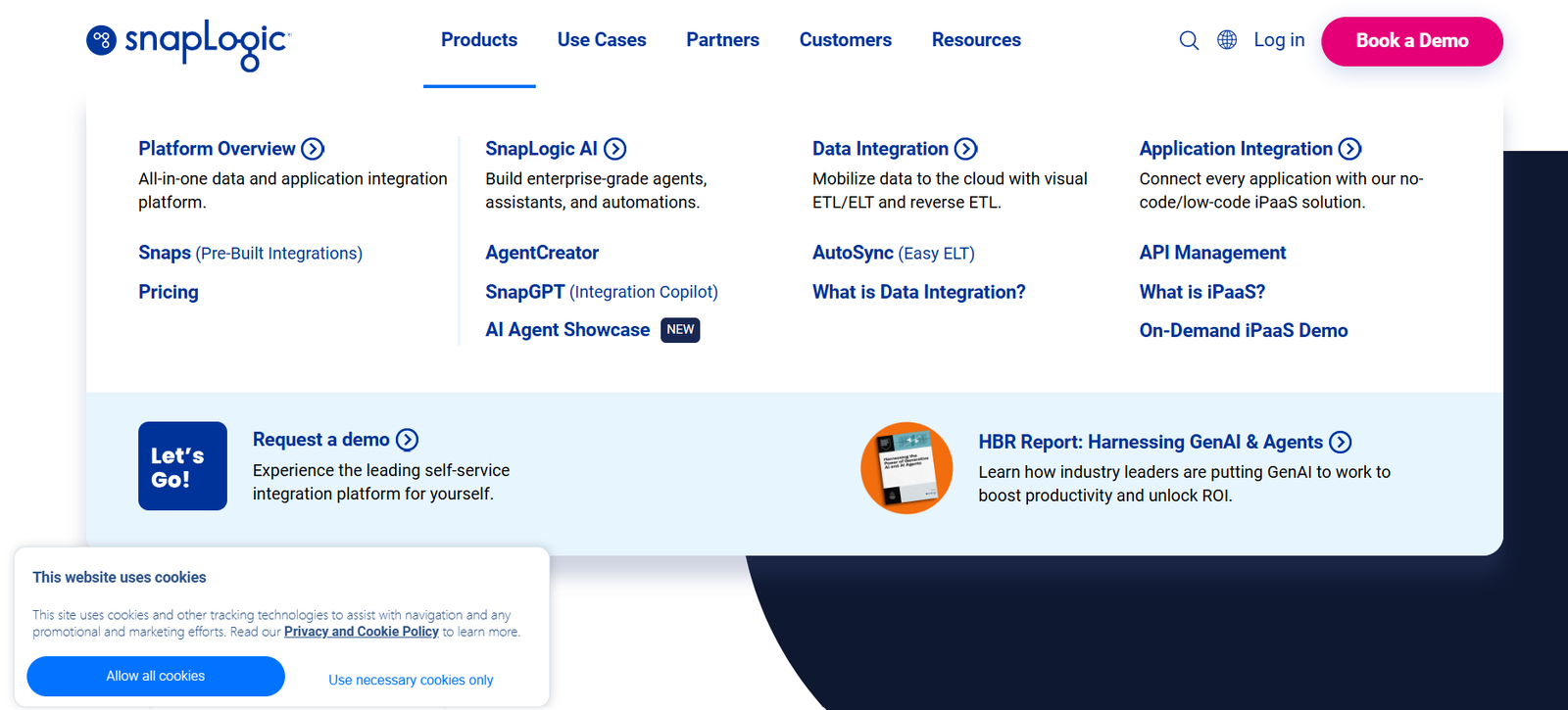
SnapLogic is a leading intelligent integration platform as a service (iPaaS) that enables organizations to connect applications, data sources, APIs, and systems using low-code, AI-assisted tools. Designed for both IT professionals and business users, SnapLogic helps businesses streamline data integration, automate workflows, and accelerate digital transformation.
With its AI-driven assistant (SnapGPT), a rich library of prebuilt connectors (“Snaps”), and support for real-time and batch integration, SnapLogic simplifies complex integrations and makes enterprise automation accessible at scale.
SnapLogic is trusted by organizations across sectors including finance, healthcare, retail, and manufacturing to orchestrate processes and unlock the full potential of their data.
Features of SnapLogic
SnapLogic Snaplex
Snaplex is SnapLogic’s flexible execution architecture that allows integration pipelines to run in the cloud, on-premises, or in hybrid environments. It ensures scalability, reliability, and secure data flow between systems.
SnapGPT (AI-Powered Integration Assistant)
SnapGPT is an embedded generative AI tool that helps users build integrations through natural language prompts. It accelerates pipeline design by suggesting Snaps and mapping data intelligently.
Visual Low-Code Designer
Build workflows and integrations using a drag-and-drop interface. The visual pipeline builder is intuitive and requires little to no coding experience.
Prebuilt Snaps
SnapLogic offers over 700 Snaps—prebuilt connectors for popular applications, databases, and services such as Salesforce, Workday, SAP, Oracle, Snowflake, and Google BigQuery.
Real-Time and Batch Data Integration
Supports both real-time streaming and scheduled batch processes. It handles ETL, ELT, and data replication scenarios with ease.
API Management and Creation
Easily build, publish, and manage APIs using built-in tools. Expose integrations as REST APIs to power microservices and third-party apps.
Data Orchestration
Coordinate data flows between multiple sources and destinations, including data lakes, cloud warehouses, and BI tools.
Security and Compliance
Features include SSO, RBAC, audit logging, encryption in transit and at rest, and compliance with standards like SOC 2, HIPAA, and GDPR.
How SnapLogic Works
Design Pipelines
Users begin by accessing the SnapLogic Designer to create integration pipelines visually, selecting and connecting Snaps for different data sources and tasks.Use SnapGPT for Suggestions
SnapGPT helps generate integration logic, suggests data mappings, and completes pipeline steps using natural language inputs, speeding up development time.Deploy on Snaplex
Pipelines are deployed to the Snaplex engine, which can run in the cloud or within a company’s data center based on architecture needs.Monitor and Manage
The SnapLogic Dashboard provides real-time monitoring, error detection, and performance analytics. Alerts can be configured for failures or SLA violations.Scale and Reuse
Pipelines and Snaps can be versioned, reused, and shared across teams to maintain consistency and efficiency.
Use Cases for SnapLogic
Enterprise Application Integration
Connect systems like Salesforce, SAP, Workday, and Oracle to synchronize data and automate workflows across business units.
Data Lake and Warehouse Pipelines
Move data from sources into cloud data warehouses like Snowflake, BigQuery, or Redshift, enabling real-time analytics and reporting.
HR and Payroll Sync
Integrate HR systems with payroll providers, automate onboarding/offboarding tasks, and sync employee records across platforms.
Marketing Automation
Connect tools like HubSpot, Marketo, and Google Ads with CRMs and analytics tools to unify campaign data and lead scoring.
Finance and ERP Automation
Automate purchase order approvals, invoice processing, and financial reporting by integrating ERP, accounting, and analytics platforms.
API-Based Ecosystem Integration
Publish SnapLogic pipelines as REST APIs to support internal development, mobile apps, or third-party partner integrations.
Pricing of SnapLogic
SnapLogic uses a tiered, usage-based pricing model that scales with the number of pipelines, API calls, Snap executions, and users. While exact pricing is not publicly listed, packages generally include:
Starter Package
Access to core SnapLogic Designer and Manager
Limited Snaps and pipeline volume
Ideal for small teams or pilot projects
Professional Package
Expanded access to Snaps
Support for hybrid deployments
Moderate API traffic and user licenses
SnapGPT access included
Enterprise Package
Unlimited Snaps and pipelines
Dedicated support and onboarding
High throughput and SLA guarantees
SSO, RBAC, and compliance features
Custom pricing based on volume and complexity
Organizations can request custom quotes and a demo at: https://www.snaplogic.com/request-demo
Strengths of SnapLogic
AI assistance (SnapGPT) reduces integration build time and errors
Massive connector library (Snaps) for all major apps and data platforms
Flexible deployment (cloud, on-premises, hybrid)
Support for both application and data integration
Real-time and batch processing for modern data needs
Powerful API creation and management tools
Low-code design interface accessible to non-developers
Enterprise-grade scalability and security
Drawbacks of SnapLogic
Pricing is not publicly transparent, which may hinder early-stage buyers
Learning curve for advanced Snap orchestration and data mapping
Custom Snaps may require developer involvement
High cost at scale for businesses with large data volumes or user bases
Limited offline capabilities—cloud connectivity required for most use cases
Dependency on SnapLogic ecosystem for integrations vs. open frameworks
Comparison with Other Tools
SnapLogic vs. MuleSoft
MuleSoft offers deep API management and is developer-centric. SnapLogic is better suited for faster low-code deployments and citizen integrators.
SnapLogic vs. Boomi
Boomi offers strong community support and lightweight integrations. SnapLogic offers greater scalability, AI assistance (SnapGPT), and better support for complex data engineering needs.
SnapLogic vs. Workato
Workato targets business teams with recipe-style automations. SnapLogic provides more powerful data pipeline features and robust API capabilities for IT and DevOps teams.
SnapLogic vs. Talend
Talend excels in open-source ETL. SnapLogic provides better ease of use, AI-assisted development, and cloud-native scalability for hybrid enterprises.
Customer Reviews and Testimonials
SnapLogic is praised by enterprises for its speed, usability, and AI-driven tools:
“SnapLogic allowed us to integrate Salesforce, NetSuite, and Snowflake in under a week—what used to take months now takes days.”
— Head of IT, Global Retailer
“SnapGPT is a game-changer. It helps my team design pipelines without needing to deep-dive into every field.”
— Integration Lead, Healthcare SaaS Firm
“The Snaps library gave us plug-and-play access to 90% of our tech stack. We went live with zero custom code.”
— VP of Engineering, FinTech Startup
SnapLogic maintains high user ratings on G2, TrustRadius, and Gartner Peer Insights.
Conclusion
SnapLogic is a leading intelligent integration platform that combines low-code tools, an extensive connector ecosystem, and AI-powered assistance to help enterprises connect their data, applications, and APIs with unprecedented speed and ease.
Whether you’re managing complex cloud migrations, launching new digital products, or integrating legacy systems with modern platforms, SnapLogic enables your teams to build scalable, secure, and intelligent integrations—fast.