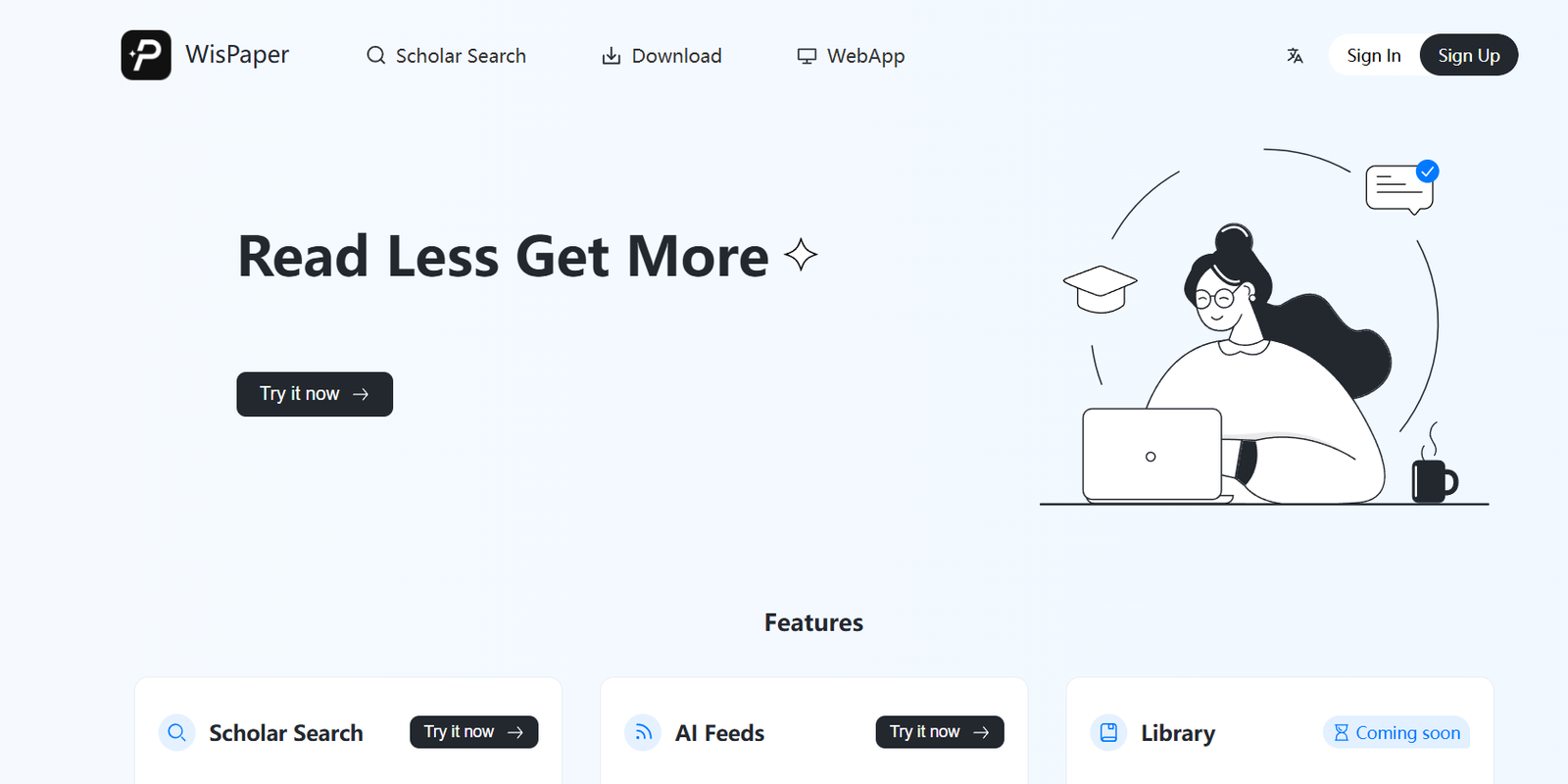
Wispaper AI is an AI-powered summarization tool designed to simplify complex academic content, particularly research papers, into easy-to-understand summaries. It targets students, researchers, educators, and professionals who need to grasp the essence of dense academic texts without reading through entire documents.
By leveraging advanced natural language processing and large language models, Wispaper AI automatically condenses lengthy research papers into well-structured summaries. The goal is to make scientific and technical content more accessible, saving users time and helping them quickly identify whether a paper is relevant to their needs.
Wispaper AI is especially useful for users in academia, where staying updated with new literature is critical but time-consuming. It offers a streamlined way to digest knowledge and supports better decision-making when selecting materials for deeper study or citation.
Features
Automatic Research Paper Summarization: Users can upload a research paper or provide a link, and Wispaper AI will generate a concise summary highlighting the key points, methods, and conclusions.
PDF and URL Support: The platform accepts both PDF uploads and direct links to papers, including preprints, journals, and repositories like arXiv.
Readable Summaries: Wispaper creates clear, digestible summaries written in layman’s terms, helping non-experts understand technical topics.
Highlight Key Sections: The tool extracts important parts such as research questions, methodology, findings, and implications.
Save and Access Summaries: Users can save summaries for later reference and revisit them anytime from their dashboard.
Citation Assistance: The platform often includes citation-ready information, which can be helpful for academic writing and referencing.
AI-Powered Q&A (Coming Soon): A planned feature will allow users to ask questions about a paper and receive AI-generated answers in context.
Multilingual Summarization (Planned): The team is working on supporting other languages to broaden accessibility.
How It Works
Wispaper AI operates through a simple user interface. The process begins when a user uploads a PDF file or pastes a URL to a research paper. The AI engine then analyzes the document’s structure, identifies the most critical parts, and generates a summarized version that includes the paper’s background, research goals, methodology, results, and conclusions.
The summary is presented in an easy-to-read format that distills the complexity of academic language. Users can read the summary directly on the platform and revisit it later through their saved summaries list. The AI also avoids excessive jargon, making it ideal for non-specialist readers trying to understand scientific or technical material.
The backend uses transformer-based models and natural language processing to identify the most informative sections and rewrite them in simpler terms while preserving accuracy.
Use Cases
Students: Learners can use Wispaper AI to better understand difficult readings, prepare for exams, and review literature faster.
Researchers: Academics can preview a large number of papers quickly, helping them identify which studies are most relevant for their work.
Educators: Teachers and professors can use the tool to prepare lesson content or generate summaries to guide classroom discussions.
Journalists: Reporters covering scientific or technical news can rely on Wispaper to break down complex topics into content suitable for general audiences.
Professionals: Business or healthcare professionals who need to stay informed on research trends can use Wispaper to quickly digest new findings.
Content Creators: Writers creating educational or science-based content can generate summaries to use as a starting point for articles or videos.
Pricing
Wispaper AI currently offers a free plan with basic features and access to limited summaries. Based on the information available on the official website, premium features may be introduced in the future as the platform grows.
At this time, users can sign up and use the summarization feature without payment. The free version includes uploading papers and accessing AI-generated summaries.
As of the current release, there are no publicly listed subscription tiers, team plans, or pricing structures. Users interested in expanded capabilities or future updates can sign up for the mailing list or follow product updates via the platform’s roadmap.
More details on premium access or enterprise offerings may be released as the platform matures.
Strengths
Wispaper AI’s key strength lies in its ability to break down complex research papers into summaries that are both accurate and readable. This is highly valuable for time-strapped students and professionals who need quick insights.
The platform’s ease of use is another major advantage. With a clean interface and minimal steps, users can go from file upload to summary in just seconds.
It supports a broad range of academic fields, making it useful across disciplines like medicine, physics, computer science, social sciences, and more. The inclusion of both PDF and link input adds to its flexibility.
Wispaper also promotes better learning by focusing on comprehension. The summaries are structured in a way that explains the research context and outcomes, helping users retain knowledge.
Another major strength is the platform’s accessibility—currently free, web-based, and doesn’t require technical expertise to use.
Drawbacks
While Wispaper AI offers great functionality, it does come with some limitations. At the time of review, citation styles and reference formatting are not automatically generated in full academic formats, which may be a drawback for users writing research papers.
The platform also currently supports only English-language papers, limiting its utility for researchers working in other languages.
In terms of customization, there is limited control over the format or depth of the summary. Users cannot yet choose between brief or detailed summaries or select specific sections to focus on.
As an emerging tool, Wispaper may occasionally misinterpret complex methodologies or nuanced academic language, though its overall accuracy is strong for most papers.
Finally, offline access or integration with other tools like Zotero, Notion, or reference managers is not yet available.
Comparison with Other Tools
Wispaper AI enters a growing space of AI academic tools, but it differentiates itself through its laser focus on summarizing full research papers for understanding, not just discovery.
Compared to tools like Scholarcy, which also summarizes PDFs and research, Wispaper places more emphasis on simplicity and readability for non-specialist users.
Versus Elicit, which supports research discovery and citation-based querying, Wispaper is more narrowly focused on generating readable explanations of existing papers rather than building literature reviews.
Unlike general-purpose summarizers like ChatGPT or Claude, Wispaper is optimized for academic content and provides structure tailored to how scientific papers are written.
Tools like Scite or Connected Papers offer citation network exploration, while Wispaper focuses instead on digesting the paper’s content itself.
Wispaper’s simplicity and specialization make it a unique and valuable tool for those who need clarity over quantity.
Customer Reviews and Testimonials
As of now, Wispaper AI has received positive early feedback from its users, particularly on X (formerly Twitter), Reddit, and educational forums.
Users have praised the tool for saving time, especially when needing to read multiple papers quickly. Students mention it helps them understand difficult topics they would otherwise skip. Researchers have highlighted how it helps them screen papers more effectively during literature reviews.
Educators appreciate how summaries can be used as teaching aides. Some beta users have shared that Wispaper helped them clarify studies outside their core field, like when reading interdisciplinary content.
While the platform is still building its public review base, early testimonials reflect strong appreciation for its accessibility and usefulness in academic settings.
To see more user reactions or join the waitlist for updates, visit https://www.wispaper.ai
Conclusion
Wispaper AI is a powerful and easy-to-use AI tool that solves a critical problem in academia: how to understand complex research quickly. With just a paper link or file, users can generate clear, concise summaries that make dense academic work more accessible.
Its user-friendly design, strong summarization engine, and focus on readable output make it especially helpful for students, educators, and anyone engaging with academic content. While there is room for future enhancements, such as better citation tools and deeper customization, Wispaper is already a valuable tool in the academic AI space.
For those looking to reduce reading time, improve comprehension, and streamline their research workflow, Wispaper AI offers a modern, AI-powered solution that’s free to use and easy to adopt.