
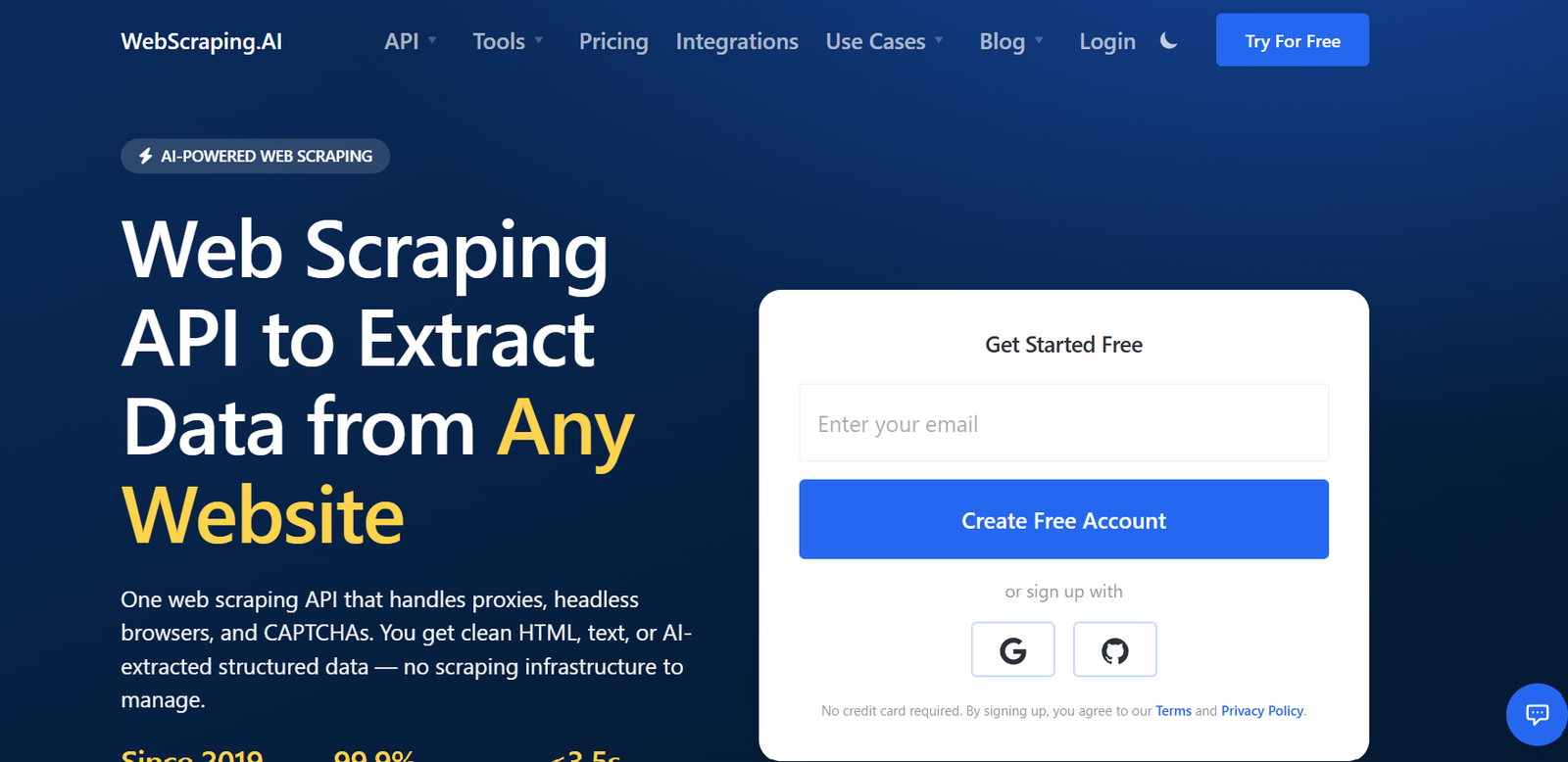
WebScraping.AI is an AI-powered web scraping API designed to help developers and businesses extract information from websites without building and maintaining their own scraping infrastructure.
The platform handles many of the technical challenges involved in web scraping, including proxy rotation, JavaScript rendering, browser automation, CAPTCHAs and request retries. Users provide a webpage URL through the API and can receive rendered HTML, clean text or AI-extracted structured data.
One of its most useful capabilities is AI-powered extraction. Instead of creating CSS selectors or XPath rules for every website, developers can describe the information they need in natural language. WebScraping.AI can then analyze the webpage and return answers or structured JSON containing the requested fields.
The platform is suitable for developers, data teams, AI applications, ecommerce companies, marketers, researchers and businesses that need reliable access to public web information at scale.
Features
AI-Powered Data Extraction
WebScraping.AI allows users to describe the information they want in natural language. Its AI extraction endpoint can return specific fields as structured JSON, reducing the need to manually create extraction rules for every website.
AI Question Answering
Developers can submit a webpage and ask a specific question about its content. The API analyzes the page and returns an AI-generated answer based on the information it finds.
Webpage Summarization
The platform can generate concise summaries of webpage content. This can be useful for research applications, content monitoring and AI workflows that need to process large numbers of pages.
JavaScript Rendering
WebScraping.AI uses browser rendering to process JavaScript-heavy websites, including modern single-page applications built with technologies such as React, Vue and Angular.
Rendered HTML Extraction
Users can retrieve fully rendered HTML after JavaScript has executed. This helps when important webpage information is loaded dynamically rather than appearing in the initial HTML response.
Clean Text Extraction
The API can return clean and formatted webpage text. This output can be particularly useful for AI prompts, retrieval systems, content analysis and RAG applications.
Rotating Proxies
WebScraping.AI manages proxy rotation automatically. Datacenter and residential proxies are available depending on the requirements of the target website.
Stealth Proxy Option
For websites with stronger anti-bot protections, the platform also provides a premium stealth proxy option designed for more difficult scraping situations.
CAPTCHA Handling
The service handles CAPTCHAs as part of its scraping infrastructure, reducing the amount of anti-bot logic developers need to build themselves.
Geotargeting
Users can access location-specific webpage content through geographically targeted proxies. The official website states that geotargeting is available across 195 countries.
Device Emulation
API requests can emulate desktop, mobile or tablet devices. This is useful when websites display different information or layouts depending on the visitor’s device.
Custom Headers and Cookies
Developers can send custom HTTP headers and cookies with scraping requests, providing greater control over how websites are accessed.
Structured JSON Output
The AI field extraction endpoint can convert unstructured webpage information into structured JSON that can be passed directly into databases, applications and AI systems.
MCP Server
WebScraping.AI provides a hosted Model Context Protocol server. This allows compatible AI assistants and coding tools to access its web extraction capabilities.
The company also provides a self-hostable open-source MCP option.
Official SDKs
Official SDKs are available for several programming languages, including Python, JavaScript, PHP, Ruby, Go, Java and C#/.NET.
No-Code Integrations
WebScraping.AI supports automation environments such as n8n, Zapier, Make and Pipedream. These integrations can help users build scraping workflows without creating everything from code.
CLI Tool
A command-line interface is available for developers who want to use the service directly from terminal-based workflows and coding assistants.
API Request Builder
Users can experiment with API requests through an interactive request builder before implementing them inside their own applications.
Google SERP and Amazon Scraping
The platform provides resources and specialized workflows for extracting information from search results, ecommerce websites and other common web data sources.
How It Works
Step 1: Create an Account
Users sign up for WebScraping.AI and receive an API key. A free allowance is available for testing the service.
Step 2: Choose a Webpage
Provide the URL of the webpage from which information needs to be extracted.
Step 3: Select the Required Output
Users can request rendered HTML, clean text or AI-extracted information depending on their application.
Step 4: Configure the Request
Optional settings can be used for JavaScript rendering, proxy type, geographic location, device type, custom headers and other requirements.
Step 5: Send the API Request
The application sends the URL and relevant parameters to WebScraping.AI.
Step 6: WebScraping.AI Processes the Website
The infrastructure handles browser rendering, proxies, retries and anti-bot challenges according to the selected configuration.
Step 7: Extract Information with AI
For AI extraction, users can ask a natural-language question or specify the fields they want returned.
Step 8: Receive the Data
Results are returned as HTML, text, an AI-generated answer or structured JSON.
Step 9: Integrate the Results
Developers can send the extracted information into databases, analytics systems, AI agents, RAG pipelines, monitoring tools or other business applications.
Use Cases
Ecommerce Price Monitoring
Retailers can collect product and pricing information from ecommerce websites to monitor competitors and understand market changes.
Lead Generation
Businesses can extract publicly available company and business information for research and lead-generation workflows.
SEO Monitoring
Marketing and SEO teams can collect search-related information and monitor rankings or other public website data.
Real Estate Data
Property businesses can aggregate publicly available property listings, pricing information and other real estate data.
AI Applications
Developers can supply fresh web information to AI agents, assistants and other AI-powered applications.
RAG Systems
Clean webpage text can be collected and prepared for retrieval-augmented generation pipelines.
AI Training Data
Data teams can use the API to collect publicly accessible web information for datasets used in machine learning and AI development, subject to applicable legal and website requirements.
Market Research
Businesses can collect public information from multiple websites for competitive research, market analysis and trend monitoring.
Job Market Analysis
Recruitment and HR technology companies can collect publicly available job listings and related information for analysis.
Travel Data
Travel applications can gather public information about destinations, accommodations and other travel-related services.
Financial Research
Organizations can extract public financial, market and news information for research and analytical applications.
Developers
Developers can use the API to avoid managing browsers, proxy networks and scraping infrastructure internally.
Pricing
WebScraping.AI provides a free starting allowance of 2,000 API credits, with no credit card required.
Personal
The Personal plan costs $29 per month and includes 250,000 API credits, up to 10 concurrent requests and geotargeting.
Plus
The Plus plan costs $99 per month and includes 1,000,000 API credits, up to 25 concurrent requests and geotargeting.
Startup
The Startup plan costs $249 per month and includes 3,000,000 API credits, up to 50 concurrent requests and geotargeting.
Pay As You Go
Users can also purchase credits without a monthly subscription. The listed rate is $0.0002 per credit, with a $20 minimum purchase providing 100,000 credits. Purchased credits remain valid for 12 months, and topping up extends the validity of the balance.
Request Credit Usage
Credit consumption depends on the type of scraping request. Basic requests using datacenter proxies consume fewer credits, while JavaScript rendering, residential proxies and stealth proxies require more.
AI extraction adds additional credits to the underlying scraping request.
Custom enterprise arrangements are also available for organizations with larger usage requirements.
Pricing and credit consumption can change, so users should verify current rates before purchasing.
Strengths
WebScraping.AI combines web scraping infrastructure and AI extraction within a single API.
Its AI endpoints reduce dependence on CSS selectors and XPath rules, which can be useful when websites change their layouts.
The platform handles JavaScript rendering, proxies, CAPTCHAs and retries, reducing the infrastructure developers need to operate themselves.
Structured JSON extraction is particularly useful for applications that need web information in a predictable machine-readable format.
The availability of clean text extraction makes the platform suitable for LLM and RAG workflows.
Its official SDKs support several popular programming languages, while integrations with automation platforms make it accessible beyond traditional software development.
The free credits provide developers with a way to test the API before subscribing.
Drawbacks
WebScraping.AI is primarily an API-based service, so users without technical knowledge may find it less straightforward than visual point-and-click scraping platforms.
Credit usage increases when JavaScript rendering, residential proxies, stealth proxies or AI extraction are required.
AI extraction can simplify data collection, but conventional selectors may still be more cost-effective for very large scraping projects involving stable website structures.
Scraping success can vary depending on the target website and its anti-bot protections.
Users are also responsible for ensuring that their web scraping activities comply with applicable laws, website terms, privacy requirements and data-use restrictions.
Comparison with Other Platforms
WebScraping.AI operates in the same general market as web scraping APIs, browser automation services, proxy-based extraction platforms and AI web data tools.
Traditional scraping platforms often require developers to identify elements using CSS selectors or XPath. WebScraping.AI supports these conventional approaches while also offering AI extraction based on natural-language instructions.
Compared with visual no-code scrapers, WebScraping.AI is more developer-oriented and designed to become part of applications and automated data pipelines.
Its combination of scraping infrastructure, AI extraction, official SDKs, MCP access and automation integrations makes it particularly relevant for developers building AI agents and applications that require live web information.
Organizations should compare competing services based on target websites, request volumes, proxy requirements, AI extraction needs, concurrency, reliability and total credit costs.
Customer Reviews and Testimonials
Customer reviews and testimonials are not clearly available on the official website.
Conclusion
WebScraping.AI is a useful web data extraction platform for developers and businesses that want to collect information from websites without building their own proxy, browser and anti-bot infrastructure.
Its strongest advantage is the combination of conventional web scraping with AI-powered extraction. Developers can retrieve HTML and clean text or simply describe the information they need and receive structured results.
The platform is particularly suitable for ecommerce monitoring, market research, lead generation, SEO applications, AI agents, RAG systems and other applications that depend on fresh web information.
For developers who want an API-first approach with JavaScript rendering, proxy management, AI extraction, SDKs and MCP support in one service, WebScraping.AI provides a practical option worth evaluating.


