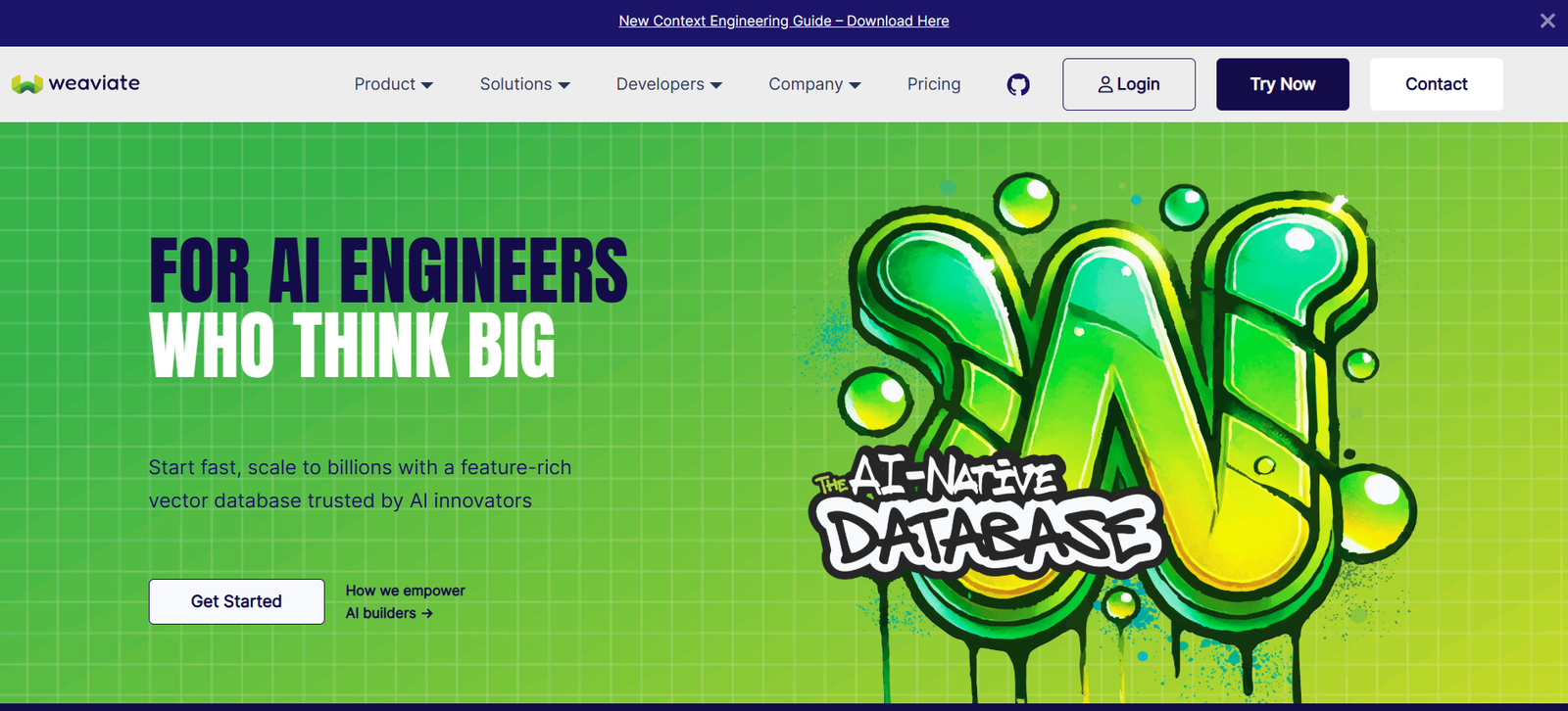
Weaviate is an open-source vector database designed to help developers build AI-powered applications with semantic search, retrieval-augmented generation, recommendation systems, and large-scale machine learning pipelines. It allows you to store and query both structured and unstructured data using high-dimensional vectors generated from AI models.
Weaviate stands out by combining a powerful vector search engine with built-in support for hybrid search, GraphQL, filtering, and modular integrations with leading machine learning frameworks and models. Developers can bring their own vectors or use Weaviate’s built-in vectorizers, including integrations with OpenAI, Cohere, Hugging Face, and more.
It is designed to support applications like AI chatbots, recommendation engines, semantic search systems, and real-time RAG pipelines. Weaviate scales from small local deployments to large, distributed production environments and is available both as an open-source package and as a fully managed cloud service.
Weaviate: Features
Weaviate delivers a comprehensive set of features for developers and teams building vector-based AI applications.
Vector Search Engine – Enables fast approximate nearest neighbor search across high-dimensional vectors.
Hybrid Search – Combines keyword-based and vector-based search for improved accuracy and relevance.
Modular Architecture – Supports modular plug-ins for vectorization, authentication, replication, and monitoring.
Built-in Vectorization – Integrates with external models and APIs such as OpenAI, Cohere, Hugging Face, and Google PaLM to automatically vectorize text, images, and more.
GraphQL and RESTful API – Offers GraphQL and REST APIs for data insertion, querying, filtering, and managing schema.
Filters and Metadata – Supports structured filtering on metadata and properties alongside vector similarity search.
Scalability – Scales horizontally to support large datasets, real-time queries, and production-grade workloads.
Replication and Sharding – Distributes data across multiple nodes for high availability and performance.
Multitenancy – Supports multitenant data separation and access control for enterprise-grade applications.
Vector Index Types – Offers several ANN index types including HNSW for high-performance similarity search.
Persistent Storage – Built-in persistence using local or remote storage for durability and recovery.
Security and Authentication – Provides support for OAuth, API keys, and TLS for secure deployments.
Weaviate: How It Works
Weaviate works by storing and indexing objects as high-dimensional vectors, which represent the semantic meaning of text, images, or other data types. When a user submits a query, Weaviate performs a similarity search to retrieve the most relevant results based on vector proximity.
To get started, developers define a schema for the objects they want to store. Each object can include both structured attributes (such as titles or tags) and unstructured data (such as text descriptions or images). This unstructured data is vectorized using a built-in or external machine learning model.
Weaviate then stores the resulting vectors in a vector index such as HNSW, allowing for efficient nearest-neighbor retrieval. Users can perform semantic queries, keyword searches, or hybrid queries using REST or GraphQL endpoints. Filtering by metadata and custom attributes is also supported.
This makes Weaviate ideal for use cases where understanding meaning, not just keywords, is essential—such as document retrieval, personalized recommendations, and RAG pipelines for LLMs.
Weaviate: Use Cases
Weaviate supports a wide range of use cases where vector similarity and semantic understanding are required.
Semantic Search – Build search systems that return results based on meaning rather than exact keyword matches, ideal for content platforms, academic research, and document management.
Retrieval-Augmented Generation (RAG) – Enhance large language models with grounded, real-time information by retrieving contextually relevant data from Weaviate.
Chatbots and AI Assistants – Improve chatbot responses with vector-based retrieval from FAQs, product catalogs, and knowledge bases.
Recommendation Systems – Suggest similar products, articles, or users based on vector embeddings that represent preferences and behaviors.
Enterprise Knowledge Management – Organize internal documents, policies, and communications into a semantically searchable knowledge base.
Image and Multimedia Search – Index image embeddings and enable similarity search for use cases in media, fashion, or e-commerce.
Healthcare and Life Sciences – Power semantic search over clinical records, research papers, and diagnostic information.
Fraud Detection – Detect anomalies and similarities in high-dimensional data such as transaction patterns and behavior logs.
Legal and Compliance – Search across legal documents, case law, and regulatory content using natural language queries.
Weaviate: Pricing
Weaviate offers both an open-source version and a fully managed cloud offering with usage-based pricing. Pricing details for the cloud version are available on the official Weaviate Cloud Services page.
Open Source – Free to use and self-host under the permissive business source license (BSL). Suitable for developers and teams who want to deploy and manage Weaviate themselves.
Weaviate Cloud Services (WCS) – Fully managed vector database in the cloud with pricing based on compute usage, storage, and API volume. Features include autoscaling, backups, security, and monitoring.
The WCS pricing model includes:
Starter Tier – Ideal for prototyping and small workloads. Offers basic storage and query limits at a lower monthly cost.
Pro and Enterprise Tiers – Custom plans for production deployments, offering higher limits, SLAs, dedicated infrastructure, and compliance features.
Exact pricing for managed services is usage-dependent and requires selecting a plan based on resource needs and query volume. Teams can request a demo or free trial for evaluation.
Weaviate: Strengths
Weaviate stands out as a leading vector database for AI applications due to its rich features and developer-friendly design.
Open Source Core – Allows full customization and control with community-supported and enterprise-ready capabilities.
Hybrid Search – Supports both keyword and vector-based search in a single query, enhancing accuracy and versatility.
Multiple Integrations – Built-in support for top ML models from OpenAI, Hugging Face, and Cohere eliminates the need for separate vectorization pipelines.
Scalable and Distributed – Designed for large-scale workloads with sharding, replication, and fault tolerance.
GraphQL Support – Enables powerful and flexible querying with a modern API standard preferred by many frontend teams.
Extensible and Modular – Plug-in architecture allows adding custom components for authentication, vectorization, and monitoring.
Fast Performance – Uses high-performance ANN algorithms like HNSW for fast, approximate nearest-neighbor search.
Developer Ecosystem – Strong documentation, SDKs, and an active open-source community contribute to rapid development and innovation.
Enterprise Features – Includes access control, multitenancy, and cloud deployment options for mission-critical use cases.
Weaviate: Drawbacks
While Weaviate is a powerful solution, there are a few limitations and considerations depending on your use case.
Learning Curve – May require time to understand the schema, indexing, and vectorization setup for new users unfamiliar with vector databases.
Infrastructure Requirements – Self-hosted deployments need appropriate infrastructure for optimal performance and scalability.
Cloud Pricing Complexity – Usage-based cloud pricing can become expensive at high query or storage volumes without optimization.
Vector Size Limits – Performance may degrade with extremely large vector dimensions unless indexes and configurations are carefully tuned.
No Native UI – Currently lacks a full-featured graphical user interface for data management, though third-party dashboards and community tools are available.
Dependence on External Models – Built-in vectorizers rely on third-party APIs like OpenAI, which may introduce latency or usage costs.
Weaviate: Comparison with Other Tools
Weaviate competes with other vector databases and search platforms such as Pinecone, FAISS, Milvus, and Elasticsearch with vector support.
Compared to Pinecone, Weaviate is open-source and offers more flexibility in deployment and customization. Pinecone is fully managed and optimized for ease of use but does not offer an open-source option.
Compared to FAISS, which is a vector search library developed by Facebook, Weaviate provides a complete database solution with APIs, persistence, and integrations, while FAISS requires custom implementation for full database functionality.
Milvus is another open-source vector database focused on high-speed ANN search. While both are powerful, Weaviate offers richer hybrid search, GraphQL support, and easier model integration via plug-ins.
Elasticsearch with vector search extensions supports similarity search, but Weaviate is purpose-built for vector use cases and offers better performance and scalability in that area.
Overall, Weaviate is ideal for teams that want an open-source, scalable, and AI-native database with built-in vectorization, flexible APIs, and a strong open-source foundation.
Weaviate: Customer Reviews and Testimonials
Weaviate has been well-received by AI developers, startups, and enterprises building modern search and recommendation engines.
Developers appreciate its simplicity in setting up a vector-based search engine without needing to manage complex infrastructure. One user noted, “Weaviate made it incredibly easy to get semantic search up and running in just a day.”
Early adopters in the LLM and RAG space highlight its ability to seamlessly integrate with OpenAI and Hugging Face models to build chatbots and AI assistants that reference private knowledge.
On GitHub and in the open-source community, Weaviate receives positive feedback for its clear documentation, active support, and rapid release cycle.
Customers using the managed Weaviate Cloud Services report reduced maintenance overhead and faster deployment times for production-grade systems.
Conclusion
Weaviate is a modern, open-source vector database built for the age of artificial intelligence. Its ability to store, index, and search vector representations of unstructured data makes it a powerful foundation for building semantic search engines, AI assistants, recommendation systems, and retrieval-augmented generation applications.
With its hybrid search, rich API support, integrations with popular ML models, and scalability from local development to cloud production, Weaviate is a compelling choice for developers and enterprises alike. Whether you’re building your first semantic search app or scaling an LLM-powered assistant, Weaviate offers the performance, flexibility, and community support to power your AI stack.