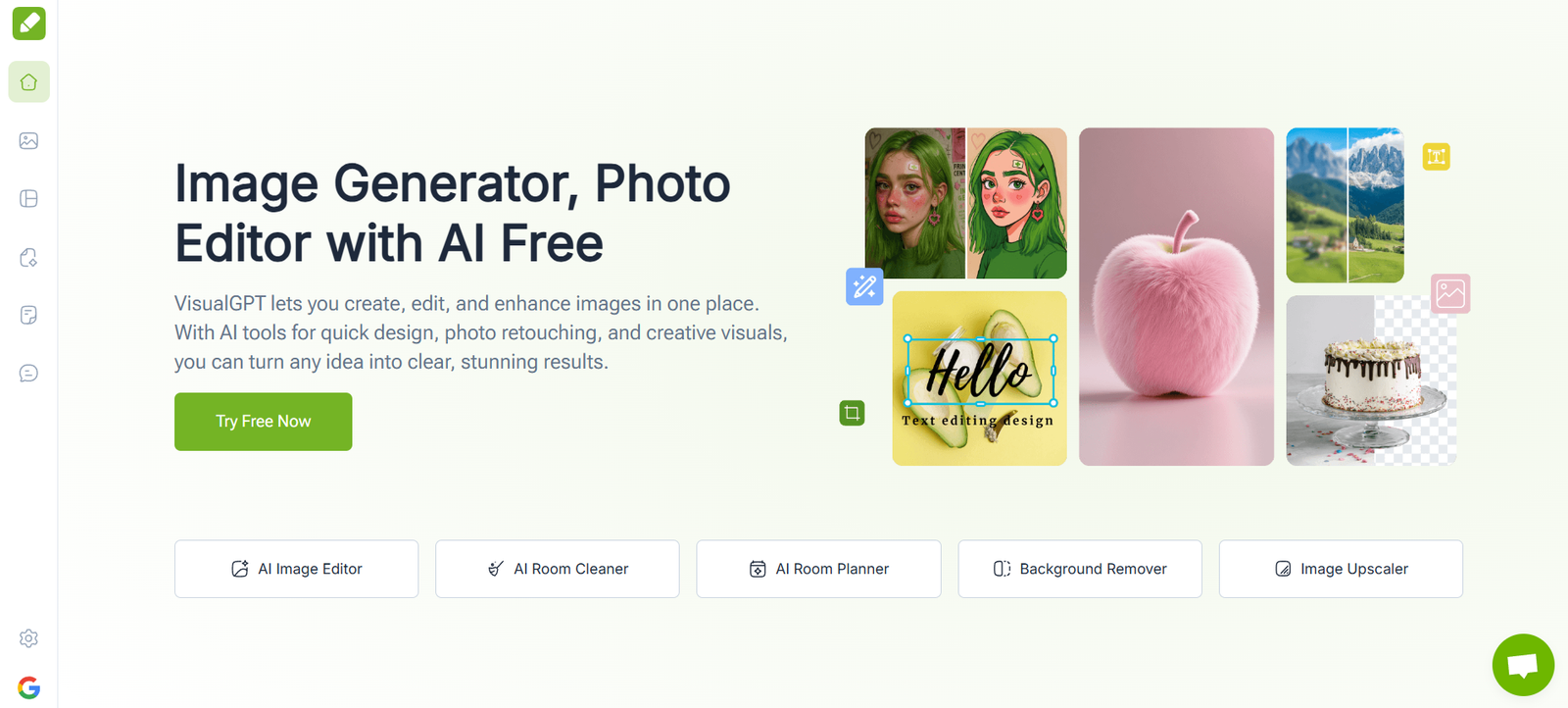
VisualGPT is a no-code platform that allows users to create AI-powered applications by connecting ChatGPT with their own data. Designed for creators, developers, and businesses, VisualGPT helps users build intelligent workflows, tools, and chat interfaces that use OpenAI models to deliver personalized, task-specific functionality.
The platform enables users to combine different types of inputs—text, files, APIs, and logic—to build custom AI apps without writing code. Whether you’re building a customer support assistant, a document search tool, or a personalized content generator, VisualGPT simplifies the process of turning GPT into a practical business solution.
Features
VisualGPT offers a wide range of features designed to help users build, deploy, and manage AI applications efficiently and without coding.
Visual App Builder: Drag-and-drop interface for building AI apps using blocks like prompts, inputs, outputs, and API calls.
GPT Integration: Directly integrates with OpenAI’s GPT models including GPT-4, allowing users to design workflows that use natural language processing.
Custom Data Upload: Users can upload files (PDFs, CSVs, DOCs, etc.) to train their apps to respond to specific company knowledge or proprietary data.
Chat Interface Generator: Automatically creates a user-facing chat interface for any app, making it easy to interact with the logic built using the visual editor.
API Support: Users can include external API calls in their workflows, allowing AI apps to fetch or send data during interactions.
Logic Flows: Add conditional logic, variables, and input validation to control how your app behaves based on user actions or content.
Embeddable Apps: Every app built on VisualGPT can be embedded on websites or shared through custom links.
Real-Time Previews: Users can test apps in real-time during the building process to fine-tune logic and content.
Templates: Prebuilt templates for common use cases like FAQ bots, file search assistants, and lead qualification apps.
Multi-Modal Input: Support for both text and file inputs in user interactions, expanding the scope of app functionality.
How It Works
VisualGPT works by enabling users to build apps visually, using modular blocks that represent various components of an AI workflow. Users begin by selecting a template or starting from scratch. In the visual builder, they can drag and connect different blocks such as user inputs, GPT prompts, decision branches, and API calls.
To personalize the app, users can upload files or documents that will serve as the data source for the AI responses. The system processes this content and integrates it into the GPT-powered interaction.
Each app can be previewed in real time. Once complete, the app is hosted automatically by VisualGPT and can be embedded or shared as needed. The platform handles backend processing, model communication, and hosting, allowing users to focus entirely on logic and content.
Use Cases
VisualGPT is built to support a wide variety of business and individual use cases.
Customer Support Automation: Build AI apps that can answer customer questions using uploaded manuals, FAQs, or internal knowledge.
Document Search Bots: Create applications that search and summarize content from files, PDFs, and training documents.
Lead Generation: Develop interactive GPT-powered apps that qualify leads based on inputs and pass data to sales teams.
Internal Tools: Create AI-powered tools that help employees access internal knowledge, procedures, or data instantly.
Coaching and Consulting: Offer clients personalized AI agents trained on your frameworks, worksheets, or service models.
Education: Build study assistants or tutoring apps that deliver contextual help based on course materials or reading assignments.
Marketing: Generate custom content, headlines, or copy with workflows that mix prompts, logic, and external data sources.
Data Extraction: Build bots that extract structured data from files and format them for downstream workflows.
Pricing
VisualGPT offers transparent pricing designed to scale with user needs. The platform currently provides the following plans:
Free Plan
Access to 1 AI app
Limited prompts per month
Community support
Basic features and templates
Ideal for exploration or personal use
Pro Plan – $29/month
Up to 10 AI apps
Increased prompt and message usage
File upload and knowledge base features
Private sharing and advanced logic flows
Priority support
Ideal for freelancers, educators, and startups
Business Plan – $99/month
Up to 50 AI apps
Higher usage limits and storage
Full API access and embeddable app options
Custom domains and branding
Team collaboration features
Advanced support and analytics
Best for growing businesses and agencies
Enterprise Plan – Custom Pricing
Unlimited apps and usage
Advanced security and compliance
Dedicated support and onboarding
Service-level agreement
Ideal for enterprises with custom integration needs
All plans come with access to the visual builder and GPT integrations. Full plan comparisons and feature lists are available at https://visualgpt.io
Strengths
VisualGPT stands out for making GPT-powered app development accessible to non-developers. The visual interface eliminates the need for backend coding while still offering powerful functionality like API calls and logic branching.
Its seamless integration with OpenAI’s GPT models ensures that the output quality is high and conversational. The ability to upload files and use them as data sources makes it practical for real-world knowledge-based applications.
Users also benefit from the platform’s embeddable apps and chat interfaces, making deployment and sharing simple. The range of templates and customizable workflows enables rapid development across industries.
Drawbacks
VisualGPT may not be ideal for highly technical users who prefer full control over AI model tuning or advanced data processing. While powerful for no-code use cases, it may lack the flexibility or depth of developer-first platforms.
Usage limits on lower-tier plans could be restrictive for high-volume needs. Users building complex workflows may also find some limitations in multi-step logic or data handling, especially compared to platforms with scripting support.
Current integrations with third-party tools and CRMs are limited and may require external API configuration. Some users may also expect more analytics and usage tracking than currently available.
Comparison with Other Tools
VisualGPT competes with other no-code AI builders like Bubble with GPT plugins, Peltarion, and Landbot. Compared to Bubble, which requires more technical setup, VisualGPT is purpose-built for GPT and focused on conversational workflows, making it easier for non-technical users.
Unlike Landbot, which is more focused on linear chat flows, VisualGPT offers better support for GPT-based content generation and custom file uploads.
Compared to Zapier-based automation or tools like Chatbase, VisualGPT provides more flexibility in designing complete, embeddable applications rather than just chat widgets or isolated bots.
While platforms like Botpress and Flowise offer more technical flexibility, VisualGPT excels in simplicity, speed, and accessibility for creators and small businesses.
Customer Reviews and Testimonials
VisualGPT has received positive feedback from early users for its intuitive design and fast deployment. Users have highlighted how easy it is to build functional GPT-powered apps without needing a developer.
Educators, consultants, and solopreneurs particularly appreciate the ability to upload files and convert them into searchable, interactive AI tools. Several users mentioned that they could create apps for clients in less than an hour using templates and the visual editor.
Some testimonials request deeper integrations and more analytics, but overall the sentiment is highly favorable for the tool’s usability and output quality.
Conclusion
VisualGPT is a powerful and accessible platform for building AI applications using GPT and your own data. With its drag-and-drop builder, file upload support, and instant deployment options, it allows creators and businesses to turn ideas into working AI tools quickly and effectively.
Whether you’re automating support, enhancing user experiences, or building internal productivity tools, VisualGPT lowers the barrier to entry and offers a practical, no-code solution. While advanced users may find some limitations, its simplicity and flexibility make it a strong choice for small teams, educators, freelancers, and entrepreneurs.