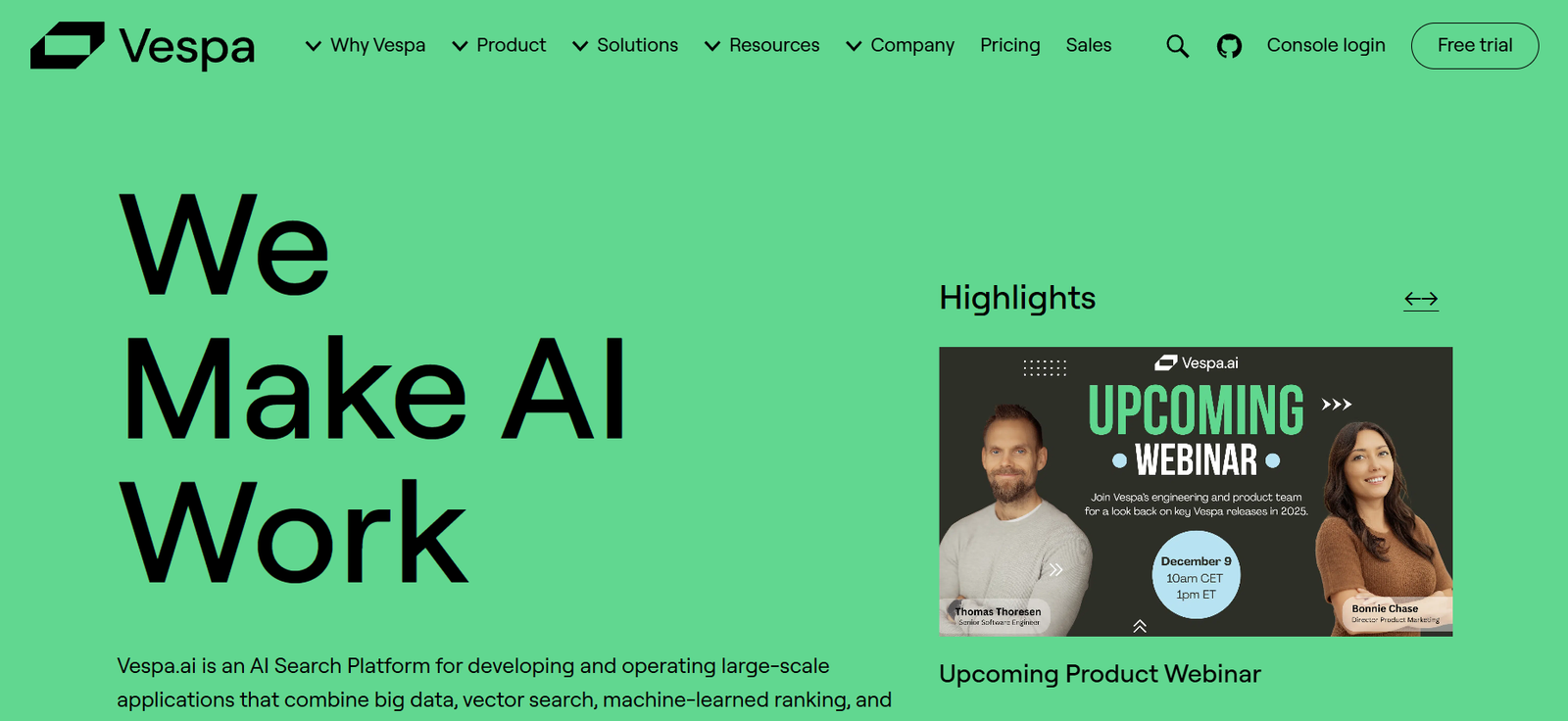
Vespa is an open-source engine for real-time search, recommendation, and personalization at scale. Developed by Yahoo (now Verizon Media) and released as open-source software, Vespa enables developers to serve and rank data using machine-learned models, natural language processing, and vector similarity search in real time.
Unlike traditional search engines that simply retrieve and display matching documents, Vespa can apply AI models and complex ranking functions at query time, enabling intelligent search, content recommendation, and personalization on massive datasets. It can handle structured and unstructured data and perform inference directly on the data during retrieval.
Vespa is used in production by companies operating at internet scale, including Yahoo’s own services. It is ideal for applications where relevance, latency, and scalability are critical, such as search engines, e-commerce platforms, ad targeting, and AI-driven personalization systems.
Vespa: Features
Vespa offers a rich set of features designed for developers building real-time, intelligent data-serving applications.
Real-Time Inference – Apply machine learning models at query time, including ONNX models for deep learning inference on documents and queries.
Hybrid Search – Combine full-text search, structured filtering, vector similarity, and machine-learned ranking in a single query.
Approximate Nearest Neighbor (ANN) – Built-in support for fast and scalable vector search across high-dimensional embeddings.
Scalable and Distributed – Designed to handle petabyte-scale datasets and low-latency requirements across multiple nodes.
Structured and Unstructured Data – Supports flexible document schemas with fields for text, numbers, tensors, arrays, and more.
Advanced Ranking – Create complex ranking expressions combining metadata, text relevance, and ML scores.
Streaming and Batch Updates – Support for both low-latency updates and batch ingestion for high-throughput systems.
Containerized Architecture – Easily deployable with Docker and Kubernetes for flexible cloud-native infrastructure.
Fault Tolerance and Replication – Ensures high availability through distributed replication and automatic failover.
RESTful and gRPC APIs – Provides APIs for querying, feeding, and managing content in modern application stacks.
Multilingual Support – Supports search and ranking in multiple languages with stemming, tokenization, and language detection.
Open Source – Licensed under Apache 2.0 with active community contributions and maintained by Vespa Engineering at Yahoo.
Vespa: How It Works
Vespa works by storing data in a distributed system where each document is indexed and prepared for advanced retrieval operations. When a query is submitted, Vespa executes the query across multiple nodes, retrieving documents, evaluating ranking functions, and applying AI models—all in real time.
The process begins with data ingestion. Documents are fed into Vespa using its feed API. Each document is parsed and indexed based on the schema, which includes field types, searchable properties, and ranking settings.
At query time, Vespa matches the query terms to relevant documents using a combination of traditional search (like BM25), structured filtering (e.g., numeric range filters), and vector similarity (e.g., cosine or dot-product similarity). It then applies a ranking expression that can include static weights or learned ML models for dynamic scoring.
Developers can deploy models trained in external frameworks like TensorFlow, PyTorch, or XGBoost and convert them to ONNX format for use in Vespa. These models are then used to compute relevance scores per document as part of the search pipeline.
Vespa’s architecture includes content nodes (for storing and retrieving data) and container nodes (for query processing and serving). These components can be horizontally scaled to match the system’s performance and availability requirements.
Vespa: Use Cases
Vespa supports a wide range of use cases that require high-performance, intelligent serving of large-scale data.
Search Engines – Build search platforms that deliver relevant results with advanced ranking and real-time updates.
E-commerce Search – Provide personalized product search, ranking by popularity or relevance, and filtering by product attributes.
Content Recommendation – Serve personalized article, video, or product recommendations using collaborative filtering or content-based models.
Ad Targeting – Match ads to users or page content using real-time AI-driven ranking and filtering of ad inventory.
News and Media – Enable semantic search and real-time personalization for large-scale digital media content libraries.
Customer Support Search – Power intelligent FAQ systems, help desks, and internal knowledge search using hybrid and semantic search.
Personalized Portals – Deliver customized user experiences by scoring content for each user using behavior, preferences, and ML models.
Conversational AI – Enable retrieval-augmented generation systems with real-time document serving and ranking for chatbot backends.
Enterprise Knowledge Management – Organize and retrieve documents, reports, and insights from across the organization in a smart and scalable way.
Vespa: Pricing
Vespa is completely open source and free to use under the Apache 2.0 license. It can be self-hosted on your own infrastructure or deployed on any cloud platform using Docker, Kubernetes, or other container orchestration tools.
There is no official paid version or managed cloud service directly offered by Vespa at the time of this writing. However, commercial support, consulting, and services may be available through third-party vendors or via enterprise agreements with Vespa’s maintainers.
Organizations interested in enterprise deployment or consulting are encouraged to contact Vespa’s core team through their website or GitHub repository.
Because of its open-source model, Vespa is particularly attractive to developers and companies seeking performance and flexibility without vendor lock-in or per-query costs.
Vespa: Strengths
Vespa offers several advantages that make it one of the most capable engines for real-time AI-powered data serving.
Real-Time ML Inference – Supports deep learning inference directly within search queries using ONNX models.
Full Flexibility – Combines full-text search, structured filters, vector search, and ML-based ranking in a single platform.
Open Source – Freely available and backed by a well-documented, active community under a permissive Apache license.
Enterprise-Grade Scalability – Built for large-scale workloads with horizontal scalability and fault-tolerant design.
No Vendor Lock-In – Self-hosted deployment allows full control over infrastructure and data without external dependencies.
Rich API Support – Includes REST, gRPC, and SDK integrations for modern application development.
Optimized Performance – Designed for low-latency response times, high throughput, and efficient memory usage.
Modular Architecture – Allows for flexible deployments using content and container nodes as needed.
Backed by Experience – Used in production by Yahoo and other global platforms to serve billions of queries per day.
Vespa: Drawbacks
Despite its powerful features, Vespa has a few limitations that may impact certain users.
Complex Setup – Initial configuration and deployment may be challenging for users unfamiliar with distributed systems and search engines.
No Managed Service – Lack of an official managed cloud offering may require additional DevOps overhead for smaller teams.
Resource Intensive – Full functionality may demand significant system resources, especially for high availability and scaling.
Learning Curve – Mastering Vespa’s schema, ranking expressions, and ML model integration can take time for new users.
Limited Ecosystem – Compared to more mainstream tools like Elasticsearch, Vespa has a smaller set of third-party integrations and plugins.
Documentation Depth – While improving, documentation for certain advanced features may require deeper technical experience to fully utilize.
Vespa: Comparison with Other Tools
Vespa is often compared to tools like Elasticsearch, OpenSearch, Weaviate, and Pinecone for search and vector database functionality.
Compared to Elasticsearch and OpenSearch, Vespa offers more advanced ranking capabilities and native support for ML inference at query time. While Elasticsearch has broad adoption and excellent full-text search capabilities, Vespa shines in use cases where ML models need to be integrated into the ranking pipeline.
Compared to vector databases like Weaviate or Pinecone, Vespa offers a more comprehensive platform that blends vector search, keyword search, and structured data filtering. Pinecone and Weaviate are easier to get started with but lack the full ranking flexibility and query-time model inference Vespa offers.
In essence, Vespa is better suited for complex, performance-critical systems that require full control over search, recommendation, and personalization logic.
Vespa: Customer Reviews and Testimonials
Vespa is widely respected in the developer and AI infrastructure community for its scalability, performance, and flexibility.
Enterprises that have adopted Vespa in production highlight its ability to run ML models at query time and scale seamlessly to serve billions of documents. Yahoo has published use cases showing Vespa’s role in delivering search, news, and ad content to millions of users daily.
Users on GitHub and open-source forums often commend Vespa’s innovative architecture and the ability to combine different types of search logic. One user noted, “Vespa lets us deploy our ranking models directly in the query pipeline, giving us control and performance we couldn’t get elsewhere.”
While not as broadly reviewed on traditional SaaS review platforms, Vespa continues to grow its open-source community and maintain active releases, tutorials, and documentation.
Conclusion
Vespa is a powerful, open-source engine for real-time AI-powered search, recommendation, and personalization. With built-in support for large-scale data serving, vector search, and ML model inference at query time, Vespa delivers unique capabilities that go far beyond traditional search platforms.
Whether you are building an e-commerce recommendation system, a media search engine, or a semantic knowledge base, Vespa gives you full control over data retrieval, ranking, and personalization—all with low latency and high scalability.
While setup and operation may require a learning curve, the platform’s flexibility, performance, and open-source licensing make it an outstanding choice for organizations looking to build cutting-edge AI applications without vendor lock-in.
For companies ready to embrace search and recommendation as core infrastructure, Vespa offers the depth, reliability, and innovation needed to operate at scale.