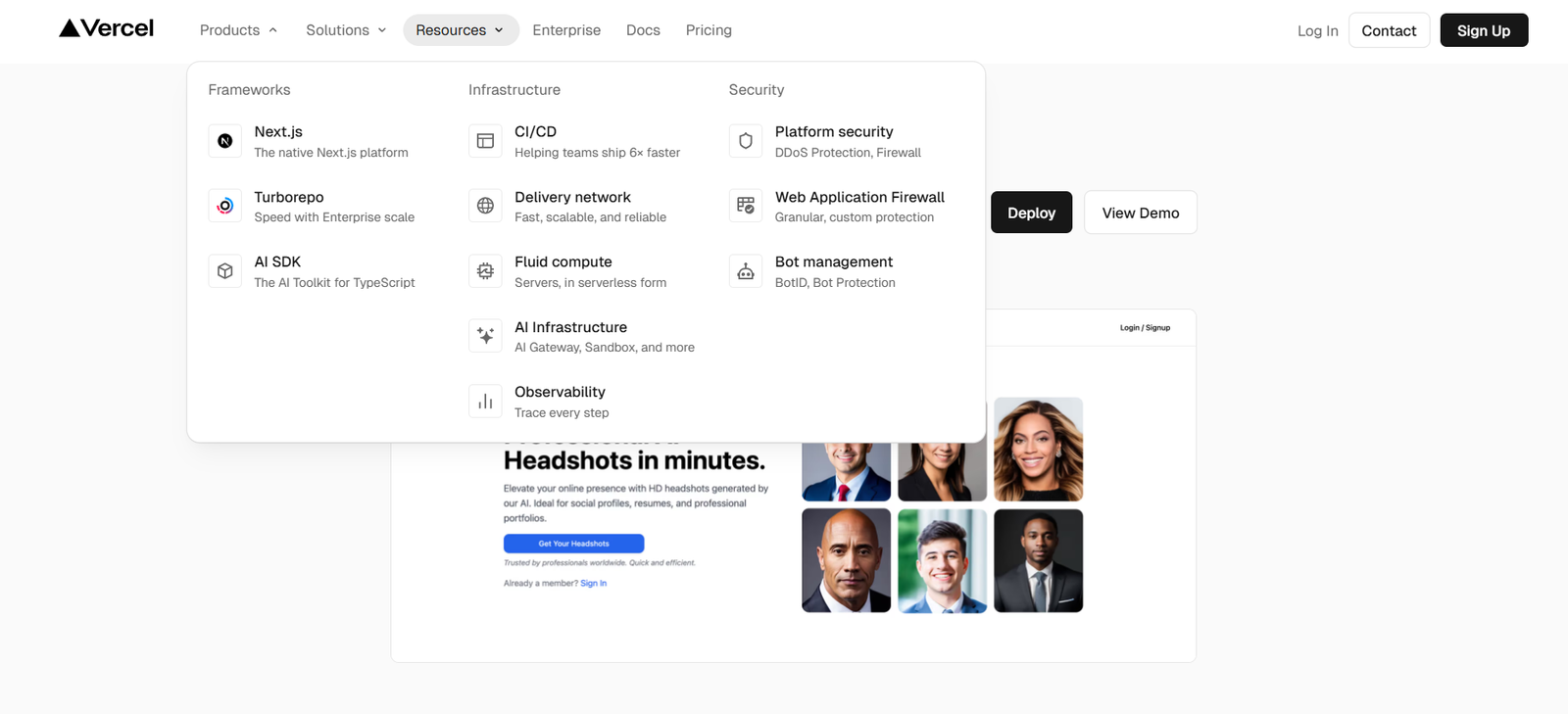
Vercel is a frontend cloud platform designed to help developers and teams build, preview, and ship websites and web applications quickly and efficiently. It provides a seamless experience from code to production, optimized for frontend frameworks like Next.js, React, Vue, Svelte, and others.
Founded by Guillermo Rauch in 2015, Vercel was created to address the complexity of deploying frontend applications at scale. Today, it powers production deployments for some of the largest and fastest-growing companies in the world, including Notion, HashiCorp, and The Washington Post.
With zero-configuration deployments, automated previews, global CDN, edge functions, and seamless Git integration, Vercel enables teams to collaborate effectively while delivering fast and reliable web experiences.
Features
1. Zero-Config Deployments
Vercel simplifies the deployment process. Developers can deploy directly from GitHub, GitLab, or Bitbucket repositories with no setup required. Just push your code, and Vercel builds and deploys automatically.
2. Built for Next.js
As the creators of Next.js, Vercel provides first-class support for the framework. Features like Incremental Static Regeneration (ISR), serverless functions, and edge rendering are deeply integrated and optimized for performance.
3. Edge Network and Global CDN
Vercel’s platform delivers content through a globally distributed edge network, ensuring low latency and high performance for users regardless of their location.
4. Preview Deployments
Every Git push creates a unique deployment preview URL, allowing teams to collaborate, review, and test changes before merging. This feature streamlines workflows and enhances code quality.
5. Serverless and Edge Functions
Vercel allows you to run backend logic through serverless functions and edge functions. These functions scale automatically, support languages like Node.js, Go, and Python (via WebAssembly), and can be deployed alongside your frontend.
6. Analytics
Built-in web analytics provide real-time insights into traffic and performance without affecting site speed. Vercel’s analytics are privacy-friendly and require no cookies or external scripts.
7. Middleware and Personalization
Use middleware to run code before a request is completed. This enables dynamic routing, feature flagging, and real-time personalization at the edge.
8. Image Optimization
Automatically optimize images on-demand using modern formats like WebP and AVIF. Vercel intelligently serves the best version based on the user’s device and network conditions.
9. Environment Variables and Secrets Management
Manage different environments (development, preview, production) with scoped environment variables. Secure secret management ensures that sensitive information like API keys is protected.
10. Team Collaboration and Role Management
Vercel is designed for teams, offering shared dashboards, role-based access control, and integrations with collaboration tools like Slack, Trello, and Jira.
How It Works
Using Vercel typically follows a simple and efficient workflow:
Connect Your Repository
Start by importing your Git repository from GitHub, GitLab, or Bitbucket. Vercel automatically detects the framework you’re using and configures the build settings accordingly.Push Code to Deploy
Every push triggers an automatic build and deployment. You’ll receive a unique URL for preview, which can be shared with stakeholders for feedback.Collaborate and Iterate
Teams can comment directly on preview deployments. This fosters cross-functional collaboration between developers, designers, QA, and product managers.Promote to Production
Once approved, code can be merged to the main branch, triggering a production deployment with instant cache invalidation and global availability.Monitor and Optimize
Use built-in analytics, performance monitoring, and serverless function logs to continuously optimize your application.
Use Cases
1. Jamstack Websites
Vercel is a top choice for deploying Jamstack architectures, where sites are pre-rendered for speed and served over a CDN. Popular with static site generators and headless CMSs.
2. SaaS Platforms
Teams building scalable SaaS platforms can deploy both frontend and API routes, using serverless and edge functions to handle authentication, billing, and user management.
3. E-Commerce
Fast loading speeds, real-time updates, and personalized experiences make Vercel ideal for e-commerce stores built with headless commerce platforms and frameworks like Next.js Commerce.
4. Documentation Sites
Vercel is widely used for product and developer documentation. With fast builds, markdown support, and excellent SEO performance, it’s ideal for internal or public docs.
5. Marketing Websites
Marketers can preview changes before publishing, work closely with developers, and maintain performance and SEO standards across campaigns.
6. Internal Tools and Dashboards
Quick to deploy and update, Vercel is also useful for creating internal applications, admin panels, and dashboards that require secure access and fast performance.
Pricing
Vercel offers several pricing tiers tailored to individual developers, growing teams, and large enterprises.
Hobby (Free)
For personal projects
Unlimited preview deployments
100 GB bandwidth/month
1 concurrent build
Community support
Pro (Starting at $20/user/month)
For professionals and small teams
Shared team dashboard
1 TB bandwidth/month
6,000 serverless function execution minutes
Role-based access control
Email support
Enterprise (Custom Pricing)
For large organizations
SSO and custom roles
Advanced security and compliance
Uptime SLAs
Dedicated account manager
Priority support
Visit https://vercel.com/pricing for full details and updated limits.
Strengths
Optimized for modern frameworks like Next.js
Seamless integration with Git workflows
Exceptional developer experience and tooling
Global CDN and edge-first architecture
Built-in analytics and performance monitoring
Robust support for serverless and edge computing
Preview URLs improve team collaboration
Scales from personal projects to enterprise apps
Drawbacks
Free plan has limited bandwidth and function usage
Advanced features like SSO and custom domains may require enterprise plans
Cold starts can affect some serverless functions
Limited support for traditional backend frameworks
Not ideal for stateful applications or monolithic architectures
Comparison with Other Tools
Compared to other hosting platforms like Netlify, Render, and AWS Amplify, Vercel stands out for its tight integration with Next.js and its polished developer experience.
Netlify also offers Jamstack hosting but is more framework-agnostic and may lack the depth of features for Next.js-specific deployments.
Render supports full-stack apps but may have more setup complexity.
AWS Amplify offers deep AWS integration but requires more configuration and may not be as intuitive for frontend developers.
Vercel prioritizes simplicity, speed, and frontend developer happiness, which makes it especially appealing to startups, SaaS teams, and frontend-focused engineering orgs.
Customer Reviews and Testimonials
Vercel is trusted by startups and enterprises alike, and is consistently rated highly on platforms like G2 and Product Hunt.
G2 Rating: 4.7/5
Product Hunt: Featured and highly upvoted
Customer Feedback Highlights:
“Vercel has made our CI/CD pipeline seamless and eliminated deployment friction.”
“The preview deployments are a game-changer for collaboration.”
“Incredible performance improvements after switching from traditional VPS hosting.”
“Perfect for modern web frameworks and frontend-first teams.”
Many well-known companies use Vercel, including:
Notion
HashiCorp
Loom
The Washington Post
TripAdvisor
Conclusion
Vercel is much more than a hosting platform—it’s a frontend cloud for the modern web. With support for edge rendering, serverless functions, automatic scaling, and real-time collaboration features, it empowers teams to build, preview, and ship high-performance web applications with confidence.
Whether you’re an indie developer, a growing startup, or an enterprise engineering team, Vercel provides the tools and infrastructure needed to bring your ideas to life—fast, secure, and at global scale.