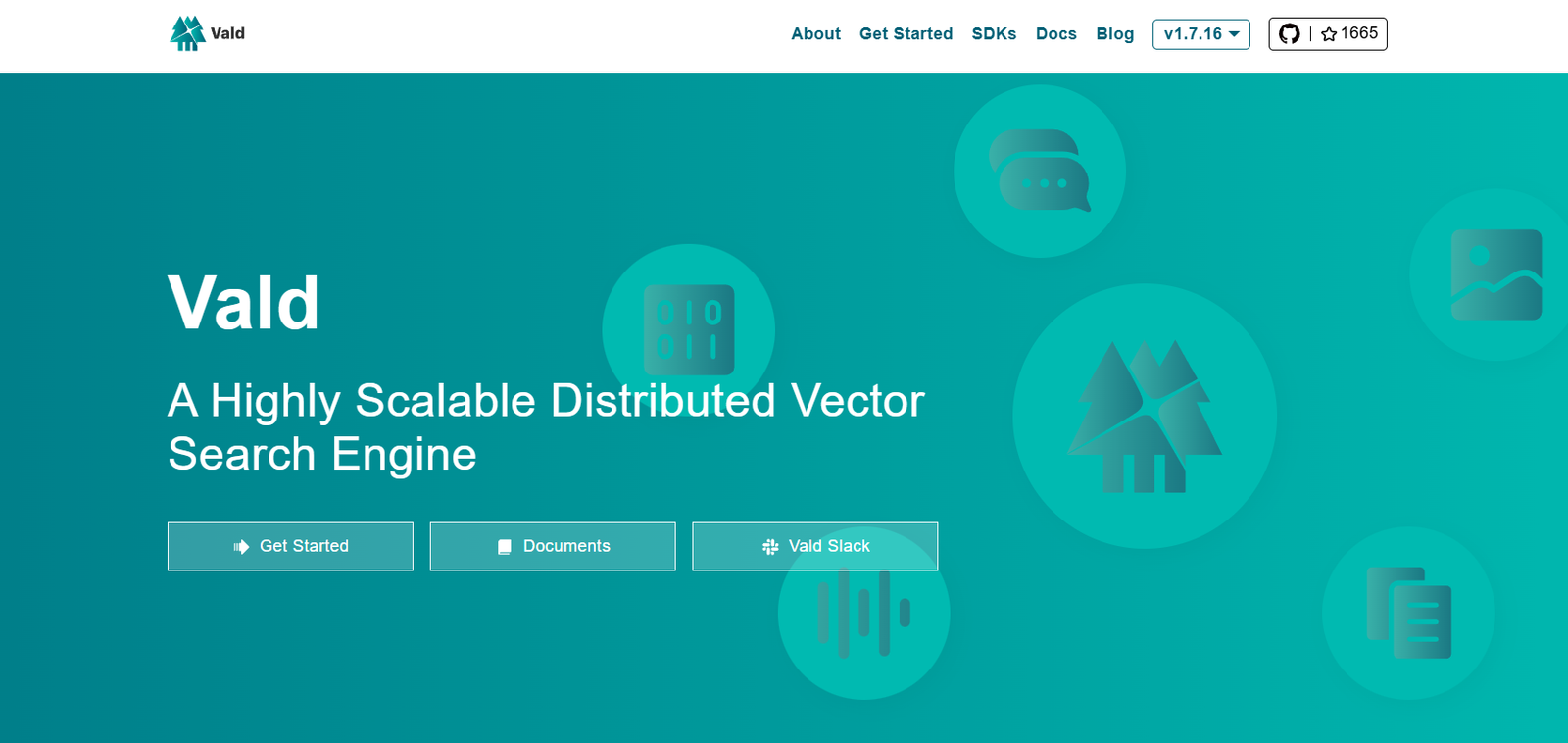
Vald AI is an open-source, cloud-native vector search engine built specifically for scalable, high-performance similarity search. Designed and maintained by the VDA group, Vald is optimized for machine learning and deep learning applications that rely on vector embeddings for semantic understanding, recommendation systems, and retrieval-augmented generation (RAG).
Vald stands out for its Kubernetes-native architecture, which enables dynamic scaling, automated recovery, and easy integration into cloud environments. It is especially suitable for organizations building AI infrastructure that requires fast, accurate, and flexible vector indexing and retrieval in real time.
Features
Vald is built on a fully Kubernetes-native architecture, supporting scalable and resilient deployments in cloud and on-premise environments.
The platform uses Approximate Nearest Neighbor (ANN) algorithms for efficient high-dimensional vector similarity search.
It supports real-time vector insertion, update, and deletion, making it ideal for dynamic and frequently changing datasets.
Vald provides gRPC and RESTful APIs for seamless integration with various AI and ML pipelines.
It supports multi-index and distributed clustering, allowing users to store and search billions of vectors across nodes.
The system includes auto-indexing and rebalancing features, ensuring continuous optimization and performance without downtime.
Vald is compatible with popular ANN libraries, including NGT (Neighborhood Graph and Tree), enabling high-accuracy and speed.
The engine supports both batch and stream processing, which makes it suitable for real-time inference and analytics.
Built with production-readiness in mind, Vald offers observability tools, health checks, and metrics integration with platforms like Prometheus.
Vald is open source and available under the Apache 2.0 License.
How It Works
Vald operates by indexing high-dimensional vectors—such as those derived from natural language, image, or audio embeddings—and enabling fast approximate nearest neighbor search.
When integrated into an AI application, Vald stores vector data and processes queries to return similar vectors based on metrics such as cosine similarity or Euclidean distance. These capabilities allow developers to build intelligent systems that understand semantic relationships instead of relying solely on exact matches.
The engine’s underlying architecture uses NGT for vector indexing and Kubernetes for orchestration. Vald’s auto-scaling and auto-indexing modules automatically adjust to workload changes, improving uptime and performance without manual intervention.
Developers interact with Vald through APIs to insert, update, or delete vectors and to perform similarity search operations. Its support for gRPC and REST makes it easy to integrate into modern cloud-native ML systems.
Thanks to its stateless microservices design, Vald can be deployed in distributed environments, ensuring fault tolerance and horizontal scalability.
Use Cases
AI and ML teams use Vald to build semantic search engines that return relevant results based on meaning, not just keywords.
E-commerce platforms implement Vald to offer personalized product recommendations based on user behavior and embedding similarity.
Chatbot and RAG systems integrate Vald to retrieve relevant knowledge or documents that enhance generative model accuracy.
Multimedia platforms use Vald for content-based image retrieval, finding visually similar items or frames in large datasets.
Cybersecurity applications utilize Vald to detect anomalous behavior by comparing real-time activity embeddings with known patterns.
Healthcare and biotech organizations use Vald for similarity analysis in genomics, diagnostics, or medical literature.
Enterprise search tools benefit from Vald’s ability to scale and handle large document embeddings for internal knowledge bases.
Pricing
Vald is completely open source and free to use under the Apache 2.0 License. This makes it accessible to individuals, startups, and enterprises looking for a flexible and cost-effective vector search solution.
There is no official managed cloud offering as of now, so users deploy and maintain Vald themselves, typically in Kubernetes environments.
Since Vald is designed for Kubernetes, organizations hosting it will need infrastructure capable of running containers and services, which may involve associated cloud or on-premise operational costs.
Enterprise users can extend the platform with observability and monitoring tools and integrate it with CI/CD systems, identity management, and Kubernetes-native DevOps workflows.
Strengths
Cloud-native design enables seamless scaling and orchestration with Kubernetes.
Supports dynamic data with real-time insert, update, and delete capabilities.
High-performance ANN algorithms provide fast and accurate vector search.
Open source and community-driven, with transparent development.
Robust API support allows easy integration into existing ML pipelines.
Modular and microservices-based architecture supports fault tolerance and high availability.
Observability features make it suitable for production use in enterprise environments.
No vendor lock-in due to full self-hosting and open licensing.
Drawbacks
Requires Kubernetes knowledge for deployment and maintenance, which may limit accessibility for small teams without DevOps resources.
No official hosted or managed service option available as of the latest release.
ANN search may not always return exact matches, which may be a concern for precision-critical applications.
Initial setup may involve a steep learning curve, especially for developers unfamiliar with vector databases or distributed systems.
Documentation is improving but may still lack depth in some advanced use cases compared to older, more established platforms.
Comparison with Other Tools
Compared to Pinecone, which is a fully managed proprietary vector database, Vald offers open-source flexibility and no vendor lock-in, but requires self-hosting and Kubernetes expertise.
Versus Qdrant or Weaviate, Vald is more Kubernetes-native, making it highly scalable and suitable for container-based cloud-native environments.
Unlike FAISS, which is a C++ library for local use, Vald is a full vector database with distributed support, API endpoints, and auto-indexing features.
Compared to Milvus, Vald emphasizes a microservice-oriented design and integration with Kubernetes, offering dynamic scaling but a less plug-and-play experience.
While Redis Vector Search adds vector capabilities to a key-value store, Vald is purpose-built for vector workloads and handles billions of high-dimensional vectors more efficiently.
Customer Reviews and Testimonials
As an open-source project, Vald is praised by contributors and users in the ML and DevOps communities for its cloud-native approach and high scalability.
Early adopters appreciate its performance, Kubernetes integration, and dynamic data handling capabilities.
Community feedback on GitHub highlights its modularity, strong architecture, and potential as an alternative to commercial vector solutions.
Vald is used in several AI research and production environments, especially where privacy, self-hosting, and scalability are priorities.
Though lacking formal customer reviews on platforms like G2, Vald has gained credibility through consistent open-source development, public roadmap, and contributions from a growing user base.
Conclusion
Vald AI is a powerful, open-source vector search engine purpose-built for modern AI and machine learning workflows. With its Kubernetes-native design, support for dynamic vector operations, and high-performance indexing, Vald is well-suited for scalable, real-time applications such as semantic search, recommendations, and RAG systems.
For organizations looking for an open, customizable, and cloud-ready vector infrastructure, Vald offers the tools and flexibility to build intelligent, high-performance search systems at scale. While it requires some operational overhead, especially for deployment, its strengths in scalability, openness, and architectural design make it a leading choice for developers and data scientists building production-grade AI systems.