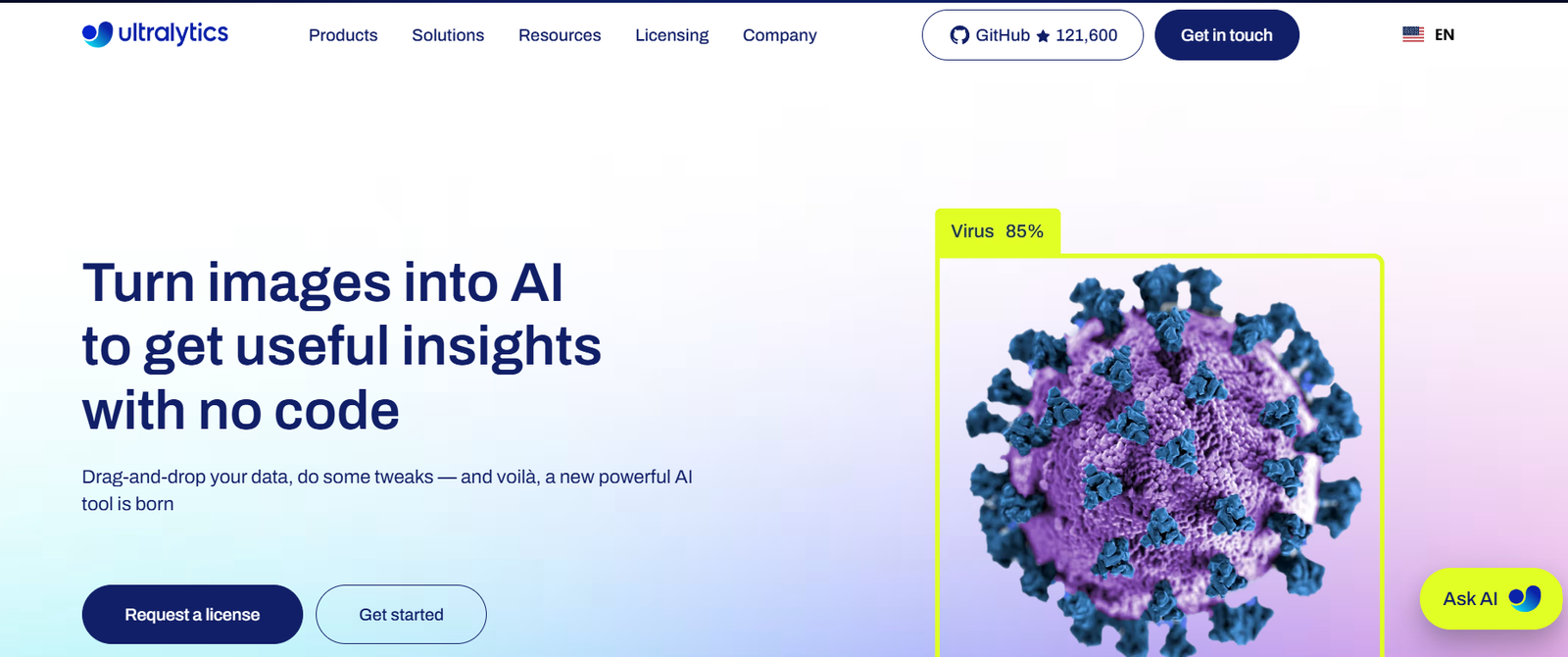
Ultralytics is a leading AI company known for developing YOLOv8 (You Only Look Once, version 8), one of the most advanced open-source models for real-time computer vision tasks such as object detection, image segmentation, pose estimation, and classification. Ultralytics provides tools and APIs to help developers and businesses build, train, and deploy vision-based AI models efficiently and at scale.
The YOLO series, originally developed for speed and accuracy in object detection, has evolved into a robust ecosystem through Ultralytics’ contributions. With YOLOv8, the company has created a production-ready model architecture that delivers high accuracy and performance while remaining lightweight and adaptable for edge devices, cloud environments, and on-premise solutions.
Ultralytics empowers both developers and organizations by offering intuitive tools, pretrained models, and seamless deployment options across various platforms.
Features
Ultralytics offers a powerful suite of features centered around computer vision and real-time AI applications.
YOLOv8 Model: A state-of-the-art architecture for object detection, segmentation, classification, and pose estimation, designed for fast and accurate performance.
Pretrained Models: Access to high-quality pretrained models ready for fine-tuning on custom datasets, reducing time to deployment.
Multi-Task Support: Train and deploy models for different tasks such as bounding box detection, image segmentation, pose estimation, and classification with a unified interface.
Ultralytics HUB: A cloud-based platform that enables training, management, version control, and deployment of models via a web interface without writing code.
Python SDK: A developer-friendly software development kit that allows programmatic interaction with training workflows, datasets, and inference routines.
Command-Line Interface (CLI): A simple CLI to manage training, validation, and inference workflows locally or in the cloud.
Export to Multiple Formats: Export trained models to ONNX, TensorRT, CoreML, and OpenVINO for edge and mobile deployment.
AutoML Features: Built-in functionality for hyperparameter tuning and model optimization using built-in training workflows.
Real-Time Inference: Achieve high FPS (frames per second) on GPUs and edge devices, making YOLOv8 ideal for real-time applications.
Extensive Documentation: Detailed guides, tutorials, and API references to support developers at every stage of model development and deployment.
How It Works
Ultralytics makes building and deploying AI vision models intuitive, even for developers with limited experience in deep learning.
Step 1 – Install YOLOv8: Use pip to install the Ultralytics package and access YOLOv8 tools via Python or CLI.
Step 2 – Prepare Dataset: Use your own labeled images in supported formats (e.g., COCO, YOLO) or explore open datasets available through the Ultralytics community.
Step 3 – Train the Model: Run training using a single command. You can fine-tune a pretrained YOLOv8 model on your dataset with real-time progress and logging.
Step 4 – Evaluate Performance: Automatically validate model accuracy using precision, recall, F1-score, and other key metrics.
Step 5 – Run Inference: Perform real-time inference on images, videos, or streams using the trained model.
Step 6 – Export and Deploy: Export the model to your desired format and deploy it on edge devices, mobile applications, or cloud services.
Step 7 – Monitor and Update: Use Ultralytics HUB for managing model versions, retraining on new data, or deploying updates across environments.
Use Cases
Ultralytics serves a wide variety of industries and use cases where real-time computer vision is critical.
Retail Analytics: Use object detection and footfall analysis to improve in-store operations and product placement.
Security and Surveillance: Implement real-time monitoring systems for intrusion detection, anomaly detection, and people tracking.
Healthcare Imaging: Support medical diagnostics with automated detection of anomalies in radiology, dermatology, and pathology.
Smart Cities: Enable intelligent traffic monitoring, vehicle counting, and pedestrian detection to improve urban mobility.
Manufacturing and Industrial: Detect product defects, monitor assembly lines, and ensure safety compliance in real time.
Agriculture: Monitor crop health, detect pests, and classify plant species using aerial or ground-based vision systems.
Sports and Fitness: Track player movement, analyze poses, and generate performance metrics in real-time for coaching or broadcasting.
Robotics and Drones: Empower autonomous navigation with live object detection and segmentation for obstacle avoidance and task execution.
Pricing
Ultralytics offers both free and paid options for individuals and organizations.
Open Source YOLOv8: Free to use under the GPL-3 license. All models, training scripts, and tools are available on GitHub.
Ultralytics HUB (Cloud Platform):
Free Plan: Train and manage models with limited usage quotas. Ideal for hobbyists and students.
Pro Plan: Includes larger datasets, more training hours, priority compute, and version control features. Starts at $10/month.
Enterprise Plan: Custom solutions with SLA, dedicated support, private cloud deployment, and compliance (e.g., SOC2). Contact sales for pricing.
Ultralytics also offers professional services for companies needing help with custom development, model training, or deployment support.
For the latest pricing details, visit the Ultralytics pricing page.
Strengths
Ultralytics provides several key advantages in the AI computer vision ecosystem:
State-of-the-Art Models: YOLOv8 is one of the fastest and most accurate open-source object detection models available.
Developer-Friendly: Simple APIs, CLI, and SDKs make it easy to integrate YOLO into any project or workflow.
Open Source Flexibility: Full access to source code allows deep customization and transparency.
Cross-Platform Deployment: Export to multiple formats and run models across cloud, desktop, and edge environments.
Community and Ecosystem: A large, active community of developers, contributors, and researchers supporting continuous improvement.
Fast Inference: Optimized for real-time use cases on GPU and edge hardware, even on low-resource devices.
All-in-One Tooling: Unified support for multiple vision tasks including detection, segmentation, classification, and pose estimation.
Strong Documentation: Comprehensive resources, guides, and examples make onboarding easy for teams of all skill levels.
Drawbacks
While Ultralytics offers an impressive platform, there are some limitations to consider:
Limited Non-Technical User Support: While the HUB simplifies things, the platform still caters primarily to developers and engineers.
Requires Labeled Data: Users must provide well-labeled datasets, which can be a challenge for niche or small-scale use cases.
No Native GUI for Local Use: Unlike some platforms, there’s no desktop GUI for managing models locally—most features are accessed via CLI or cloud.
Cloud Limits on Free Tier: The free tier of Ultralytics HUB comes with restricted training hours and limited storage.
Enterprise Support Requires Contact: Advanced features and support are available only via the enterprise plan, which requires direct contact.
Comparison with Other Tools
Ultralytics stands apart in the computer vision and AI development space.
Compared to TensorFlow or PyTorch directly, Ultralytics offers a higher-level abstraction with ready-to-use vision models, dramatically reducing the time from development to deployment.
Against platforms like OpenCV, which focus more on image processing, Ultralytics focuses on deep learning models for detection and segmentation.
Compared to cloud-based platforms like AWS Rekognition or Google Vision AI, Ultralytics provides more control, better performance on custom datasets, and avoids vendor lock-in.
Ultralytics is ideal for teams that want open-source flexibility with production-ready capabilities for vision-based AI.
Customer Reviews and Testimonials
Ultralytics has been widely adopted by developers, researchers, and organizations around the world. Testimonials emphasize:
– Fast setup and training even on consumer-grade GPUs
– Impressive real-time performance on both cloud and edge devices
– Developer-focused tools that simplify complex vision tasks
– High-quality documentation and responsive community support
– Rapid iteration cycles due to modular model design
Companies in logistics, retail, industrial automation, and healthcare have built AI-powered solutions using Ultralytics’ tools and YOLOv8.
To explore user success stories, community projects, and tutorials, visit the Ultralytics community page and GitHub repository.
Conclusion
Ultralytics is a standout platform for anyone working with AI vision systems. With YOLOv8, it delivers high-performance object detection and segmentation capabilities that are both easy to use and production-ready. Whether you’re a developer building a custom model or a company deploying AI at scale, Ultralytics provides the tools, infrastructure, and community to accelerate your computer vision projects.
From open-source flexibility to enterprise-grade cloud solutions, Ultralytics bridges the gap between research and real-world applications—making real-time AI vision accessible to all.