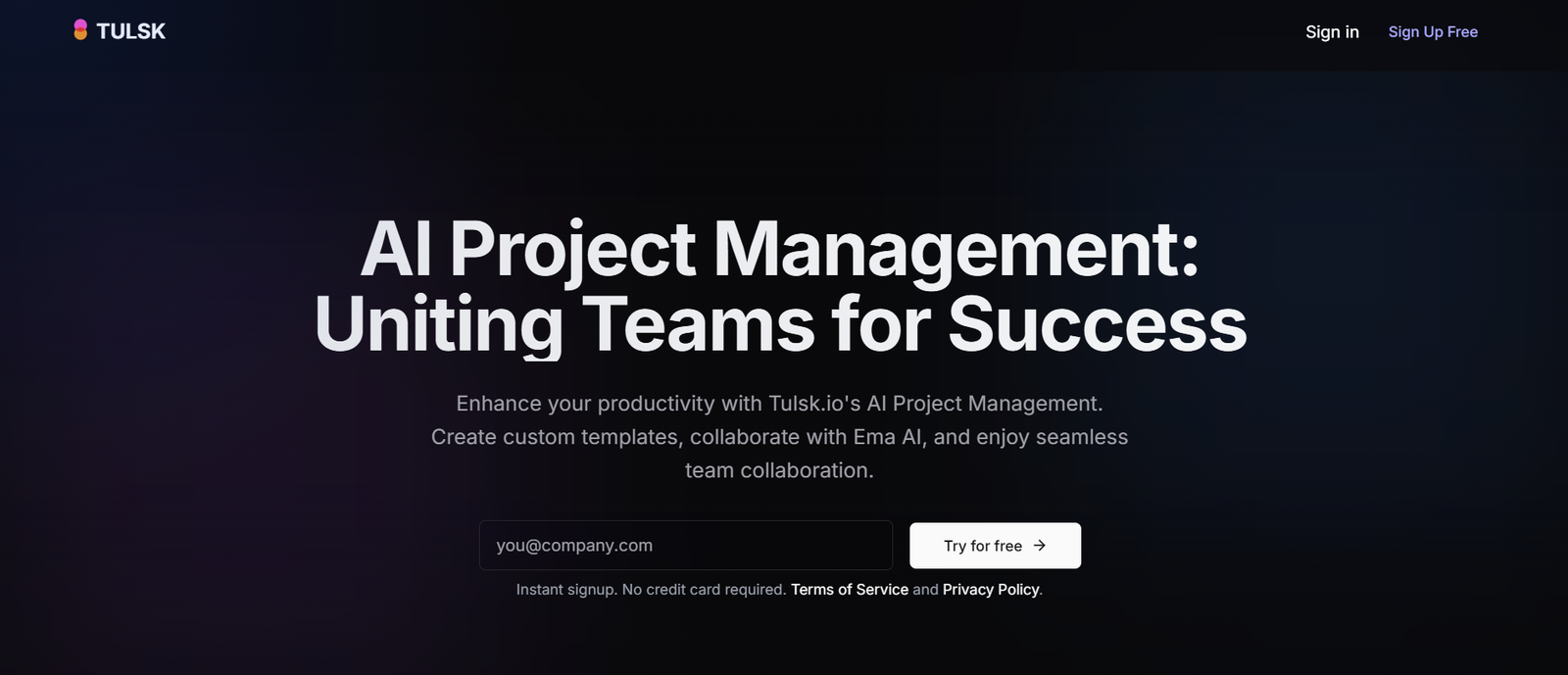
Tulsk is a specialized infrastructure platform designed to help enterprises securely deploy, manage, and monitor large language models (LLMs). Built for AI engineers, platform teams, and compliance-driven industries, Tulsk provides a modular, cloud-agnostic framework that enables fast experimentation and responsible scaling of LLM applications.
Unlike public APIs or hosted playgrounds, Tulsk allows organizations to run LLMs in isolated, auditable environments, with fine-grained control over usage, access, and performance. It’s an ideal choice for teams looking to develop AI agents, RAG pipelines, or internal tools without compromising data privacy or compliance requirements.
Features
Isolated LLM Environments
Spin up secure, dedicated runtime environments for each LLM task or application with full audit trails.
LLM Router and Load Balancer
Route and scale requests across multiple models (e.g., OpenAI, Mistral, Claude) with intelligent fallback and usage policies.
Built-in Audit Logging
Track every input, output, and system-level event to meet compliance, privacy, and governance needs.
Secrets and Key Management
Centralized storage of API keys, tokens, and credentials in secure, encrypted vaults.
Developer Toolkit (SDK + CLI)
Deploy, monitor, and debug LLM workloads using intuitive Python SDKs and command-line tools.
Multi-Model Support
Works seamlessly with hosted APIs (OpenAI, Anthropic, Cohere) and open-source models running in self-managed environments.
Integration-Friendly Architecture
Designed to embed into enterprise stacks via REST APIs, webhooks, and event-based systems.
How It Works
Configure a Secure LLM Runtime
Set up an isolated LLM environment with defined permissions, model type, and usage quotas.Route and Execute LLM Calls
Use Tulsk’s API to send queries to OpenAI, Claude, or self-hosted models through a unified interface.Monitor and Trace Requests
View complete logs, latency metrics, token usage, and user-level access patterns in real time.Manage Secrets and Keys
Store and rotate credentials securely with built-in access control and versioning.Scale and Automate
Leverage CI/CD integrations or scripts to deploy new LLM workflows, update environments, or run tests.
Use Cases
Enterprise AI Platform Teams
Build internal AI tooling and LLM-backed features with centralized observability and security.
RAG and LLMOps Deployment
Manage prompt routing, fallback models, and load balancing across vector databases and LLM providers.
Compliance-Driven Industries
Ensure full auditability and data isolation for financial, legal, or healthcare applications.
Multi-Tenant SaaS Products
Run user-specific LLM environments with strict sandboxing and performance guarantees.
Security-Conscious Research Labs
Experiment with prompts, fine-tuned models, or private data in a safe, governed setting.
Pricing
As of June 2025, Tulsk uses a quote-based pricing model, tailored to enterprise needs and deployment scale. Pricing depends on:
Number of LLM environments
Model traffic (queries per second, token volume)
Type of models used (hosted vs. self-managed)
Feature set (logging, key vaults, SLA support)
Deployment model (cloud, on-prem, hybrid)
To receive a custom quote or schedule a demo, visit https://tulsk.io and use the contact form.
Strengths
Security-First Design: Enables compliant AI usage with strict data isolation and audit logging.
Multi-Model Compatibility: Route calls across OpenAI, Claude, Mistral, and open-source models with a single API.
Developer-Centric Tools: Offers SDKs, CLIs, and APIs that fit modern engineering workflows.
Observability and Monitoring: Real-time metrics and full event logging support transparency and optimization.
Enterprise-Ready: Designed for teams that need scale, reliability, and operational control.
Drawbacks
No Free Tier Listed: Ideal for mid-to-large teams, not built for individual developers or hobbyists.
Requires Technical Setup: Full benefits require integration into internal systems and DevOps pipelines.
Still Early in Ecosystem Growth: Compared to mature LLM platforms, the community and third-party integrations are growing.
Comparison with Other Tools
Tulsk vs. LangChain + OpenAI
LangChain is for app development. Tulsk adds infrastructure, security, and observability for enterprise deployments.
Tulsk vs. Modal
Modal supports model execution and serverless infra. Tulsk focuses more on LLM isolation, auditing, and API management.
Tulsk vs. Azure OpenAI or AWS Bedrock
Cloud-native tools lock users into their ecosystems. Tulsk is cloud-agnostic, enabling hybrid or multi-cloud setups.
Customer Reviews and Testimonials
“Tulsk helps us deploy multiple LLMs in a secure, controlled way—perfect for regulated environments.”
– Head of ML Ops, Fintech Company
“The built-in logging and routing features save us hours of custom engineering every week.”
– CTO, Healthcare SaaS Startup
“Our devs love the SDK, and our compliance team loves the audit trails. Tulsk nailed both sides.”
– VP of Engineering, LegalTech Firm
Conclusion
Tulsk is solving a critical challenge in today’s AI landscape: how to operationalize LLMs securely and responsibly at scale. With its flexible infrastructure, API routing, and strong governance capabilities, Tulsk enables enterprise teams to build and deploy LLM-powered applications without sacrificing security or control.
If your organization is scaling AI workflows and needs a trustworthy backend for LLM orchestration, Tulsk is an ideal foundation.