
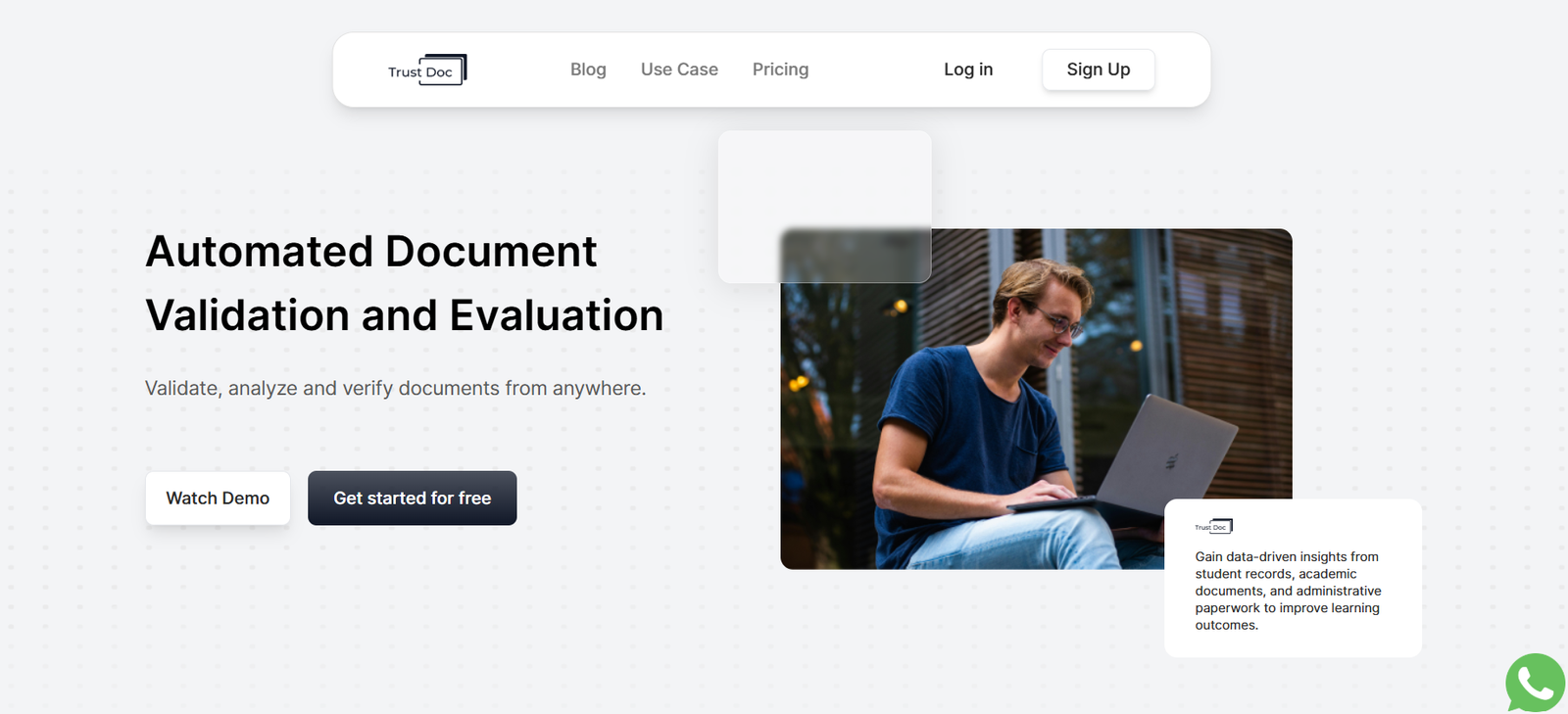
TrustDoc is a HIPAA-compliant, AI-powered document management platform built specifically for healthcare providers and organizations. Its core purpose is to enable fast, secure, and accurate generation, processing, and sharing of medical documents using artificial intelligence. By automating repetitive documentation tasks and ensuring regulatory compliance, TrustDoc enhances clinical efficiency, reduces administrative burden, and improves patient data handling.
Designed with both providers and patients in mind, TrustDoc is more than a digital document manager—it serves as a complete AI documentation assistant. Whether it’s clinical notes, intake forms, referrals, or chart summaries, TrustDoc ensures healthcare organizations can manage all document workflows in a secure and intelligent environment.
Features
TrustDoc comes equipped with a range of features tailored to the specific needs of the healthcare industry. One of its primary offerings is AI-driven document generation, which helps physicians and staff create accurate and structured medical documents in real time.
The platform also includes automated speech-to-text capabilities, enabling clinicians to dictate notes that are instantly converted into written medical records. TrustDoc uses secure AI models to summarize patient encounters, generate SOAP notes, and extract key data points, significantly reducing the time needed for documentation.
In addition, TrustDoc features role-based access control, document tracking, and digital signing. These features support collaborative workflows while ensuring data privacy and integrity. Its dashboard offers a centralized view of all document statuses, from draft to completion.
The platform also ensures all stored data and communications are HIPAA-compliant, with end-to-end encryption, secure access protocols, and audit trails.
How It Works
TrustDoc works by integrating AI into every stage of the document lifecycle within a healthcare setting. When a patient visit is recorded, either through voice, typed notes, or uploaded forms, the system uses natural language processing to parse and understand the content.
AI then organizes the information into structured documents such as SOAP notes, referral letters, or progress reports. The documents can be edited, shared, signed, or exported directly from the platform. Staff can also use templates and custom workflows to standardize and speed up common documentation tasks.
Physicians can dictate notes using TrustDoc’s voice capture feature. The audio is converted into text and then summarized into formatted clinical records using medical AI models. This reduces the manual work typically required for record-keeping while improving the consistency and accuracy of the information recorded.
Use Cases
TrustDoc is ideal for various healthcare environments where accurate documentation and compliance are critical. In clinics and private practices, physicians use it to generate progress notes, referrals, and patient histories quickly without typing everything manually.
Hospitals use TrustDoc to streamline discharge summaries, admission records, and interdepartmental communication. For mental health professionals, the platform offers efficient note-taking and session summaries while maintaining strict privacy standards.
Telehealth providers benefit from TrustDoc’s voice-to-text and document sharing capabilities, enabling smooth virtual consultations and post-visit documentation. Administrative staff use the system to manage consent forms, billing documents, and insurance communications—all within a secure and AI-assisted environment.
Pricing
TrustDoc does not publish its pricing plans directly on its website. Instead, interested users are encouraged to book a demo or contact the sales team to get custom pricing based on the size and needs of their practice or healthcare organization.
This suggests a flexible pricing model that scales with usage, team size, and specific document volume. While this approach ensures tailored solutions for healthcare providers, it may be a consideration for smaller practices looking for upfront cost transparency.
Strengths
One of TrustDoc’s main strengths is its focus on the healthcare industry, with all features purpose-built for medical professionals. Its HIPAA-compliance and secure infrastructure ensure that patient data is always protected, aligning with legal and ethical requirements.
The AI automation drastically reduces time spent on documentation, freeing up clinicians to spend more time with patients. The platform’s voice-to-text capabilities are especially beneficial for busy professionals who prefer dictation over manual typing.
Its role-based access control and collaborative features make it easy for medical teams to work together on documents while maintaining compliance. The intuitive user interface makes adoption easier even for those with minimal technical skills.
Drawbacks
One drawback is the lack of transparent pricing on the public website, which may hinder quick decision-making for smaller practices or independent clinicians.
Since TrustDoc is focused solely on healthcare, its applicability outside the medical industry is limited. Organizations in other sectors may find the platform too specialized for general-purpose document automation.
Another consideration is that the AI functionality, while powerful, may require an initial learning curve for users unfamiliar with AI-generated documentation or speech-to-text workflows.
Comparison with Other Tools
Compared to general document automation platforms like DocuSign or PandaDoc, TrustDoc offers a much deeper focus on healthcare workflows and compliance. While those tools handle document creation and signatures, they lack medical-specific AI features such as SOAP note generation and HIPAA-compliant infrastructure.
When compared to medical transcription platforms like Nuance Dragon Medical, TrustDoc stands out with its broader document management capabilities. While Dragon focuses primarily on transcription, TrustDoc integrates dictation with structured AI output, editing, collaboration, and secure sharing—all in one platform.
Other healthcare AI tools like Suki or DeepScribe offer similar voice-to-text features but may not include the end-to-end document lifecycle management and form handling that TrustDoc provides.
Customer Reviews and Testimonials
TrustDoc’s official website does not display public user reviews or testimonials at this time. However, its positioning suggests it is currently adopted by private practices, clinics, and healthcare teams focused on enhancing efficiency and compliance.
Prospective customers are encouraged to schedule a demo, during which they can explore the platform’s performance, accuracy, and fit within their clinical workflows. Given the platform’s HIPAA focus and AI capabilities, it is likely to appeal to healthcare providers looking for both automation and regulatory peace of mind.
Conclusion
TrustDoc is a powerful, AI-driven documentation solution tailored specifically for the healthcare sector. It automates the generation of medical documents, supports real-time voice dictation, and ensures complete HIPAA compliance, making it a highly secure and time-saving tool for modern clinical environments.
By reducing the manual workload associated with medical documentation, TrustDoc enables providers to focus more on patient care. Its customizable workflows, secure architecture, and intuitive interface make it suitable for a wide range of healthcare settings, from small clinics to larger hospital systems.
Although pricing is only available upon request, the platform’s features and specialization offer substantial value for organizations that require both accuracy and compliance in their documentation. For healthcare providers seeking to modernize and automate their document workflows with trustworthy AI, TrustDoc is a compelling choice.


