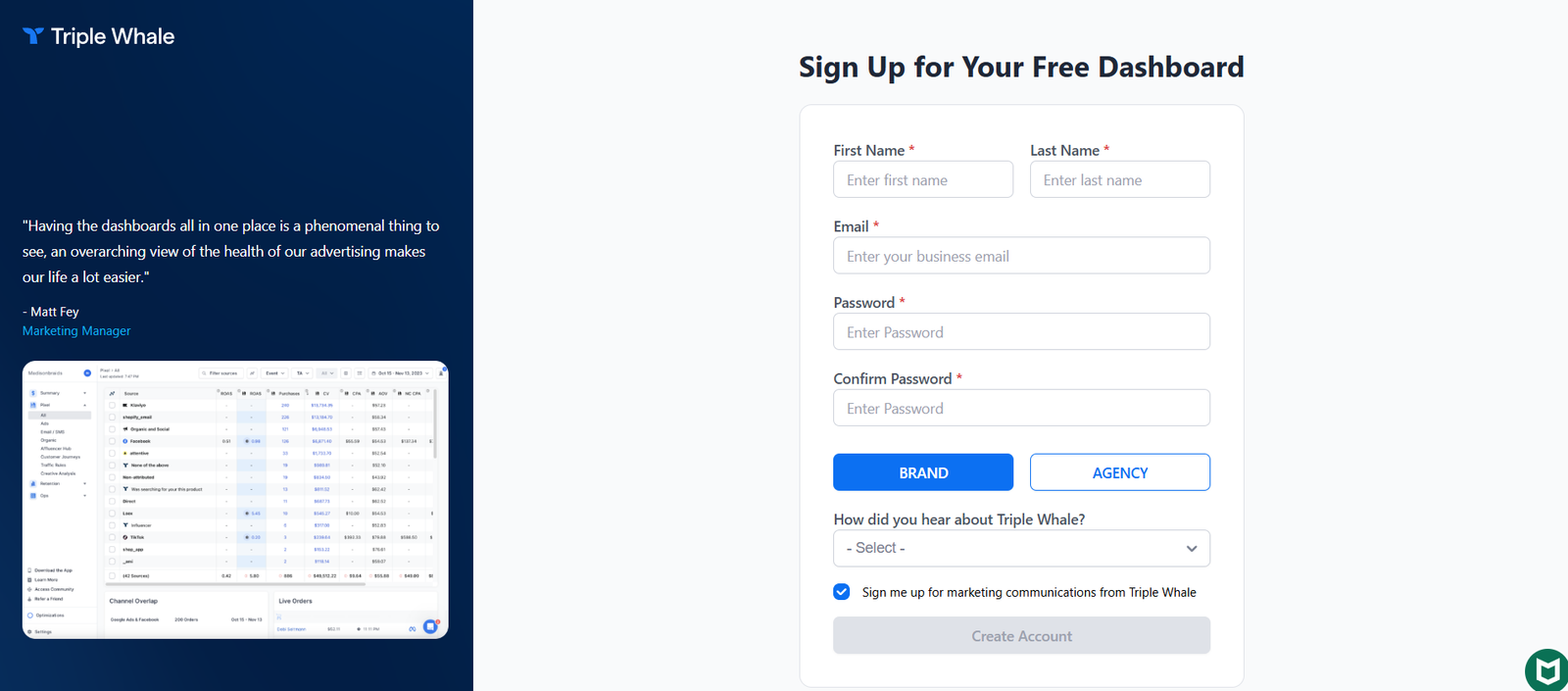
Triple Whale is an AI-powered analytics, attribution, and business intelligence platform designed primarily for ecommerce and retail brands.
The platform brings marketing, sales, customer, website, subscription, Amazon, advertising, and operational data into a single environment. Instead of switching between advertising dashboards, ecommerce platforms, spreadsheets, analytics tools, and reporting systems, teams can monitor their business from one central workspace.
Triple Whale’s proprietary Triple Pixel tracks customer journeys across devices and marketing touchpoints. This data feeds its attribution, analytics, audience, and AI systems.
A major part of the platform is Moby, Triple Whale’s ecommerce-focused AI operator. Moby can answer questions about business performance in natural language, investigate changes in metrics, generate reports and dashboards, build customer audiences, create marketing assets, and perform supported actions across connected systems.
Higher plans expand Moby from an analytical assistant into a more autonomous operator. Businesses can create recurring automations for activities such as KPI alerts, leadership reports, advertising monitoring, creative preparation, audience updates, and operational workflows.
Triple Whale also provides advanced measurement capabilities including multi-touch attribution, marketing mix modeling, and incrementality testing for brands that need to understand the actual impact of marketing investments.
The platform is designed for ecommerce founders, performance marketers, marketing leaders, agencies, analysts, operations teams, and larger retail organizations.
Features
Unified Ecommerce Dashboard
Triple Whale brings important business metrics into one central dashboard.
Teams can monitor revenue, advertising spend, ROAS, customer acquisition, sales, website activity, email and SMS performance, and other metrics without constantly moving between platforms.
Triple Pixel
Triple Pixel is Triple Whale’s proprietary tracking and identity-resolution technology.
It combines an identity graph with server-side technology to track customer interactions across devices and marketing touchpoints.
First-Click and Last-Click Attribution
The Free plan includes first-click and last-click attribution models for understanding where customers initially came from and which touchpoint occurred before conversion.
Multi-Touch Attribution
Paid plans provide more advanced attribution capabilities for evaluating multiple marketing touchpoints involved in a purchase.
Total Impact Attribution
Advanced measurement capabilities help teams evaluate marketing performance beyond simple platform-reported attribution.
Moby AI
Moby is Triple Whale’s AI operator for ecommerce.
Users can ask questions about their business in natural language rather than manually building every report.
Moby Chat
Moby Chat allows teams to investigate their data conversationally.
For example, users can ask why revenue changed, which campaigns are underperforming, how customer acquisition is trending, or what happened during a particular period.
Moby Automations
Higher plans allow users to turn recurring work into automations.
Examples include leadership reports, KPI alerts, advertising monitoring, creative preparation, purchase orders, and audience updates.
Moby Specialists
Triple Whale provides specialized AI agents designed around particular ecommerce responsibilities.
Examples include agents focused on media buying, creative performance, and conversion optimization.
AI-Generated Reports
Moby can generate reports and analytical artifacts using live business data.
Custom Dashboards
Teams can create dashboards around the metrics that matter to their particular business.
No-Code Dashboard Builder
Users can build custom views without needing to write code.
SQL Editor
More technical users can query underlying business data using SQL.
Custom Metric Builder
Businesses can create their own metrics when standard ecommerce KPIs do not fully match their reporting requirements.
Customer Segmentation
Triple Whale allows users to create customer segments for deeper analysis and marketing activation.
Creative Analytics
Teams can analyze advertising creatives and compare their performance.
This can help identify stronger hooks, formats, concepts, and creative approaches.
Product Analytics
Brands can examine product-level performance and identify trends across their catalog.
Cohort Analysis
Customer cohorts can be analyzed to understand purchasing patterns, retention, and lifetime value.
Inventory and Profitability Analysis
Advanced analytics can incorporate inventory and profitability information into business reporting.
Post-Purchase Surveys
Triple Whale provides built-in post-purchase surveys that allow brands to ask customers how they discovered the business.
Survey responses can complement digital attribution data.
Sonar Send
Sonar Send helps brands identify more website visitors and activate first-party data through email and SMS marketing.
Sonar Optimize
Sonar Optimize uses first-party signals to help improve advertising optimization.
Audience Activation
Customer segments and high-intent signals can be pushed back into supported marketing platforms.
Ad Platform Controls
Users can manage supported advertising settings such as campaign status and budgets from Triple Whale.
AI Visibility
Triple Whale can track how a brand appears in AI-generated answers.
Available metrics include mentions, citations, and sentiment.
The Free plan currently focuses on ChatGPT visibility, while paid plans provide broader LLM coverage.
Web Search
Moby can search the web when external information is needed to complement internal business data.
Web Interaction
Moby includes web interaction capabilities for supported workflows where an AI operator needs to inspect or interact with websites.
Creative Generation
Supported Moby capabilities include generating marketing images and videos.
Creative Studio
Triple Whale provides a workspace for developing and refining advertising creative with brand assets and AI assistance.
Marketing Mix Modeling
Advanced measurement capabilities include Marketing Mix Modeling, or MMM.
MMM helps brands estimate how different marketing channels contribute to overall performance and inform budget allocation.
Incrementality Testing
Triple Whale supports incrementality measurement to help determine whether marketing activity is producing genuinely additional sales rather than simply receiving credit for purchases that would have happened anyway.
Compass
Enterprise customers can use Compass to combine attribution, MMM, and incrementality signals into a more unified measurement framework.
Real-Time Data Refresh
Triple Whale states that core business data can refresh every 15 minutes or less.
60+ Integrations
The platform connects with more than 60 ecommerce, advertising, marketing, subscription, fulfillment, and business platforms.
Supported categories include ecommerce stores, Meta and Google advertising, TikTok, email and SMS platforms, Amazon, review platforms, shipping systems, and subscription tools.
Data-In API
Businesses can bring additional proprietary data into Triple Whale.
Data-Out API
Data can also be exported to warehouses, BI tools, and internal applications.
Data Warehouse Export
Triple Whale supports outbound data workflows involving platforms such as BigQuery, Snowflake, and Redshift.
Mobile App
Teams can monitor business performance through Triple Whale’s mobile application.
How It Works
Step 1: Create an Account
Businesses can begin with the Free plan without providing a credit card.
Step 2: Connect the Ecommerce Store
Connect the relevant ecommerce platform and sales data.
Step 3: Connect Marketing Channels
Add advertising platforms such as Meta, Google, TikTok, Pinterest, Snapchat, and other supported channels.
Step 4: Connect Additional Business Tools
Add email, SMS, subscription, Amazon, fulfillment, review, and other relevant integrations.
Step 5: Install Triple Pixel
Configure Triple Pixel to improve customer journey tracking and attribution.
Step 6: Review the Unified Dashboard
Triple Whale brings connected data into a central performance view.
Step 7: Analyze Attribution
Compare channels, campaigns, and customer journeys using available attribution models.
Step 8: Ask Moby Questions
Use natural language to investigate business performance.
Step 9: Build Reports and Segments
Create custom dashboards, reports, metrics, and customer audiences.
Step 10: Activate Insights
Push supported first-party signals and audiences into marketing platforms.
Step 11: Create Automations
Higher plans allow teams to automate recurring analytical and operational work.
Step 12: Measure Incrementality
Larger brands can use advanced measurement capabilities to combine attribution, MMM, and incrementality testing.
Use Cases
Ecommerce Performance Monitoring
Founders can see the overall health of their business from one dashboard.
Marketing Attribution
Teams can evaluate which channels and campaigns contribute to sales.
Media Buying
Performance marketers can monitor ROAS, spend, acquisition costs, and campaign performance.
AI Business Analysis
Teams can ask Moby questions about performance instead of manually building every analysis.
Executive Reporting
Recurring leadership reports can be created and automated.
Creative Analysis
Marketing teams can compare advertising creative and identify stronger concepts.
Customer Retention
Cohort and customer data can help brands understand repeat purchasing and lifetime value.
Audience Building
Businesses can create customer segments and activate them across marketing platforms.
Email and SMS Optimization
First-party identification can support lifecycle marketing and additional email or SMS flows.
AI Search Visibility
Brands can monitor how frequently AI assistants mention or cite them.
Agency Reporting
Agencies can consolidate client performance information and use Moby for analysis.
Inventory Planning
Advanced analytics can help teams connect marketing activity with product and inventory performance.
Marketing Budget Allocation
MMM and incrementality tools can support decisions about how advertising budgets should be distributed.
Pricing
Triple Whale currently provides Free, Foundation, Automate, and Enterprise packages.
Pricing for paid plans depends partly on the brand’s annual GMV, so the final price can vary according to business size.
Free: $0 per month
The Free plan requires no contract or credit card.
It currently includes:
Triple Pixel
Cross-device and cross-platform tracking
First-click and last-click attribution
Marketing channel performance tracking
DTC and Amazon sales tracking
Standard post-purchase survey
Moby Chat
ChatGPT AI visibility tracking for mentions, citations, and sentiment
12 months of historical data
Up to 10 users
The Free plan provides a useful entry point for founders and smaller ecommerce teams.
Foundation: From approximately $219 per month
Foundation adds the core paid measurement and business intelligence capabilities.
It includes features such as:
Multi-touch attribution
Custom dashboards
Customer segmentation
Custom metrics
SQL capabilities
First-party data activation
Moby AI operating across Triple Whale and supported environments such as Slack
Unlimited data lookback
Sonar
Pricing varies according to annual GMV.
Automate: From approximately $749 per month
Automate includes Foundation features and expands Moby into recurring operational work.
Key additions include:
Moby Automations
Recurring leadership reports
KPI and anomaly alerts
Advertising monitoring
Creative preparation
Audience updates
Operational workflows
Moby Specialists
The final price depends on annual GMV.
Enterprise: Custom Pricing
Enterprise is designed for larger and more complex ecommerce organizations.
It adds capabilities such as:
Compass
Marketing Mix Modeling
Incrementality testing
Unified MTA, MMM, and incrementality measurement
Multi-brand reporting
Custom integrations
Advanced onboarding and migration
Enterprise security and controls
Dedicated success support
Pricing is provided by Triple Whale based on business requirements.
GMV-Based Pricing
Triple Whale calculates paid pricing using both the selected package and the brand’s annual gross merchandise value.
As the business grows into a higher revenue tier, pricing can change.
Annual Billing
Foundation, Automate, and Enterprise are generally structured as 12-month subscriptions.
Customers can choose monthly billing within the commitment or annual prepayment.
Annual prepayment currently provides two months free and locks the applicable GMV tier for the year.
Pricing excludes applicable taxes.
Because Triple Whale uses revenue-based pricing, businesses should enter their current annual GMV on the official pricing page to determine the exact current cost.
Strengths
All-in-One Ecommerce Intelligence
Triple Whale combines analytics, attribution, customer intelligence, AI, reporting, and measurement in one environment.
Free Plan
Businesses can start with useful analytics and attribution capabilities without a credit card.
First-Party Tracking
Triple Pixel provides an independent measurement layer rather than relying entirely on advertising-platform reporting.
AI with Business Context
Moby works with the brand’s actual ecommerce data, making it more specialized than using a general AI chatbot without connected business context.
Natural-Language Analytics
Teams can investigate performance without building every report manually.
AI Automations
Higher plans allow recurring analytical and operational tasks to run automatically.
Strong Integration Coverage
More than 60 integrations allow brands to consolidate information from many parts of their ecommerce stack.
Advanced Measurement
Attribution, MMM, and incrementality can be combined for larger brands that need stronger evidence when making budget decisions.
Business Intelligence Tools
Custom dashboards, metrics, segmentation, and SQL provide flexibility for both non-technical and technical users.
AI Visibility Tracking
Brands can monitor their presence in AI-generated answers in addition to conventional marketing channels.
Drawbacks
Triple Whale is primarily designed for ecommerce and retail. Businesses outside these categories may not benefit from its specialized data model and features.
Paid plans can become expensive, particularly for larger brands because pricing scales with annual GMV.
Automate starts substantially higher than Foundation and is most useful for businesses that will actively use recurring AI workflows.
Advanced measurement capabilities such as Compass, MMM, and incrementality are primarily aimed at larger organizations.
The platform’s extensive feature set can require time to learn, particularly for teams moving from basic ecommerce dashboards.
Attribution models are useful decision-making tools but should not be treated as perfect representations of causality.
Moby can automate analysis and supported actions, but businesses should maintain appropriate human oversight when AI can change advertising budgets, publish marketing material, or trigger operational actions.
Comparison with Other Platforms
Triple Whale competes with ecommerce analytics and attribution platforms such as Northbeam, Rockerbox, Lifetimely, Polar Analytics, and conventional business intelligence tools.
Its main distinction is the breadth of its ecommerce operating system.
Rather than focusing only on attribution, Triple Whale combines first-party tracking, business intelligence, customer analytics, creative analysis, audience activation, AI visibility, marketing measurement, and AI agents.
Moby adds another layer by allowing teams to interact with their business data conversationally and automate recurring work.
For larger brands, combining multi-touch attribution with MMM and incrementality testing can provide a broader measurement framework than relying on one attribution model.
However, businesses that need only a simple dashboard or a single attribution capability may find a narrower product easier and less expensive.
Customer Reviews and Testimonials
Triple Whale publishes customer stories and testimonials from established ecommerce brands.
The official website currently highlights companies such as Marine Layer, Travelpro, Laura Geller, Goodr, Culture Kings, OUAI, Peloton Apparel, Portland Leather, True Classic, Milk Bar, Ogee, LSKD, Rhoback, Dixxon, Simba, and Origin.
One highlighted customer reports saving approximately 10 hours per week using Moby, while another case study reports a 25% quarter-over-quarter revenue increase.
Triple Whale also publishes broader performance and adoption statistics based on its customer base.
These case studies and statistics are provided by Triple Whale and should be treated as company-selected evidence rather than guarantees that every customer will achieve similar results.
Conclusion
Triple Whale is an AI-powered operating system for ecommerce that combines analytics, attribution, first-party tracking, business intelligence, customer data, marketing activation, and AI agents.
Triple Pixel provides the data foundation by tracking customer journeys across marketing touchpoints. Triple Whale then brings this information together with advertising, sales, website, Amazon, subscription, email, SMS, product, and operational data.
Moby transforms this data into a conversational and increasingly action-oriented AI layer. Teams can ask questions, investigate performance, create reports, build audiences, generate creative assets, and automate recurring work.
For larger brands, Triple Whale goes further by combining multi-touch attribution, marketing mix modeling, and incrementality testing.
Its main limitations are its ecommerce-specific focus and the increasing cost of paid plans as brands grow.
For ecommerce founders, performance marketers, agencies, analysts, and larger retail teams that want to consolidate fragmented business data and use AI to move from analysis toward action, Triple Whale is a comprehensive option.