
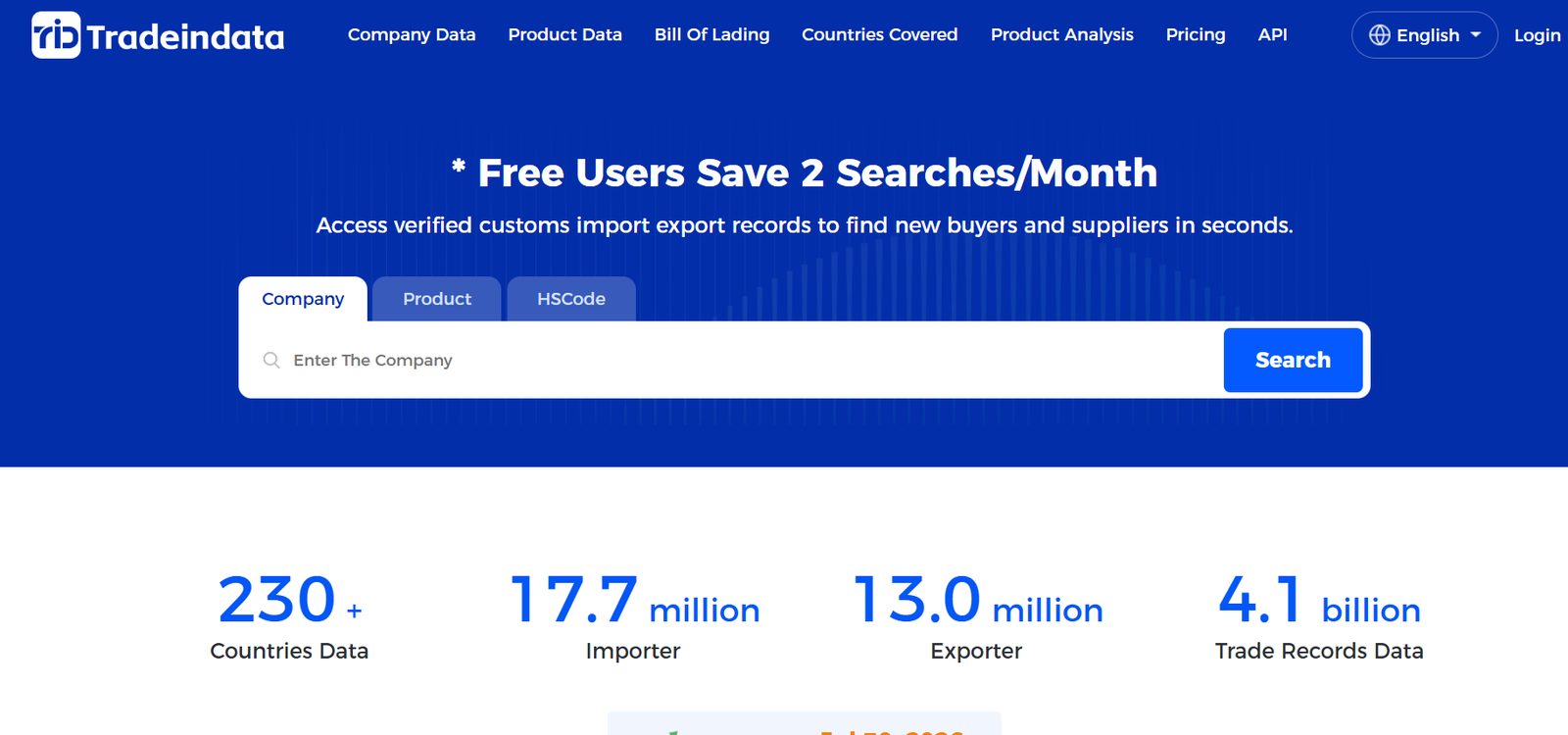
TradeInData is a global import and export intelligence platform designed to help businesses research international trade, identify buyers and suppliers, analyze competitors and discover potential market opportunities.
The platform brings together customs information, shipment-level records, bill of lading data and international trade statistics. According to its official website, TradeInData provides coverage across more than 200 countries and regions and maintains billions of trade records.
Users can search international trade information by importer, exporter, company, product, HS Code and country. This makes the platform useful for businesses that need to understand who is buying or selling particular products and how trade activity is developing across different markets.
TradeInData also incorporates AI into its business intelligence capabilities. Its AI-powered system can generate and organize available contact information for international buyers, including company websites, phone numbers, emails and social profiles. Combined with market analysis and company intelligence, this can help businesses move from trade research to potential lead generation.
The platform is mainly intended for exporters, importers, manufacturers, sourcing teams, international sales professionals, trade analysts and companies planning expansion into new markets.
Features
Global Import and Export Data
TradeInData provides import and export information across more than 200 countries and regions. Users can research international trade activity without relying on separate country-specific databases.
Bill of Lading Data
The platform provides shipment and bill of lading-level information where available. This can help businesses investigate actual trading relationships between companies.
Importer Search
Users can search for companies importing particular products within selected countries and markets.
This can be useful for exporters looking for potential international buyers.
Exporter Search
TradeInData allows businesses to identify companies exporting particular products. Importers and sourcing teams can use this information to research potential suppliers.
Product Search
Users can search international trade activity by product and examine companies involved in importing or exporting relevant goods.
HS Code Search
Trade information can be researched using Harmonized System codes. This helps users conduct more precise product-level analysis when product descriptions differ between shipments.
Advanced Search Engine
The platform provides an advanced search system for navigating large volumes of customs and shipment information.
Users can refine results according to criteria such as country, product, date, port and other available trade fields.
Multi-Keyword Search
TradeInData supports targeted searches involving multiple keywords, helping users narrow large datasets to more relevant trade records.
Customizable Filters
Search results can be filtered using factors such as shipment weight, ports and date ranges. This helps users focus on transactions matching specific business requirements.
AI-Generated Contact Information
TradeInData uses AI to compile available contact information for potential global buyers.
The platform can provide information such as official websites, phone numbers, emails and social profiles when these details are available.
Buyer Discovery
Exporters can use customs and trade information to identify companies already purchasing relevant products internationally.
This provides a more data-driven approach to prospecting than simply searching general business directories.
Supplier Discovery
Importers can identify exporters and suppliers already participating in international trade for selected products.
Company Profiles
TradeInData provides company profiles containing available legal, business and international trading information.
Relationship Mapping
The platform can help users understand trading relationships between companies. Businesses can investigate buyers, suppliers and other partners associated with international transactions.
Market Analysis
Users can analyze international markets using trade volumes, HS Codes, product segments and statistical trends.
This can help businesses evaluate potential markets before committing resources to expansion.
Product Analysis
TradeInData provides product-oriented analysis for examining import and export patterns around specific goods and categories.
Trade Trend Analysis
Historical trade information can help businesses identify changes in demand, supplier activity and trading relationships over time.
Port Analysis
Users can examine available port information associated with import and export activity. This may help logistics and sourcing teams understand how goods move through particular markets.
Data Visualization
Trade information can be converted into charts and visual reports, making large datasets easier to understand and communicate.
Company Labels and Tags
Users can label and organize companies using custom tags. This helps sales and research teams manage potential buyers, suppliers and competitors inside the platform.
Saved Searches
Frequently used searches can be saved, reducing the need to recreate the same research criteria repeatedly.
Email Alerts
Users can receive notifications about relevant trade-data changes, helping them monitor companies and market activity over time.
Data Export
Trade data can be exported for external analysis and use in spreadsheets, CRM systems and internal business processes, subject to plan limits.
API Access
TradeInData provides an API that allows companies to integrate import and export intelligence into their own applications and workflows.
How It Works
Step 1: Visit TradeInData
Users can begin from the TradeInData search interface and select the type of international trade information they want to investigate.
Step 2: Choose Import or Export Data
Select whether the research should focus on importers, exporters or other trade information.
Step 3: Enter Search Criteria
Search using a company name, product, HS Code or relevant keyword.
Step 4: Select a Country
Choose the country or market relevant to the research.
Step 5: Apply Filters
Refine results using available filters such as date range, port, weight and other trade parameters.
Step 6: Examine Trade Records
Review available shipment records and trade information to understand which companies are importing or exporting the selected products.
Step 7: Analyze Companies
Open company profiles to examine available business information, trading activity, products and relationships.
Step 8: Find Potential Contacts
Where available, TradeInData’s AI-powered system can help compile contact information for relevant companies and potential buyers.
Step 9: Save and Organize Prospects
Useful companies can be labeled and organized for future sales, sourcing or research activities.
Step 10: Export or Integrate the Data
Depending on the subscription, information can be exported or accessed through the API for use in other business systems.
Use Cases
Exporters
Export businesses can identify companies already importing products similar to theirs and use this information to build more targeted international prospect lists.
Importers
Importers can research exporters and suppliers operating in specific countries and product categories.
Manufacturers
Manufacturers planning international expansion can analyze demand for their products and identify potential distributors, importers and buyers.
International Sales Teams
Sales professionals can use trade records to identify businesses with demonstrated purchasing activity rather than relying entirely on generic company databases.
Sourcing Professionals
Procurement teams can identify potential suppliers and examine their international trading activity before beginning further supplier evaluation.
Market Researchers
Researchers can analyze trade volumes, product categories, countries and historical patterns to understand international market activity.
Competitive Intelligence Teams
Companies can research competitors’ visible import and export activity and identify changes in their trading relationships.
Logistics Companies
Freight and logistics businesses can use trade and port information to research companies actively moving goods internationally.
Trade Consultants
International trade consultants can use market and company data to support clients exploring new countries and product opportunities.
Business Development Teams
Companies can use buyer, supplier and trade relationship information to support international business development.
Developers
Organizations can use the TradeInData API to integrate global trade intelligence into their applications, dashboards and internal workflows.
Pricing
TradeInData provides free access for limited searches and also offers paid membership options with higher search and download allowances.
The current website presents Basic, Essential and Premium membership levels. Available information indicates that plans can differ in daily search limits, transaction-data downloads and access to trade information.
The website also promotes upgrading to increase monthly data download capacity and provides custom quotation options for businesses with specific requirements.
However, clear and consistent current prices for the paid membership levels are not publicly displayed on the official website.
Pricing details are not clearly mentioned on the official website.
Businesses requiring larger datasets, downloads or specialized access should contact TradeInData for current subscription pricing.
Strengths
One of TradeInData’s main strengths is its extensive geographic coverage. Businesses can investigate trade activity across more than 200 countries and regions from one platform.
Its combination of importer, exporter, product and HS Code searches makes the platform useful for several types of international trade research.
Shipment and customs information can provide stronger commercial signals than ordinary business directories because it can show companies that are actually participating in international trade.
AI-generated contact information adds a useful prospecting layer by helping businesses move from identifying companies to finding available contact channels.
Relationship mapping can help users understand connections between buyers and suppliers.
Market analysis, product analysis and data visualization make the platform useful beyond simple lead generation.
Saved searches, tagging and alerts also help teams manage ongoing international market research.
Drawbacks
The usefulness and level of detail available can vary by country because customs and shipment information is not equally accessible in every market.
Some trade records may not provide complete company or contact information.
AI-generated or compiled contact details should be verified before businesses use them for important sales or commercial communication.
The platform contains a large amount of trade information, which may require some understanding of HS Codes, customs data and international trade terminology.
Clear pricing for paid subscriptions is not consistently displayed publicly, making it difficult to compare costs directly with competing trade intelligence platforms.
Trade data can support supplier or buyer research, but it should not replace financial, legal, compliance or commercial due diligence.
Comparison with Other Platforms
TradeInData operates in the global trade intelligence market alongside platforms that provide customs records, shipment information, importer databases and international market analysis.
Compared with ordinary B2B directories, TradeInData is more focused on customs and shipment activity. This can help users identify companies based on actual international trading behaviour rather than only company profiles.
Compared with basic import-export databases, TradeInData adds analytics, relationship mapping, company organization, visualization and AI-assisted contact discovery.
Its combination of global trade records and lead-generation functionality may be particularly useful for exporters trying to convert market intelligence into potential buyer lists.
Businesses comparing TradeInData with other platforms should consider country coverage, shipment-level detail, update frequency, historical depth, contact information, export limits, API availability and subscription cost.
Customer Reviews and Testimonials
Customer reviews and testimonials are not clearly available on the official website.
Conclusion
TradeInData is a global trade intelligence platform for businesses that want to understand international import and export activity and turn that information into practical commercial opportunities.
Its ability to search by company, product, importer, exporter, HS Code and country can help businesses identify potential buyers and suppliers while also providing a clearer picture of international trading relationships.
The addition of AI-generated contact information, market analysis, relationship mapping, visualization, saved searches and API access makes the platform useful for both research and business development.
TradeInData is particularly suitable for exporters, importers, manufacturers, international sales teams, sourcing professionals and trade analysts. For companies seeking to enter new markets or find international trading partners using customs and shipment data, it provides a broad set of research and prospecting capabilities.


