
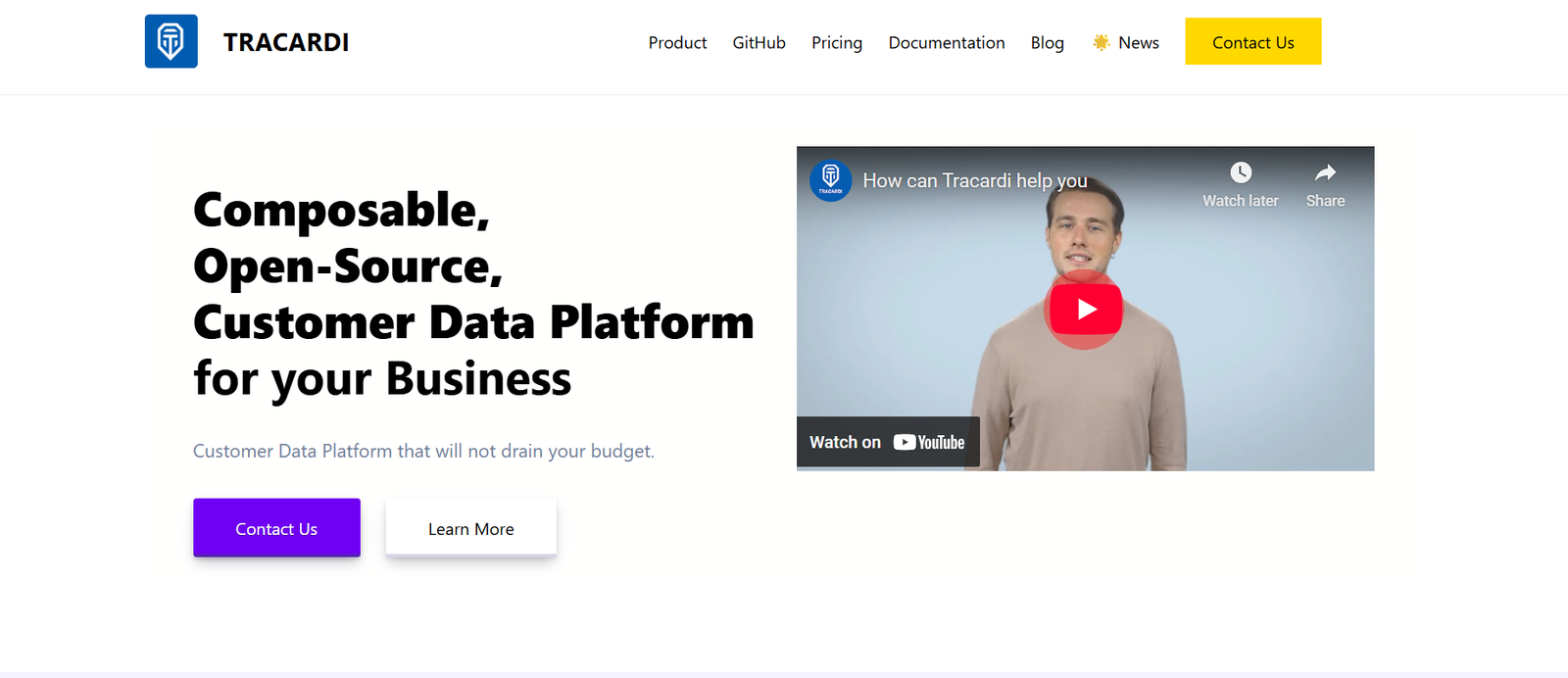
Tracardi is an open-source Customer Data Platform (CDP) designed to help businesses collect, unify, analyze, and act on customer data in real time. Built for developers, marketers, and digital experience teams, Tracardi allows you to capture customer behavior across touchpoints, build unified profiles, and automate workflows based on user intent and behavior.
Unlike traditional CDPs, Tracardi is developer-friendly, self-hosted, and extensible, offering full control over customer data pipelines, integrations, and processing. It’s a flexible solution for companies looking to own their data infrastructure while delivering personalized experiences at scale.
Tracardi stands out by combining real-time tracking, customer journey orchestration, and event-driven automation in one platform—without locking you into a proprietary ecosystem.
Features
Tracardi offers a comprehensive set of features designed to manage and activate customer data in real time.
The platform includes real-time event tracking, allowing businesses to capture customer actions across websites, apps, and systems. Events are ingested instantly, enabling immediate response and personalization.
With profile unification, Tracardi merges customer identities from multiple sources into a single customer view, including anonymous and known users, enabling accurate targeting and segmentation.
Tracardi’s workflow automation engine allows users to create behavior-driven flows such as welcome sequences, abandoned cart reminders, or dynamic content rendering based on customer interactions.
The platform supports third-party integrations with tools like ElasticSearch, Redis, Kafka, and external APIs, making it suitable for enterprise-scale deployments.
Other key features include data segmentation, data anonymization, multi-channel messaging, real-time analytics, customer scoring, and event replay for debugging and QA.
How It Works
Tracardi works as a backend data processing engine that collects and reacts to customer activity in real time. It starts by embedding tracking scripts or API connectors into websites, mobile apps, or back-end systems.
As users interact with your brand—by browsing a product, signing up for a newsletter, or abandoning a cart—Tracardi logs these actions as events.
These events are then linked to user profiles, which evolve with every interaction. Tracardi enriches profiles with additional data sources such as CRM, marketing platforms, or third-party APIs.
Users can then build automated workflows based on these profiles and actions. For example, if a customer views a specific product three times without buying, Tracardi can trigger a discount email via an external integration.
Everything is processed in real time, giving businesses the ability to respond to behavior instantly, personalize content, or update databases and dashboards automatically.
The platform runs on microservices and supports containerization (Docker, Kubernetes), making it easy to deploy, scale, and maintain in modern infrastructure environments.
Use Cases
Tracardi is designed for a wide variety of customer experience and data activation use cases.
Marketing automation teams use it to build dynamic customer journeys based on behavior, such as personalized email campaigns, retargeting ads, or triggered offers.
Developers and engineers use Tracardi to construct real-time data pipelines and build custom integrations with internal systems, CRMs, or analytics tools.
E-commerce companies leverage Tracardi for cart abandonment flows, product recommendations, and behavior-based segmentation for higher conversion rates.
SaaS companies use it to monitor user engagement, onboard new customers, and segment users based on feature usage or subscription status.
Agencies and solution integrators deploy Tracardi as a white-label CDP solution for client projects that require flexibility, compliance, and customization.
Pricing
Tracardi is available as a free, open-source platform under the MIT License. This means businesses can download, install, and self-host the system without paying license fees.
For companies looking for commercial support or ready-made cloud deployments, Tracardi offers paid services, including:
Managed Hosting: Cloud deployment with infrastructure, monitoring, and maintenance handled by the Tracardi team
Enterprise Support: SLA-backed technical support, custom integrations, and onboarding assistance
Consulting and Customization: Professional services for system design, implementation, and scaling
Pricing for these services is customized based on project size, data volume, and support needs. To get a quote or schedule a consultation, users can contact the Tracardi team through https://tracardi.com
Strengths
Tracardi’s open-source nature gives users complete control over their customer data, enabling full compliance with privacy regulations like GDPR and CCPA.
Its real-time processing capabilities enable instant responses to customer actions, which is critical for high-conversion marketing strategies.
The platform’s modular and developer-friendly architecture makes it easy to customize, extend, and integrate into any stack.
Tracardi also supports headless operation, which means it can function as a backend brain while connecting to your existing front-end tools and CRM platforms.
Its low barrier to entry—via free, self-hosted deployment—makes it accessible for startups while being scalable enough for enterprise needs.
Drawbacks
Tracardi is not a plug-and-play solution for non-technical users. Setup, configuration, and deployment require a solid understanding of backend systems and API integration.
The platform lacks a large prebuilt library of integrations compared to some commercial CDPs. Users may need to build custom connectors or workflows.
Because it is self-hosted by default, infrastructure, security, and uptime become the responsibility of your internal DevOps or IT team unless you opt for their managed service.
While documentation exists, the learning curve can be steep for users unfamiliar with CDP concepts or event-based data architectures.
Community support is growing but not as extensive as more mature CDPs or commercial martech platforms.
Comparison with Other Tools
Tracardi can be compared with commercial CDPs like Segment, mParticle, and Tealium, but with a fundamentally different approach.
Compared to Segment, which is a managed SaaS solution with a user-friendly UI, Tracardi is self-hosted and open source, making it better suited for businesses that want full control and customization.
mParticle offers enterprise-scale integrations and analytics, but at a premium price point. Tracardi is more affordable and transparent, especially for teams with technical expertise.
While Tealium focuses heavily on marketing orchestration, Tracardi emphasizes real-time data flow and developer extensibility, appealing to product-led teams and custom-build environments.
Tracardi stands out for teams that need flexibility, transparency, and data ownership, without vendor lock-in.
Customer Reviews and Testimonials
Tracardi is used by developers, digital agencies, and technical marketing teams globally. While the platform does not currently display customer reviews on its homepage, positive feedback is emerging in open-source and devops communities.
Early adopters praise Tracardi for its real-time capabilities, data control, and modular architecture. Many note that it provides enterprise-grade features without the typical enterprise-grade cost.
Community discussions on platforms like GitHub and Reddit highlight the platform’s customization potential and speed of development, particularly for teams building their own digital experience stacks.
As adoption grows, more formal case studies and testimonials are expected to become available on community forums, GitHub, and review platforms.
Conclusion
Tracardi is a powerful, open-source customer data platform that enables real-time data capture, profile building, and automation. Its self-hosted model and modular architecture make it ideal for developers and businesses that prioritize control, customization, and scalability.
While it requires technical expertise to deploy and manage, the platform offers exceptional flexibility and value for organizations that want to build personalized customer experiences on their own terms.
For companies seeking a transparent, privacy-compliant, and extensible CDP alternative to SaaS offerings, Tracardi is a strong contender in the data-driven marketing and automation space.


