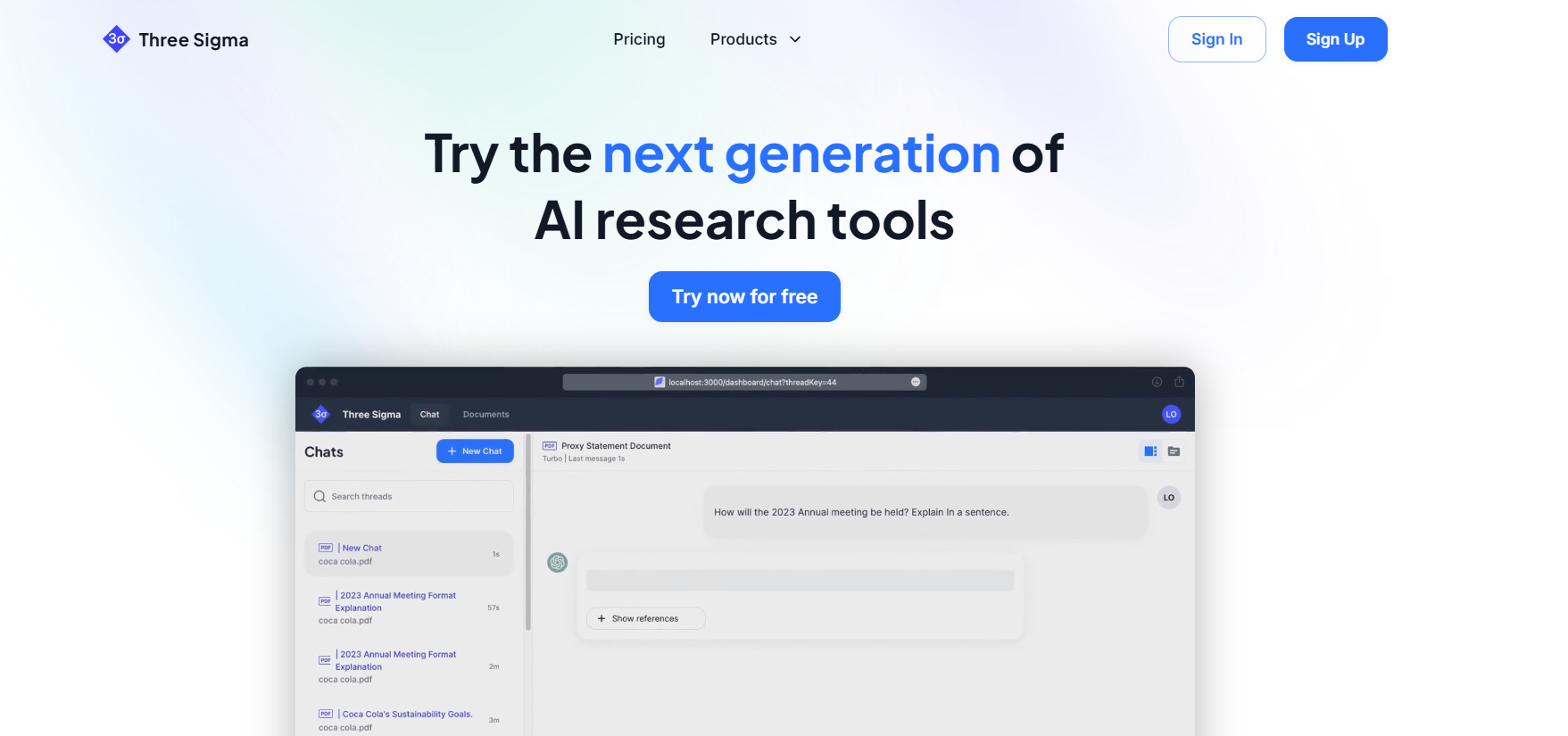
Three Sigma is an AI platform that develops autonomous agents capable of real-time reasoning, decision-making, and execution. Built to automate complex workflows across business functions, Three Sigma enables organizations to replace static automations with dynamic, AI-powered agents that can understand context, learn from outcomes, and act accordingly.
Designed for developers, operations teams, and enterprise leaders, Three Sigma helps businesses build AI agents that integrate with existing systems and adapt continuously. These agents go beyond traditional bots or rules-based automations by applying reasoning, memory, and live feedback loops. The result is a faster, more flexible approach to scaling operations and delivering value across customer support, data handling, back-office functions, and more.
Features
Autonomous AI Agents: Build agents that operate independently and intelligently across workflows using real-time data.
Live Reasoning Engine: Enables agents to make contextual decisions in dynamic environments, unlike rigid automation scripts.
Integrated Memory: Agents maintain memory of past actions and context, which helps them learn over time and improve performance.
Multi-Agent Collaboration: Supports the deployment of multiple agents that can communicate and collaborate to solve complex tasks.
No-Code & Developer-Friendly Tools: Offers tools for both technical and non-technical users to deploy and monitor agents.
System Integration: Connects seamlessly with APIs, databases, CRMs, and communication platforms.
Scalable Architecture: Agents can operate across business units and scale with demand, ensuring enterprise readiness.
How It Works
Three Sigma operates by letting users deploy autonomous agents that interact with systems and data sources in real time. These agents are configured using natural language prompts or code-based setups, depending on the user’s technical background.
Once deployed, the agents process inputs (such as support tickets, CRM data, or customer interactions), analyze context, access historical memory, and make decisions. They then execute tasks such as sending emails, updating records, or flagging exceptions.
The platform provides dashboards for monitoring agent behavior, adjusting parameters, and measuring performance. Developers can define triggers and conditions, while non-technical users can build workflows using a visual interface.
Three Sigma also supports multi-agent deployments, where agents share insights or divide tasks to improve execution speed and accuracy.
Use Cases
Customer Support Automation: Agents can handle tickets, triage messages, and resolve issues across channels like email and chat.
Sales and CRM Updates: Automatically update lead information, follow up with prospects, and sync data across tools.
Back-Office Operations: Handle recurring workflows like data entry, document processing, and approval routing.
Monitoring and Alerts: Agents can monitor dashboards, detect anomalies, and escalate incidents as needed.
Data Enrichment: Pull relevant data from external APIs and enrich internal records for sales, support, or analytics.
Finance & Procurement: Automate invoice processing, vendor communications, and approval flows.
Pricing
Three Sigma does not display public pricing on its website as of the current version. Pricing likely varies based on the scale of deployment, number of agents, and enterprise needs.
Interested businesses can book a demo or contact sales through the official website to receive a customized quote. This flexible pricing model is typical for AI platforms tailored to enterprise-grade solutions.
Strengths
True Autonomy: Unlike typical RPA tools or chatbot platforms, Three Sigma agents operate with contextual awareness and memory.
Enterprise-Ready Scalability: Designed to scale across departments and systems.
Developer + No-Code Access: Supports both engineers and business users in deploying solutions.
Integration Flexibility: Compatible with a wide range of business tools, APIs, and data systems.
Real-Time Adaptability: Agents learn and adjust behaviors based on evolving inputs.
Drawbacks
No Transparent Pricing: Lack of public pricing can be a barrier for small businesses or startups.
Requires Technical Setup for Advanced Use: While a no-code option is available, complex workflows may require development resources.
Limited Public Reviews: Being a newer or enterprise-focused solution, Three Sigma lacks widespread third-party user feedback.
Still Evolving: As a cutting-edge platform, some features may still be in development or limited in documentation.
Comparison with Other Tools
Three Sigma is part of a new generation of AI automation platforms that go beyond traditional Robotic Process Automation (RPA) tools like UiPath, Automation Anywhere, or Blue Prism. While those tools rely heavily on rules and static flows, Three Sigma’s agents reason, adapt, and make decisions on their own.
Compared to AI agent development platforms like LangChain, AutoGPT, or CrewAI, Three Sigma is more business-oriented and structured for enterprise deployments. It emphasizes real-time performance, system integration, and governance—areas that hobbyist or open-source agent frameworks typically leave to users to build themselves.
Whereas platforms like Zapier or Make offer conditional automation, Three Sigma offers cognitive automation with memory, reasoning, and autonomy, making it better suited for complex, evolving workflows.
Customer Reviews and Testimonials
As of the time of writing, Three Sigma does not showcase customer testimonials directly on its homepage, nor are there significant numbers of third-party reviews available on directories like G2, Capterra, or Product Hunt.
However, the website does include case study-style narratives and blog posts indicating real-world use across customer service, internal ops, and data workflows. Interested users are encouraged to request a demo or explore use cases with the team to better understand real-world applications.
Conclusion
Three Sigma is a forward-looking AI automation platform that enables businesses to go beyond static workflows by deploying truly autonomous agents. These agents bring contextual intelligence, adaptability, and collaboration to business operations, allowing for faster execution, fewer manual interventions, and scalable results.
For organizations aiming to streamline processes in real time without relying on rigid rule-based systems, Three Sigma offers a compelling solution. Though still maturing and best suited for enterprise or mid-market clients, its blend of AI reasoning, real-time execution, and seamless integration marks it as a standout platform in the future of AI-driven business automation.
Businesses looking to embrace AI agents for smarter operations should consider evaluating Three Sigma as a robust, scalable option.