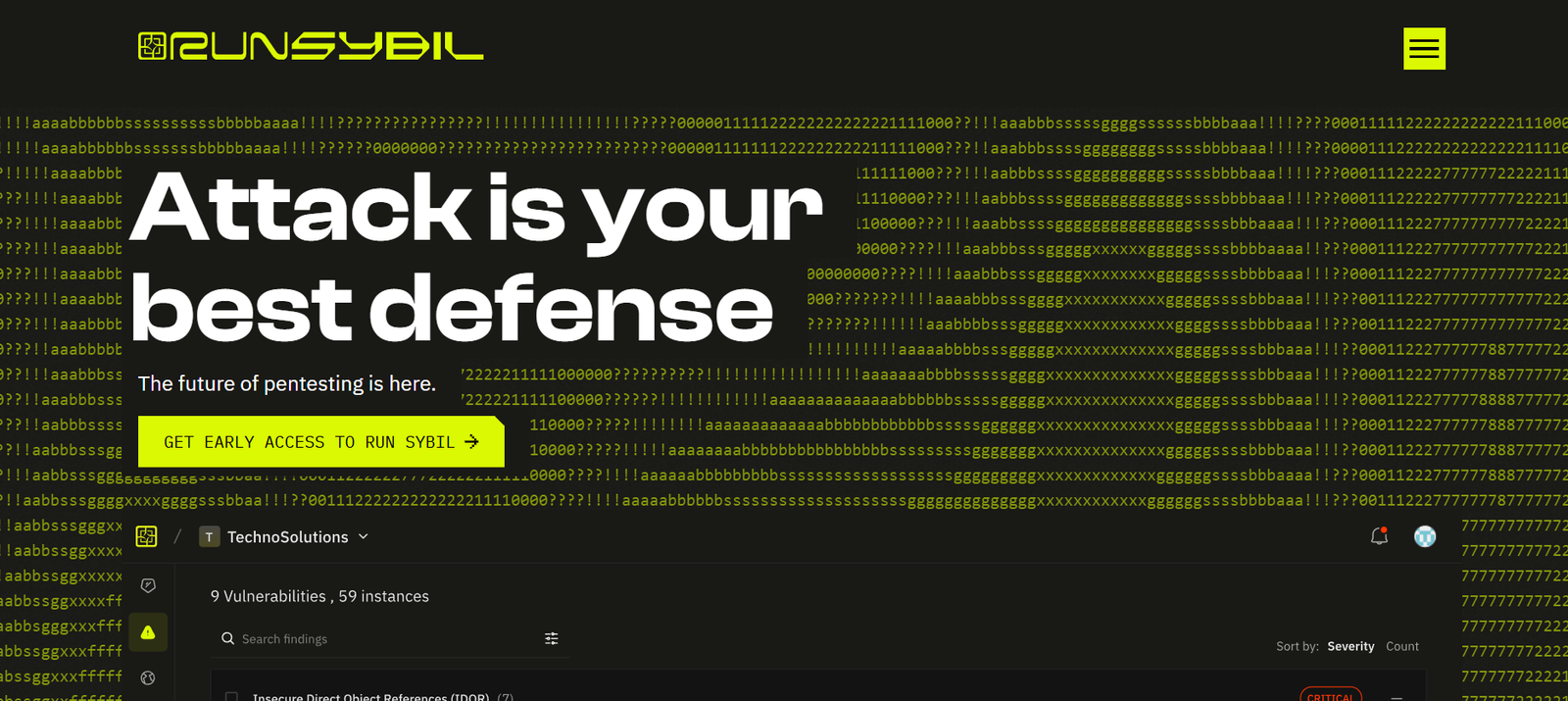
Sybil is a cutting-edge AI agent testing and evaluation platform designed for teams building with large language models (LLMs). As AI agents and autonomous LLM-driven applications become more complex, the need for robust, scalable, and repeatable testing grows. Sybil provides a framework for automatically simulating tasks, evaluating agent performance, and refining prompts or code based on empirical results.
With its focus on automated evaluation at scale, Sybil is ideal for developers and product teams building AI copilots, autonomous agents, and retrieval-augmented generation (RAG) systems. It gives users the tools to identify failure modes, benchmark against baselines, and iterate rapidly—all in a reproducible environment.
Features of Sybil
Multi-Agent Test Simulations
Run automated simulations where agents interact with other agents or tasks. Sybil helps you recreate real-world scenarios to observe agent behavior and decision-making.
Automated Evaluation Metrics
Define success criteria and measure agent outputs using built-in or custom evaluation functions, such as task completion rate, latency, coherence, or factual accuracy.
Prompt and Policy Testing
Compare different prompt styles, agent configurations, or decision policies across controlled simulations.
Version Control for Agent Logic
Track versions of agents, prompts, or code to measure performance differences over time and ensure reproducibility.
Synthetic Task Generation
Use templates or programmatic tools to generate diverse, realistic tasks for evaluation without relying solely on human labeling.
OpenAI and Claude Integration
Test agents built with OpenAI (GPT-4, GPT-3.5) or Anthropic (Claude 2, Claude 3) models directly within the Sybil environment.
Web-Based UI and API Access
Access Sybil through a user-friendly dashboard or via API for automated workflows and CI/CD integrations.
Insightful Reporting
Get visual summaries, performance trends, and logs of agent interactions to support debugging and iterative development.
How Sybil Works
Define the Agent and Task
Upload or connect the agent logic (e.g., a chatbot, decision-making policy, or LLM prompt) and define the task(s) to simulate.Simulate the Interaction
Run large batches of simulations where your agent performs tasks against synthetic users, other agents, or defined scenarios.Evaluate and Score
Apply custom metrics or use Sybil’s built-in evaluation tools to assess agent behavior, accuracy, and success rates.Analyze Results
Review detailed logs, visualize performance over multiple test rounds, and identify regression issues or improvement opportunities.Iterate and Re-Test
Modify agent logic, tweak prompts, or adjust parameters, then re-run tests to see if changes yield better performance.
Use Cases for Sybil
LLM Agent Development
Evaluate agents built to perform tasks like scheduling, summarizing, or navigating complex instructions.
Copilot Testing
Test the reliability of in-product copilots in SaaS tools or developer environments by simulating user interactions at scale.
Prompt Engineering Validation
A/B test prompt variations to identify which versions lead to more reliable or accurate outputs.
RAG System Evaluation
Benchmark retrieval-augmented generation pipelines by testing how well the agent uses retrieved knowledge.
AI Startup and Research Teams
Accelerate iteration by identifying failure cases and performance ceilings using structured experiments.
Enterprise AI QA
Enterprises deploying LLMs for customer service, automation, or decision support can validate safety, reliability, and alignment of models.
Pricing of Sybil
As of June 2025, Sybil does not publicly list fixed pricing tiers. Pricing appears to be customized based on factors such as:
Number of test runs per month
Size and complexity of agent tasks
Team size and collaboration needs
Model usage (e.g., OpenAI or Anthropic API volume)
Support and enterprise features
To get pricing details, users are encouraged to book a demo or contact the Sybil team via https://www.runsybil.com.
Strengths of Sybil
Purpose-built for testing and improving LLM-based agents
Automated, reproducible, and scalable test simulations
Great for research-driven or product-centric development teams
Integrates easily with OpenAI and Anthropic models
Encourages rigorous, metric-driven evaluation
Streamlines iteration cycles for agents and prompts
Supports custom test designs and synthetic data generation
Drawbacks of Sybil
No self-serve free tier available for casual users or solo developers
Requires familiarity with prompt engineering or agent logic to set up meaningful tests
Lacks out-of-the-box integrations with some open-source frameworks (e.g., LangChain or AutoGPT)
Still evolving—may lack features expected in traditional software QA platforms
Custom pricing may be a barrier for early-stage teams
Comparison with Other Tools
Sybil vs. LangSmith (by LangChain)
LangSmith provides observability for agent chains and traces, while Sybil focuses more on structured simulation and performance evaluation.
Sybil vs. HumanEval / Big-Bench
Benchmarks like HumanEval test model accuracy in programming or language tasks. Sybil enables customizable, real-world simulations for application-specific agents.
Sybil vs. PromptLayer
PromptLayer offers logging and prompt tracking. Sybil builds on that with simulations, evaluation metrics, and result comparison.
Sybil vs. Trulens
Trulens supports RAG evaluation and feedback loops. Sybil provides a more comprehensive, simulation-based testbed for any type of agent task.
Customer Reviews and Testimonials
Though still emerging, Sybil is gaining traction among LLM-focused teams for its unique approach to AI quality assurance:
“Sybil gives us the structure we need to test AI agents like we would any other software—at scale, with reproducibility.” – Founding Engineer, AI SaaS Startup
“We were able to benchmark four agent architectures across hundreds of tasks in one afternoon. It’s a game-changer.” – AI Researcher
“Before Sybil, we didn’t know how to measure improvements to our copilot. Now we can iterate with confidence.” – Product Manager, Developer Tools Company
Early adopters highlight Sybil’s value in bringing rigor and metrics to a space where experimentation has often been ad hoc.
Conclusion
As LLM-based applications grow in complexity and ubiquity, the need for structured, repeatable, and scalable testing becomes critical. Sybil fills this gap by offering an advanced platform for agent simulation, evaluation, and iterative improvement.
For AI teams building next-generation copilots, assistants, or automation agents, Sybil provides the infrastructure to move from guesswork to data-driven development—ensuring better performance, safety, and reliability.