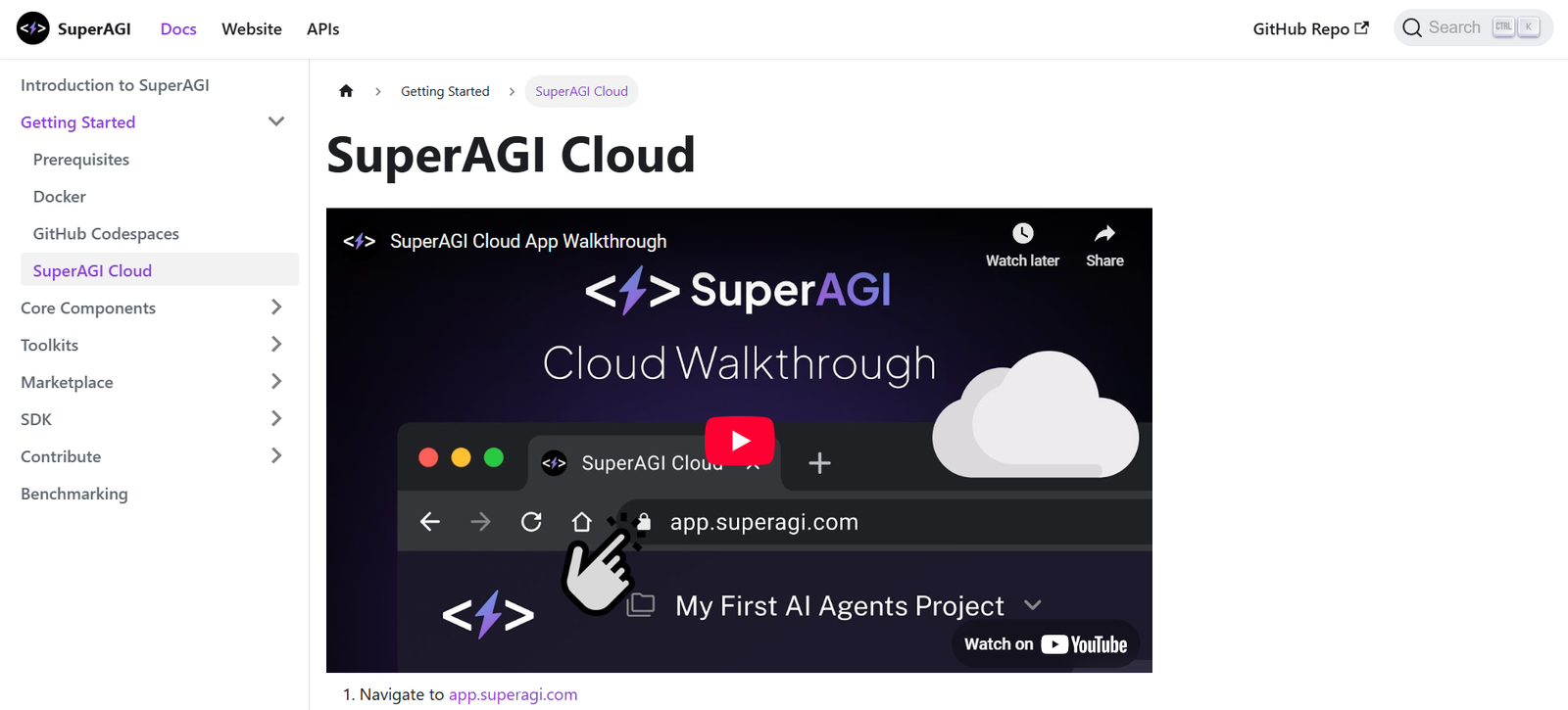
SuperAGI is an open-source platform for building, deploying, and managing autonomous AI agents. Developed to provide flexibility and scalability, SuperAGI is designed for developers, AI researchers, and enterprises seeking to leverage large language models (LLMs) in powerful, agent-based architectures.
Unlike traditional LLM wrappers or chatbots, SuperAGI enables autonomous behavior, allowing agents to operate independently, make decisions, use tools, and interact with external systems. It provides a modular framework where developers can plug in different LLMs, tools, memory modules, and vector databases to create multi-step task agents.
With growing interest in autonomous AI, SuperAGI stands out as one of the most versatile and developer-friendly options for building production-ready agent ecosystems.
Features of SuperAGI
Open Source and Extensible
SuperAGI is fully open-source (licensed under MIT), allowing customization and community-driven contributions. Developers can fork, extend, and deploy agents on their own infrastructure.
Multi-Model Support
Supports integration with OpenAI, Google Gemini, Hugging Face models, and more. Easily switch between models or use multiple LLMs across different agents.
Autonomous Agent Execution
Agents can independently plan and perform sequences of tasks. They use toolkits and memory to make decisions in real time based on goals.
Tool Usage and Plugins
Includes built-in tools like web browsing, file handling, email, and API calls. Users can also create and register custom tools.
Memory and Persistence
Agents can retain memory between tasks using vector databases such as Pinecone, Weaviate, and Redis. This allows agents to learn over time and maintain context.
Web UI for Agent Management
A clean, browser-based dashboard allows developers to create, launch, and monitor multiple agents simultaneously.
Agent Prompt Configuration
Control agent behavior through prompt engineering, role assignment, goal definition, and performance tuning.
Concurrent Multi-Agent Execution
Run multiple agents in parallel and allow them to collaborate on complex workflows or split responsibilities.
Telemetry and Logs
Real-time execution logs, event tracking, and error handling help in debugging and optimizing agent behavior.
How SuperAGI Works
Installation
Clone the SuperAGI GitHub repo or use Docker to run the framework locally or in the cloud.Configure Your Agent
Define goals, select an LLM provider, assign tools, and configure memory modules. Use YAML or the visual dashboard.Deploy the Agent
Launch your agent with a single command or via the UI. The agent begins working toward its defined goals autonomously.Track and Refine
Use the Web UI to observe each step the agent takes. Adjust tools, prompts, or configurations to improve task accuracy and performance.Integrate and Scale
Connect to APIs, databases, CRMs, or external tools for production workflows. SuperAGI supports both development and production environments.
Use Cases for SuperAGI
Automated Research Assistants
Create agents that browse the web, summarize documents, and compile insights for market research or academic tasks.
Workflow Automation
Design multi-step processes where agents handle data entry, content generation, email drafting, and API interactions.
Customer Support Automation
Build agents that respond to tickets, fetch relevant data, and resolve issues using internal documentation.
Content Creation
Enable agents to write blogs, generate SEO metadata, schedule social posts, and track engagement data.
Data Aggregation and Analysis
Agents can pull information from multiple sources, clean data, and produce summaries or visualizations.
DevOps Automation
Trigger scripts, check logs, monitor systems, and even manage deployments using autonomous agents.
Pricing of SuperAGI
SuperAGI is completely open source and free to use under the MIT license. You can self-host the platform and use all features without cost.
However, external services like:
LLM API usage (e.g., OpenAI, Gemini),
Vector databases (e.g., Pinecone, Weaviate),
Infrastructure costs (e.g., server hosting, Docker),
are not included and will incur their own charges based on usage.
There is currently no commercial SaaS version or paid license listed on the official SuperAGI site, although managed hosting and enterprise services may be introduced in the future.
Strengths of SuperAGI
Fully open-source and highly customizable
Built for developers looking for production-grade agents
Rich ecosystem of tools, plugins, and memory systems
Web-based dashboard for ease of use
Multi-agent collaboration and concurrency
Active GitHub community and frequent updates
No vendor lock-in—host on your own infrastructure
Drawbacks of SuperAGI
Not beginner-friendly—requires technical knowledge to set up
Lacks pre-built SaaS offering for non-technical users
No native mobile support or chatbot interface for consumers
Maintenance and scalability depend on self-hosting
Rapid development pace may introduce breaking changes
Comparison with Other Tools
SuperAGI vs. Auto-GPT
Auto-GPT is a pioneering agent framework, but SuperAGI offers a more polished UI, better tooling, and multi-agent support out of the box.
SuperAGI vs. LangChain
LangChain provides modular LLM building blocks but not an out-of-the-box autonomous agent framework. SuperAGI is more opinionated and ready for deployment.
SuperAGI vs. AgentGPT
AgentGPT is more focused on browser-based agent demos. SuperAGI is better suited for production use, with memory, tools, and logging.
SuperAGI vs. OpenAI Assistants API
OpenAI’s Assistants API is SaaS-first with deep GPT-4 integration but lacks autonomy and tool/plugin extensibility seen in SuperAGI.
Customer Reviews and Community Feedback
SuperAGI has quickly gained popularity on GitHub and AI developer forums. It has over 15,000 stars on GitHub (as of June 2025) and has been highlighted on platforms like Product Hunt.
“SuperAGI is the most complete open-source agent framework I’ve tested. Excellent documentation and active updates.” – AI Engineer
“We’re using SuperAGI in a production automation workflow. Setup was fast and the modularity is top-notch.” – CTO, AI Startup
“The ability to run multiple agents in parallel and use tools like web browsing is a game-changer.” – Independent Developer
Community support is primarily available through SuperAGI’s GitHub repository and Discord.
Conclusion
SuperAGI offers a compelling solution for building autonomous AI agents with full control, transparency, and scalability. Its open-source architecture makes it ideal for developers and enterprises looking to deploy LLM-powered agents without being locked into commercial platforms.
If you’re developing AI-powered workflows or intelligent assistants that need to interact with external systems, SuperAGI provides the flexibility, power, and extensibility you need—all under an open license.