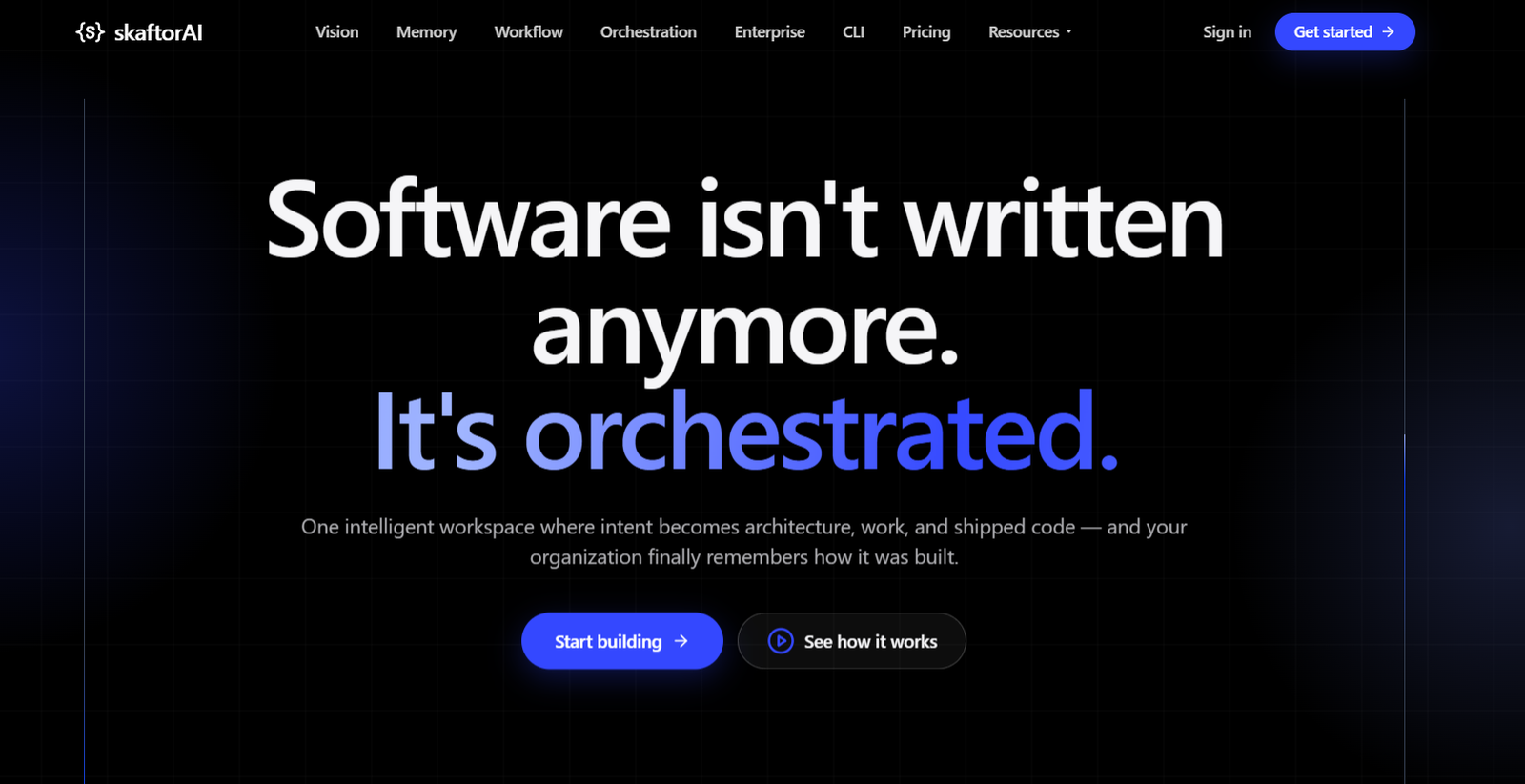
Skaftor AI is an AI-native software delivery platform designed to help engineering organizations manage the complete journey from a business requirement to production code.
Instead of functioning as another AI coding assistant, Skaftor sits around the development process. Teams describe what they want to build, and the platform turns that intent into structured requirements, architecture blueprints and executable work orders. AI coding agents such as Cursor and Claude Code can then pick up those work orders and implement the required code.
A major part of Skaftor is organizational memory. Product requirements, technical decisions, repositories, features, people and deployed changes are connected through a knowledge graph. This allows future developers and AI agents to understand not only what was built, but why particular decisions were made.
Skaftor also emphasizes governance. AI-generated changes can pass through approval workflows, impact analysis and specification checks before reaching production. Every step remains connected to the original requirement, creating a traceable record from initial intent to deployed software.
The platform is mainly intended for engineering organizations, CTOs, engineering managers and platform teams adopting AI coding agents at scale.
Features
AI Requirements Generation
Teams can begin with a product or business intent rather than a detailed technical specification.
Skaftor AI helps transform that intent into structured requirements that can be reviewed and refined before development begins.
Architecture Blueprints
Once requirements are established, Skaftor can turn them into architecture blueprints.
These blueprints map elements such as services, data and interfaces, helping create a technical structure before AI agents start writing code.
Work Orders
Large requirements are divided into smaller executable work orders.
Each work order can contain the context needed by the coding agent, including the repository, branch, service and relevant technical information.
This creates a more structured alternative to repeatedly giving coding agents independent prompts.
AI Agent Orchestration
Skaftor orchestrates coding agents rather than replacing them.
Work orders can be dispatched to supported coding agents such as Cursor and Claude Code through MCP. Agents implement the work, open pull requests and report their status back to Skaftor.
Agent-Agnostic Architecture
The orchestration layer is designed so teams are not completely dependent on one coding agent.
Supported agents can operate through the same MCP based workflow, allowing organizations to use different AI coding systems according to their requirements.
Organizational Memory
Skaftor maintains a persistent record of software decisions and project context.
This addresses a common problem with AI coding conversations: once a chat ends, important reasoning can become difficult to recover.
Knowledge Graph
Features, repositories, decisions, people and other software artifacts are linked through a knowledge graph.
This gives both humans and AI agents access to relationships across the engineering environment.
Shared Agent Context
AI agents can work from shared organizational context rather than starting every new task from a blank conversation.
This can help maintain greater consistency across multiple agents and development sessions.
Impact Analysis
Skaftor can examine the potential impact of a proposed change before implementation.
This helps engineering teams understand which services, features or other parts of the system could be affected.
Duplicate Detection
The platform can identify work that may already exist elsewhere in the organization.
This is useful for larger engineering environments where different teams may unknowingly attempt to build similar functionality.
Specification Governance
Skaftor treats specifications as an active part of software delivery rather than static documents.
Requirements can be linked with checks that determine whether the implemented code continues to match the intended specification.
Specification Drift Detection
When a requirement changes, Skaftor can identify checks that are tied to the previous version of the requirement.
Those checks can be marked as stale until the implementation has been verified against the new intent.
Requirement Coverage
The platform can show whether individual requirements are protected by appropriate validation gates.
Requirements without sufficient coverage can be identified instead of silently remaining unverified.
Approval Workflows
Organizations can require human approval before AI-generated changes progress through important stages.
A typical change can move through proposed, reviewed, approved and deployed states.
Role-Based Access Control
Permissions can be configured according to team, project and environment.
This is particularly important when AI agents are capable of interacting with real repositories and production workflows.
Audit Trail
Skaftor provides append-only records of development actions.
Organizations can track who proposed, reviewed, approved and deployed a change and when each action occurred.
AI Cost Visibility
Skaftor tracks AI costs according to areas such as team and feature.
This can help engineering leaders understand how much AI-assisted software development is costing across the organization.
CLI
Developers can work with Skaftor directly from their terminal.
The CLI allows users to access project context, retrieve work orders, start tasks, synchronize work and interact with delivery tools without constantly switching to a web interface.
MCP Support
Skaftor uses Model Context Protocol as part of its agent orchestration architecture.
A per-project MCP server helps coding agents receive structured project context and interact with Skaftor’s workflow.
Development Integrations
Skaftor works with existing software development and knowledge tools.
The official website currently highlights integrations with platforms and environments including GitHub, GitLab, Bitbucket, Cursor, Claude, Codex, Jira, Linear, Notion, Confluence, Google Cloud and Azure.
How It Works
Step 1: Connect existing tools
Bring repositories, documentation and development tools into the Skaftor workspace.
Step 2: Describe the intent
Explain the feature, change or business outcome the team wants to achieve.
Step 3: Generate requirements
Skaftor AI converts the intent into structured requirements that the team can review and refine.
Step 4: Create the architecture blueprint
The platform maps the required services, data and interfaces.
Step 5: Generate work orders
The plan is divided into executable tasks that can be assigned to developers or AI coding agents.
Step 6: Dispatch coding agents
Supported agents receive structured work orders containing the context required to perform the task.
Step 7: Generate the code
The coding agent works within the relevant repository and branch and creates the implementation.
Step 8: Open and review the pull request
Changes are submitted through the development workflow and evaluated against the architecture and requirements.
Step 9: Apply approval gates
Required reviewers or engineering managers approve changes before they progress toward production.
Step 10: Deploy
Approved code moves into production while retaining a traceable connection with its original requirement.
Step 11: Observe
Production signals can feed back into the system and inform future development decisions.
Use Cases
CTOs
CTOs can use Skaftor to establish governance around AI-assisted software development while gaining visibility into architecture, engineering activity and AI costs.
Engineering Managers
Engineering managers can convert requirements into structured work orders and monitor how work moves through AI agents, reviews and deployments.
Software Development Teams
Developers can continue using familiar coding agents while receiving better structured project context and work assignments.
Platform Engineering Teams
Platform teams can use Skaftor to create consistent AI development workflows across multiple repositories, teams and services.
Enterprise Software Development
Large organizations can use shared memory and governance to coordinate AI-assisted development across complicated software environments.
Regulated Businesses
Approval workflows, audit trails and requirement traceability can be useful for organizations where software changes require stronger oversight.
Multi-Agent Development
Organizations using several AI coding agents can provide them with shared project context rather than maintaining isolated conversations with each agent.
Legacy Software
Knowledge graphs and decision history may help teams understand why existing systems were designed in particular ways before making new changes.
Distributed Engineering Teams
Teams working across locations can maintain a shared source of context covering product intent, architecture and development decisions.
Pricing
Skaftor currently provides Pro and Enterprise plans.
Pro
The Pro plan costs $99 per seat per month.
It includes:
Unlimited projects and features
AI requirements and architecture blueprints
Work orders and agent orchestration
Cursor, Claude Code and MCP workflows
Organizational memory and knowledge graph
Repository intelligence
Impact analysis and duplicate detection
Integrations with development and knowledge tools
AI cost visibility by team and feature
Up to 20 seats
The plan can be cancelled at any time.
Enterprise
Enterprise pricing is customized according to organizational requirements.
It includes everything available in Pro plus:
SSO and SAML
SCIM provisioning
Advanced role-based access
Approval workflows
Append-only exportable audit logs
Keyless cloud connections
Self-hosting options
Dedicated support with an SLA
Custom onboarding and integrations
Unlimited seats
Organizations need to request a quote for Enterprise pricing.
Strengths
Skaftor addresses a broader problem than code generation. It manages how AI-generated software moves from business intent through architecture, implementation, review and production.
Persistent organizational memory can reduce the loss of technical reasoning that occurs when important decisions remain buried inside chat conversations.
The knowledge graph gives AI agents access to relationships between requirements, features, repositories and decisions.
Structured work orders provide agents with more controlled instructions than isolated natural-language prompts.
Agent-agnostic orchestration allows organizations to continue using established coding agents instead of replacing them with a proprietary code generator.
Impact analysis and duplicate detection can be valuable for larger engineering organizations with complicated codebases.
Approval workflows, RBAC and audit trails provide stronger governance for businesses allowing AI agents to make real code changes.
AI cost tracking can help engineering leaders understand the financial impact of agent-assisted development.
Drawbacks
Skaftor is designed for software organizations and provides little value to users who simply need an AI coding assistant for occasional programming tasks.
At $99 per seat per month, the Pro plan may be relatively expensive for individual developers and very small teams.
The platform adds another layer to the software development workflow, so teams need to integrate Skaftor with repositories, documentation systems, coding agents and project management tools.
The effectiveness of organizational memory and impact analysis will depend partly on the quality and completeness of the information connected to the platform.
AI-generated code still requires appropriate testing and human review. Structured orchestration does not eliminate the possibility of coding errors or incorrect AI decisions.
Some of the platform’s strongest advantages become more valuable in larger organizations, meaning smaller development teams may not require its complete governance and memory architecture.
Comparison with Other Platforms
Skaftor differs from AI coding assistants such as Cursor, GitHub Copilot and Claude Code because it is not primarily trying to replace them.
Those tools generally help developers generate and modify code. Skaftor operates at a higher organizational level by deciding what work needs to happen, supplying agents with structured context, governing the resulting changes and preserving the history behind them.
It also differs from traditional project management platforms. Tools such as Jira and Linear organize development tasks, while Skaftor attempts to connect requirements directly with architecture, AI agent execution, pull requests and deployment.
Another important distinction is organizational memory. Instead of allowing product decisions, architecture and AI conversations to remain scattered across different systems, Skaftor connects them through a persistent knowledge graph.
For teams already using AI coding assistants heavily, Skaftor can therefore function as an orchestration and governance layer around those existing tools.
Customer Reviews and Testimonials
Skaftor presents feedback from design partners on its official website.
Published examples include senior technology leaders from organizations such as 99minds, Xeni and GoBolt.
The feedback highlights areas such as preserving the reasoning behind software changes, understanding the impact of modifications across interconnected systems and maintaining stronger governance for compliance-sensitive software.
These testimonials are published directly by Skaftor and should therefore be considered company-presented feedback rather than independent third-party reviews.
Conclusion
Skaftor AI is an ambitious software delivery platform designed for a future where developers increasingly direct AI agents rather than manually writing every line of code.
Its value is not simply faster code generation. Skaftor attempts to connect the entire software lifecycle, beginning with business intent and moving through requirements, architecture, work orders, AI agent implementation, pull requests, approvals and production deployment.
Persistent organizational memory is particularly important. As more development work moves through AI agents, businesses need a way to preserve why decisions were made instead of losing that knowledge inside temporary AI conversations.
Skaftor is best suited to CTOs, engineering managers, platform teams and software organizations already using or planning to use AI coding agents at meaningful scale.
Individual developers who simply want faster coding assistance may find dedicated coding tools more appropriate. Larger teams concerned about coordination, traceability, architecture and governance may find Skaftor’s approach considerably more relevant.
Overall, Skaftor represents a shift from using AI merely to write code toward using AI to orchestrate software delivery while humans retain oversight of intent, architecture and production decisions.