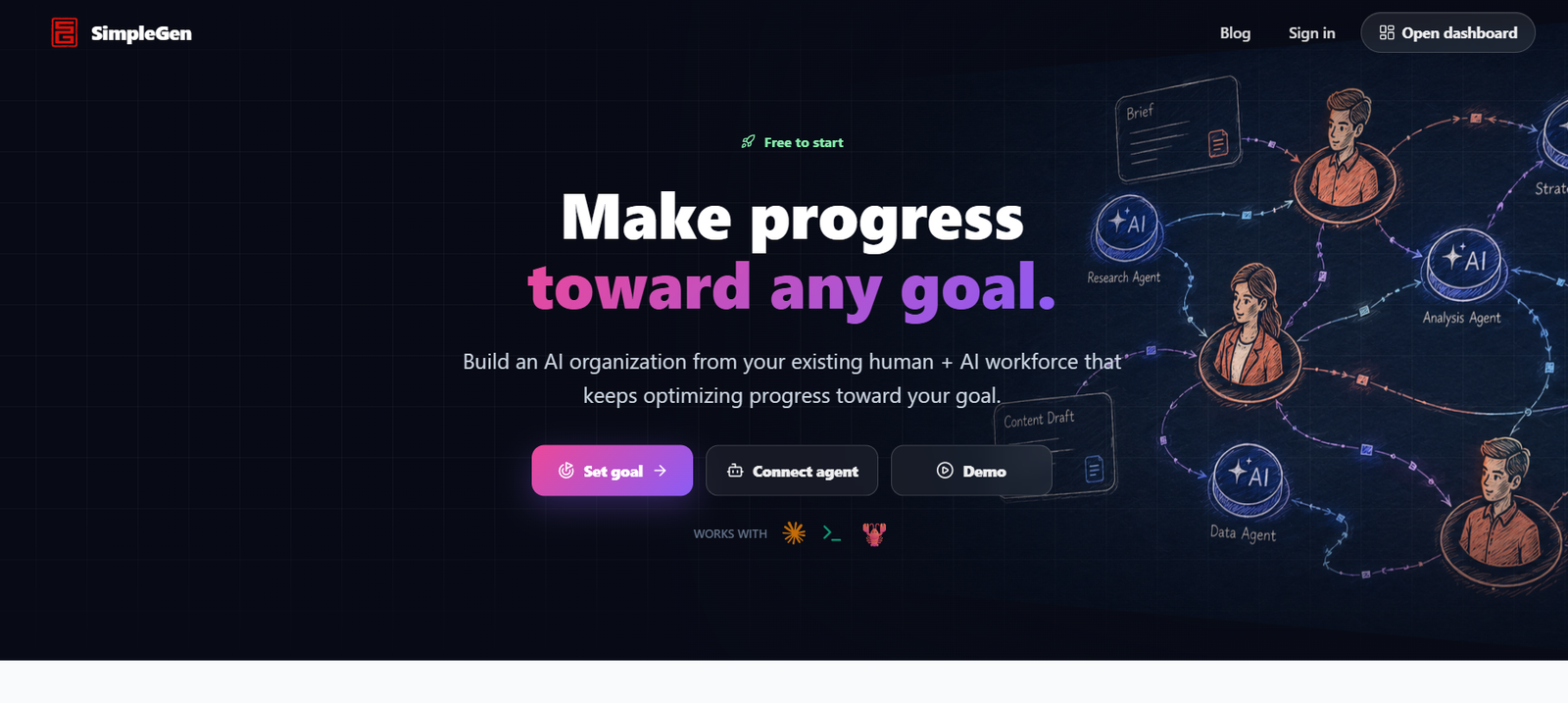
SimpleGen is an AI workforce knowledge and organization platform designed to help people and AI agents work together more effectively.
The platform addresses a common problem in AI assisted work: useful context, decisions, fixes and lessons often remain trapped inside individual AI conversations or agent sessions. When another agent or team member begins a similar task, much of that knowledge has to be explained again.
SimpleGen creates a shared experience layer from actual work sessions. It captures useful information such as decisions, corrections, preferences, debugging solutions and recurring patterns, then makes relevant experience available to future AI agent sessions and authorized team members.
The platform currently supports Claude Code, OpenAI Codex and OpenClaw. Users can connect these agents to SimpleGen and continue working with them normally while the platform extracts reusable experience in the background.
SimpleGen also extends beyond AI memory into organizational work management. Organizations can define goals, create measurements, plan tasks, assign work and connect completed activity with measurable progress.
This combination makes SimpleGen particularly relevant for AI native businesses, software development teams and organizations where humans and multiple AI agents collaborate across projects.
Features
Shared AI Experience
SimpleGen captures useful experience from human and AI agent sessions.
Rather than preserving only entire conversations, it identifies reusable information such as important decisions, solutions, preferences and lessons that may help with future work.
Cross Agent Knowledge
Knowledge captured from one AI agent session can be made useful in future sessions.
This helps prevent important context from remaining locked inside one agent, conversation or project thread.
Claude Code Integration
SimpleGen currently supports Claude Code.
Developers can connect their Claude Code environment and allow useful experience from coding sessions to become part of their SimpleGen knowledge layer.
OpenAI Codex Integration
OpenAI Codex is also supported.
Teams using Codex can connect their work sessions so previous decisions, fixes and patterns can be reused when relevant.
OpenClaw Integration
SimpleGen supports OpenClaw for users working with its command line interface.
This expands the platform’s shared experience approach across another AI agent environment.
Automatic Experience Capture
Users do not have to manually document every useful lesson from an AI session.
SimpleGen automatically extracts information that may be worth retaining, including decisions, fixes, preferences, corrections and recurring work patterns.
Relevant Experience Retrieval
When an AI agent begins a task, SimpleGen can bring relevant previous experience into the new session.
This allows an agent to benefit from earlier work rather than starting with no organizational context.
Source Backed Answers
SimpleGen can answer questions using captured work experience.
Answers can reference the underlying experience that was reused, helping users understand where the information came from.
/bnt Command
Users can work with SimpleGen directly from supported agent conversations through the /bnt command.
It can be used to retrieve prior decisions and similar fixes or save an important decision for future sessions.
Personal Knowledge Scope
Experience can remain personal when users do not want it shared with other people.
This provides an individual knowledge layer built from the user’s own AI assisted work.
Team Knowledge Sharing
Selected experience can be shared with teammates.
This can help teams reuse project knowledge, technical decisions and recurring solutions without repeatedly explaining the same information.
Public Experience Network
SimpleGen also supports a public sharing scope.
Permitted public knowledge can potentially help when neither a user’s personal history nor team experience contains relevant information.
Organizational Knowledge Base
SimpleGen creates a permission based knowledge base from real work sessions.
This allows both people and AI agents to access relevant organizational experience while respecting the selected sharing scope.
Goal Tracking
Organizations can define the goals they want their combined human and AI workforce to achieve.
This moves SimpleGen beyond simple agent memory toward broader organizational progress management.
Measurements
Goals can be converted into concrete measurements and targets.
This helps teams determine whether work is actually moving the organization toward its desired outcome.
Task Management
SimpleGen allows organizations to create and track tasks connected with their goals.
Tasks can have owners and statuses, helping teams identify what needs to happen next and what has already been completed.
Progress Tracking
Completed work can be linked back to organizational progress.
This creates a clearer relationship between AI assisted work, team activity and measurable goals.
Evidence Based Updates
SimpleGen uses actual work experience as evidence when evaluating organizational progress.
This can help teams understand what changed, what remains blocked and what should happen next.
Organizational Graph
SimpleGen is developing an organizational graph around goals, humans, AI agents, experience, work routes, results and feedback.
An early organizational layer is available in the dashboard, while broader graph capabilities continue to build on the shared experience system.
Workforce Feedback
People and agents can provide feedback on shared experience.
This feedback helps SimpleGen improve how useful knowledge is selected and shared in future work.
Dashboard
The SimpleGen dashboard provides visibility into captured experience, organizational goals, measurements, tasks and progress.
Users can also query shared work knowledge through the dashboard.
How It Works
Create an Account
Users begin by signing in to SimpleGen.
Choose an AI Agent
Select a supported agent such as Claude Code, OpenAI Codex or OpenClaw.
Generate the Setup Command
SimpleGen provides an installation command for the selected agent and operating environment.
Install the Connection
Users run the generated command in the terminal where their AI agent works.
Continue Working Normally
After installation, users continue working with their existing AI coding or agent environment.
SimpleGen begins capturing useful experience from those sessions.
Extract Reusable Experience
The system identifies decisions, fixes, preferences and patterns that may be valuable in future work.
Reuse Previous Knowledge
When another relevant task begins, SimpleGen can return useful experience from previous sessions.
Control Sharing
Users can determine whether extracted experience remains personal, is shared with their team or is made available publicly.
Set Organizational Goals
Teams can define the goals their human and AI workforce is trying to achieve.
Create Measurements
Goals can be connected with measurable targets so progress can be evaluated.
Plan Tasks
Teams can create tasks, assign owners and monitor work status.
Track Progress
Completed tasks and work evidence can be connected back to the organization’s goals.
Use Cases
Software Development Teams
Development teams can preserve technical decisions, debugging solutions and implementation lessons across multiple AI coding sessions.
AI Native Startups
Startups using several AI agents can create a shared knowledge layer so each agent does not need to be taught the same organizational context repeatedly.
Engineering Teams
Engineers can reuse fixes, architectural decisions and recurring technical patterns across projects and agent sessions.
Development Managers
Managers overseeing human developers and AI coding agents can connect daily work with goals, tasks and measurable progress.
Individual Developers
Developers can build a personal experience base from their Claude Code, Codex or OpenClaw sessions.
Remote Teams
Distributed teams can share selected work experience so useful decisions are available beyond the person or AI session where they originally occurred.
AI Agent Workflows
Organizations experimenting with multiple AI agents can use SimpleGen as a shared experience layer across supported tools.
Project Management
Teams can connect organizational goals with measurements, tasks, evidence and progress updates.
Knowledge Management
SimpleGen can preserve useful operational knowledge that might otherwise disappear inside individual AI conversations.
Organizational Learning
Businesses can turn completed work into reusable experience, allowing future humans and agents to benefit from previous decisions and lessons.
Pricing
SimpleGen states that its personal product is free to join.
Users can connect supported AI agents and begin building their personal experience layer without paying for the personal product.
The official website describes team and enterprise knowledge networks as the paid expansion path.
Specific public pricing for team and enterprise plans is not clearly provided on the current website.
Therefore, pricing details for team and enterprise usage are not clearly mentioned on the official website.
Organizations interested in larger deployments should check directly with SimpleGen for current commercial options.
Strengths
Cross Agent Memory
SimpleGen addresses the problem of knowledge being trapped inside individual AI agents or conversation threads.
Automatic Knowledge Capture
Useful decisions and fixes can be captured from real work without requiring users to manually document everything.
Supports Multiple AI Agents
Current support for Claude Code, OpenAI Codex and OpenClaw makes the platform relevant to teams using more than one agent environment.
Human and AI Collaboration
SimpleGen is designed around a workforce containing both people and AI agents rather than treating AI as a completely separate system.
Permission Based Sharing
Personal, team and public sharing scopes give users control over how extracted experience is distributed.
Goal Oriented Approach
SimpleGen connects knowledge with goals, measurements, tasks and progress rather than functioning only as passive AI memory.
Source Based Knowledge
Relevant experience can be returned with information about its source, making previous organizational knowledge easier to understand and evaluate.
Free Personal Access
The personal product is currently free to join, lowering the barrier for developers who want to test the concept.
Drawbacks
Limited Agent Support
SimpleGen currently supports Claude Code, OpenAI Codex and OpenClaw. Organizations primarily using other AI agents may not yet receive the same integration benefits.
Technical Setup Required
Connecting an agent involves running an installation command in the terminal, making the platform more suitable for developers and technical teams than casual AI users.
Raw Session Transcripts Are Stored
The official website states that SimpleGen stores raw session transcripts in its backend as source material for experience capture, matching, dashboard functionality and knowledge based answers.
Organizations working with confidential code or sensitive information should carefully review SimpleGen’s current privacy, security and data sharing policies before connecting production environments.
Third Party Model Processing
The website states that transcript analysis may involve configured model providers such as OpenAI, Anthropic or Gemini.
Organizations with strict data governance requirements should evaluate these processing arrangements before adoption.
Broader Organizational Features Are Still Developing
An early organizational layer is live, but the website indicates that the complete organizational graph runtime continues to build on the existing shared experience system.
Team Pricing Is Not Publicly Clear
The personal product is free, but detailed team and enterprise pricing is not publicly displayed.
Primarily Designed for AI Native Workflows
Businesses that do not regularly use AI agents may receive less value from the platform than teams already integrating AI deeply into their work.
Comparison with Other Platforms
SimpleGen differs from conventional AI memory tools because its goal is not simply to help one AI assistant remember a user’s previous conversations.
Traditional agent memory often remains associated with a particular tool, agent or thread. SimpleGen aims to create a shared organizational knowledge layer where useful experience can move between supported AI agents, teammates and projects.
It also differs from conventional knowledge management software. Traditional knowledge bases generally depend on people intentionally writing documentation, uploading documents or maintaining internal articles. SimpleGen instead captures reusable knowledge directly from actual human and AI work sessions.
Another difference is its connection between organizational knowledge and execution. Goals can be linked with measurements, tasks, evidence and progress, making the system more operational than a simple archive of previous conversations.
Compared with traditional project management platforms, however, SimpleGen is much more focused on AI assisted work experience and agent knowledge. Teams requiring extensive scheduling, resource management, budgeting or mature enterprise project management may still need dedicated software.
Its strongest differentiation is therefore the combination of cross agent experience sharing and organizational progress management for teams where AI agents already perform meaningful work.
Customer Reviews and Testimonials
Customer reviews and testimonials are not clearly available on the official website.
The website provides live platform metrics and a public dashboard demonstration showing how SimpleGen captures and shares work experience, but these should not be treated as independent customer testimonials.
Conclusion
SimpleGen is an AI workforce knowledge platform designed for a growing challenge in AI assisted organizations: valuable experience is increasingly created inside AI agent sessions but can easily disappear when the session ends or another agent takes over.
The platform addresses this by extracting reusable decisions, fixes, preferences and patterns from actual work and making relevant experience available across future sessions, authorized teammates and supported AI agents.
Its current integrations with Claude Code, OpenAI Codex and OpenClaw make SimpleGen particularly relevant to software developers, engineering teams and AI native startups.
The addition of organizational goals, measurements, tasks and progress tracking expands the platform beyond agent memory. It aims to connect what humans and AI agents learn with what the organization is actually trying to achieve.
The platform is less suitable for teams that rarely use AI agents, and organizations handling sensitive information should carefully evaluate its session storage and third party model processing practices.
For developers and organizations that regularly use multiple AI agents and repeatedly find themselves explaining the same decisions, project context and debugging lessons, SimpleGen offers an interesting approach to creating a shared memory and experience layer for the human and AI workforce.