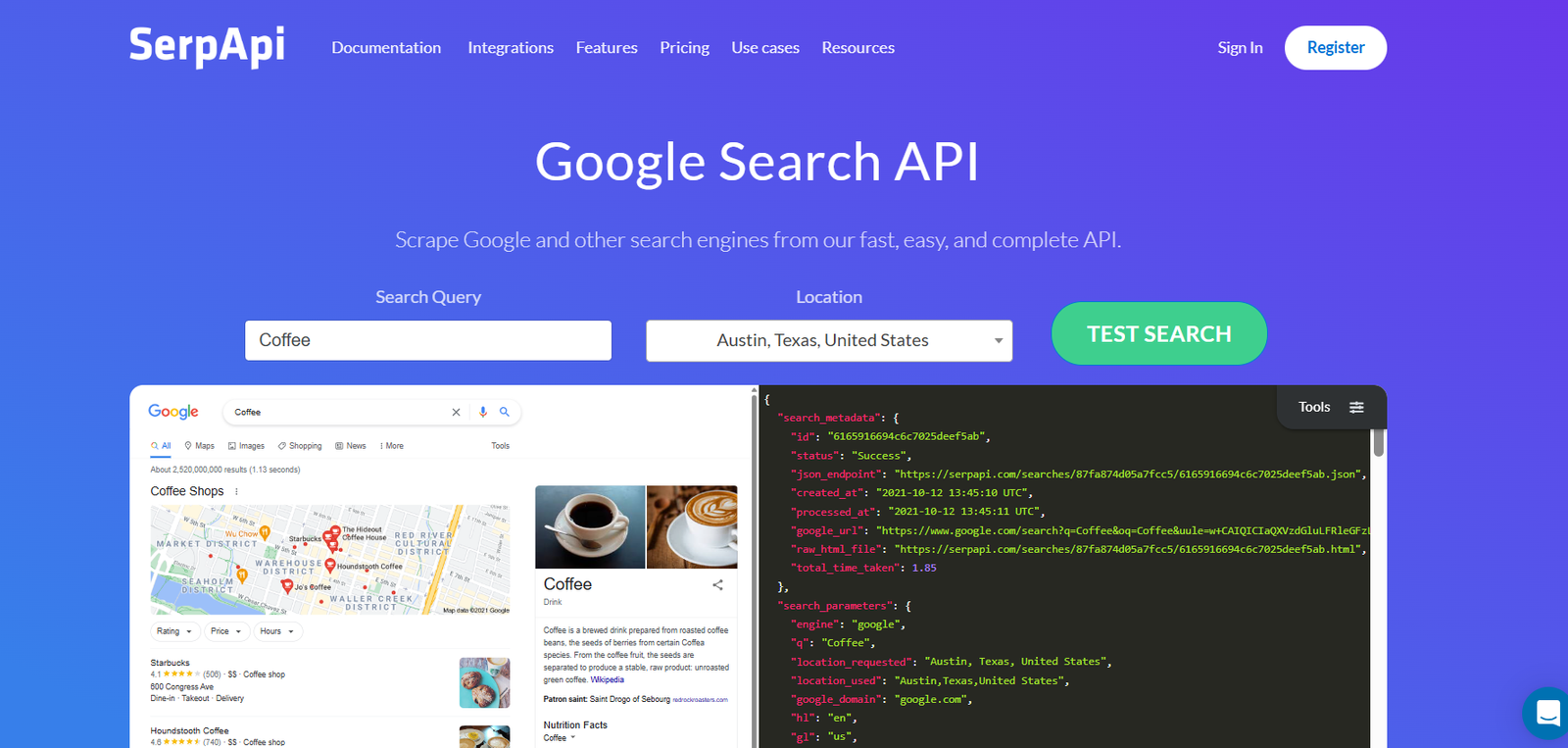
SerpApi is a real-time API that enables developers to access and scrape search engine results from Google and other major platforms without managing proxies or scraping logic. It is a robust tool built to return structured, JSON-formatted data from Google Search, Google Images, Google Maps, Google News, Bing, Yahoo, Baidu, DuckDuckGo, and more.
The platform abstracts away the complexity of web scraping, anti-bot measures, captchas, and rate limiting, providing users with reliable, scalable access to search engine data through a single API. SerpApi is widely used for SEO monitoring, competitive analysis, e-commerce tracking, news aggregation, academic research, and more.
SerpApi is trusted by developers, data analysts, startups, and enterprises that need reliable access to real-time search results at scale. The platform is fully hosted, comes with built-in proxy rotation, and guarantees 100% legal compliance with its terms of use.
SerpApi: Features
SerpApi provides a powerful set of features that make it one of the most comprehensive search result APIs on the market.
Real-Time Data – Delivers up-to-the-second results from Google and other supported search engines.
Structured JSON Output – Returns search results in clean, organized JSON format for easy integration with apps and data pipelines.
Captcha Bypass – Handles captchas, anti-bot measures, and IP blocks automatically through managed infrastructure.
Multiple Search Engines – Supports Google (web, images, maps, news, scholar), Bing, Yahoo, Baidu, Yandex, DuckDuckGo, and more.
Custom Parameters – Allows detailed control over queries including location, language, device type, search type, and filters.
Pagination Support – Enables access to multiple pages of search results, preserving order and accuracy.
Search Archive – Offers access to previously made queries for monitoring and auditing.
Batch and Bulk Queries – Supports large-scale data scraping for SEO, market research, or price monitoring.
Geolocation and Localization – Simulate searches from any geographic location or language to test SERP differences.
API Playground – Interactive web tool for testing and generating API calls in real time.
Open Source Client Libraries – Offers SDKs and code examples in Python, JavaScript, Ruby, Go, PHP, and more.
SerpApi: How It Works
SerpApi works by sending structured requests to its cloud-based API endpoint. A user specifies the search engine, query, and optional parameters such as location, language, or result filters. SerpApi then performs the search on behalf of the user using a network of rotating proxies and captcha solvers.
Once the search is complete, SerpApi parses the HTML result page and delivers a structured JSON response. This JSON includes details such as organic results, ads, featured snippets, maps, images, local packs, and shopping results—depending on the search engine and query type.
Developers can integrate SerpApi into their applications using RESTful calls and supported client libraries. For example, an e-commerce company can use SerpApi to monitor product visibility across markets, while an SEO agency can track search rankings and featured snippet placement.
The API is optimized for reliability, speed, and accuracy. It ensures that users never have to deal with captchas, proxy failures, or changing search engine structures.
SerpApi: Use Cases
SerpApi supports a wide range of use cases across industries and business functions.
SEO Monitoring – Track keyword rankings, featured snippets, and SERP changes across different regions and devices.
Price and Product Tracking – Monitor competitor pricing and product placements in Google Shopping results for e-commerce.
Market Research – Analyze brand visibility, market trends, and customer sentiment based on search engine content.
Academic Research – Collect data from Google Scholar or other sources for citation analysis, academic trends, or metadata studies.
Lead Generation – Scrape business listings, reviews, and contact information from Google Maps and local search results.
News Aggregation – Collect headlines and metadata from Google News or Bing News to feed into news dashboards and alerting tools.
Content Analysis – Monitor competitor articles and content rankings across search engines.
Ad Intelligence – Track Google Ads placements, ad copy, and advertiser domains in search results.
Data Enrichment – Add real-time search data to CRM records or enrichment pipelines.
Voice Search Optimization – Simulate voice queries and analyze how featured snippets and answer boxes respond to conversational queries.
SerpApi: Pricing
As listed on the SerpApi official pricing page, the platform offers flexible, usage-based pricing plans.
Free Plan – Includes 100 searches per month with full access to all supported APIs. Ideal for testing and small-scale experimentation.
Startup Plan – Starts at $50 per month for 5,000 searches. Additional searches are billed at $10 per 1,000 searches.
Business Plan – Starts at $250 per month for 30,000 searches. Includes priority support, team access, and higher rate limits.
Premium Plan – Custom pricing for enterprises with high-volume needs, dedicated infrastructure, and SLAs.
SerpApi charges per search request and includes all features across all tiers. There are no additional fees for captcha solving, proxy usage, or advanced search engines.
Billing is monthly, and overages are automatically added if usage exceeds plan limits. Discounts may be available for annual commitments.
SerpApi: Strengths
SerpApi offers numerous strengths that make it a leading choice for real-time search result scraping.
Fast and Reliable – Returns real-time results with low latency and near-perfect uptime.
No Scraper Maintenance – Eliminates the need to manage proxies, handle captchas, or parse changing HTML structures.
Wide Engine Support – Covers all major search engines and multiple content verticals including images, maps, and news.
Developer Friendly – Rich documentation, open-source libraries, and an interactive playground for testing and integration.
Highly Scalable – Handles thousands of requests per second for batch processing or real-time workflows.
Legal and Transparent – Offers terms of service and usage policies that prioritize legal compliance and data protection.
Accurate Results – Parses complex SERPs correctly, including structured data, rich snippets, and answer boxes.
Affordable – Offers generous limits and competitive pricing, especially for startups and scaling businesses.
Customer Support – Provides email and live chat support, with faster response times on business and premium plans.
SerpApi: Drawbacks
Despite its powerful capabilities, SerpApi has a few limitations that users should consider.
Usage-Based Costs – Can become expensive at high volumes without optimization or caching strategies.
No Self-Hosted Option – Fully cloud-hosted service; on-premise deployment is not supported for organizations with strict data residency needs.
Data Retention – While archived queries are stored, historical trend tracking requires external storage or analytics setup.
Learning Curve – While easy to get started, advanced query parameters may require some experimentation to fine-tune.
Query Limits – Each API call counts as a search, even if multiple search types are requested for the same query.
Limited Custom Parsing – Returns structured data, but cannot scrape arbitrary websites or pages outside of supported engines.
SerpApi: Comparison with Other Tools
SerpApi competes with other scraping and SERP monitoring tools like Bright Data, Apify, ScraperAPI, Zenserp, and DataForSEO.
Compared to Bright Data, which offers a full proxy and scraping platform, SerpApi focuses specifically on structured search engine data and removes the need to manage infrastructure.
Apify is more general-purpose and supports scraping arbitrary websites through custom scripts, while SerpApi provides plug-and-play access to structured search results with zero coding.
Zenserp is a direct competitor offering similar Google SERP APIs, but SerpApi stands out with better documentation, more frequent updates, and a wider selection of search engines.
DataForSEO offers bulk data APIs and rank tracking but requires more setup and infrastructure compared to SerpApi’s fully managed, real-time model.
Overall, SerpApi excels for teams that need reliable, fast, and easy access to structured search engine data without the burden of building and maintaining custom scrapers.
SerpApi: Customer Reviews and Testimonials
SerpApi is well-reviewed by developers, data engineers, and digital marketers for its ease of use, reliability, and comprehensive API coverage.
On platforms like G2, Capterra, and GitHub, users consistently praise the platform’s fast setup time, clean data output, and responsive customer support. One user noted, “SerpApi saved us weeks of development time and lets our team focus on insights instead of scraping.”
Another review stated, “We replaced our entire scraping stack with SerpApi and haven’t looked back. The API is solid, and the data is clean.”
Customers also highlight SerpApi’s transparent pricing, good documentation, and ability to handle large-scale projects without failure. Users who manage SEO tools, market intelligence platforms, or price trackers find the API especially valuable.
Conclusion
SerpApi is a robust and developer-friendly solution for accessing real-time, structured search engine data. By abstracting away the challenges of scraping, captcha solving, and proxy management, it allows teams to focus on building features and extracting insights rather than maintaining infrastructure.
With support for multiple search engines, customizable parameters, and fast, accurate results, SerpApi is ideal for SEO monitoring, e-commerce analysis, news aggregation, and competitive research. Its affordable pricing, strong developer support, and scalable infrastructure make it a top choice for startups and enterprises alike.
For any team looking to integrate real-time search data into their product or workflow, SerpApi offers a powerful, plug-and-play solution that gets results fast and reliably.