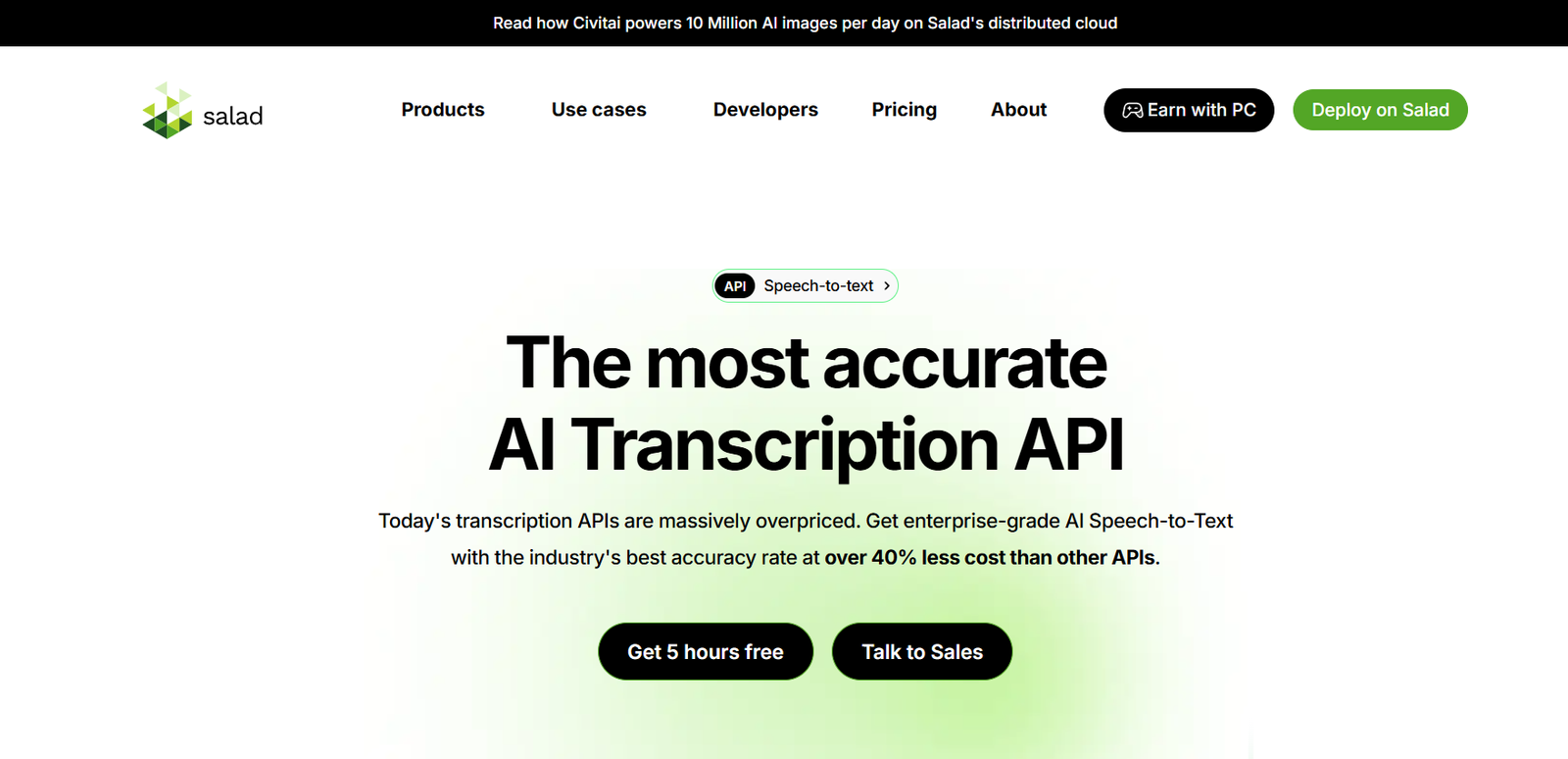
Salad AI is a decentralized compute-sharing platform that allows individuals to contribute idle computing resources—like GPU, CPU, and bandwidth—from their personal computers in exchange for real-world rewards. On the flip side, Salad provides developers and AI researchers with access to a distributed network of affordable, high-performance compute power, which can be used for machine learning, rendering, and other compute-intensive tasks.
By combining Web3 infrastructure with enterprise-grade security protocols, Salad bridges the gap between underutilized consumer hardware and skyrocketing demand for AI and cloud compute. The platform is particularly valuable for those seeking scalable GPU power and individuals looking to earn passive income with their unused PC power.
Features
Earn by Sharing Idle PC Resources
Users (called “Salad Chefs”) can install the Salad desktop app to share unused GPU, CPU, and bandwidth, earning rewards while their PC is idle.
Support for AI and ML Workloads
Salad’s infrastructure supports machine learning, inference, model training, image generation, rendering, and scientific computing.
Developer-Friendly API
Developers and businesses can access Salad’s compute power via a simple API for fast deployment of scalable AI tasks.
Reward System
Salad users are compensated in “Salad Balance,” which can be redeemed for games, gift cards, subscriptions, and more.
Zero Trust Security Framework
Built with enterprise-grade privacy and isolation standards, Salad secures workloads and contributors via a zero-trust environment.
Cross-Platform Support
The Salad app is available on Windows, with Linux support in development, enabling more users to contribute compute power.
Compute Infrastructure as a Service (IaaS)
Salad provides cost-effective cloud compute infrastructure through its decentralized network, particularly for AI and rendering tasks.
Community-Powered Network
By decentralizing compute contributions, Salad creates a global, peer-to-peer alternative to traditional cloud providers like AWS and GCP.
How It Works
Salad operates on a two-sided marketplace model.
For Contributors (Salad Chefs):
Users download the Salad desktop app and choose what resources to share—GPU, CPU, bandwidth, or storage. When the system detects idle time (like when the user isn’t gaming or working), it activates compute jobs like AI inference or rendering tasks. In return, users earn Salad Balance, which can be exchanged in the Salad Store for digital and physical rewards.
For Developers and Businesses:
Organizations use the SaladCloud API to deploy jobs across Salad’s distributed network. Salad intelligently routes tasks to machines that meet workload requirements, whether for AI model inference, 3D rendering, or data processing. Developers pay based on usage and benefit from highly scalable and cost-efficient compute resources.
Use Cases
AI Model Inference
Run machine learning models cost-effectively using Salad’s distributed GPU network instead of expensive cloud infrastructure.
Rendering and Media Processing
Salad enables fast, scalable rendering for 3D graphics, animation, and VFX projects using idle GPUs across the globe.
Scientific and Academic Computing
Research teams can access compute power for simulations, data analysis, and scientific modeling without heavy capital investment.
Passive Income for PC Users
Gamers, students, and professionals with powerful PCs can earn passive income by contributing resources during downtime.
Decentralized Cloud Computing
Salad serves as a decentralized alternative to AWS or Azure, enabling flexible deployment of compute-heavy applications at lower costs.
Pricing
Salad does not charge end users for downloading or using the app to share computing power. Instead, it compensates them for contributing.
For Developers and Businesses:
Salad offers usage-based pricing through its SaladCloud infrastructure. According to the Salad for Developers page:
Pricing is competitive with traditional cloud providers, with cost reductions due to leveraging idle consumer hardware.
Exact pricing is customized based on compute usage, application type, and volume.
Developers can contact Salad’s sales team for enterprise quotes or use the API documentation to estimate workloads.
Strengths
Incentivized Decentralized Model
Salad’s unique compute-sharing model creates value for both contributors and developers, fostering an efficient ecosystem.
Lower Cost Compute for Developers
The decentralized nature of SaladCloud allows for lower pricing compared to centralized cloud services.
Ease of Use
The Salad desktop app is user-friendly and requires minimal setup to start earning.
Security and Isolation
Workloads are containerized and sandboxed, ensuring privacy and system integrity for both contributors and clients.
Scalability
Salad’s growing network can dynamically scale to meet demand for AI inference, training, or rendering.
Sustainability
By repurposing idle consumer hardware, Salad helps reduce the environmental impact of traditional cloud infrastructure.
Drawbacks
Windows-Only (for now)
Currently, the Salad desktop app is only available on Windows, which limits participation for Mac and Linux users.
Not Suitable for Low-End PCs
Users need relatively powerful GPUs or CPUs to run profitable workloads, so those with older hardware may not benefit.
Limited Control Over Jobs
Contributors don’t choose which jobs their PC runs, which may concern users wanting full transparency over tasks.
Dependency on Idle Time
Earnings depend on how often the system is idle, meaning inconsistent revenue for those using their PC actively.
Comparison with Other Tools
vs. NiceHash
While NiceHash is focused on cryptocurrency mining, Salad supports a broader range of workloads such as AI inference and rendering. Salad also offers more user-friendly rewards and less crypto exposure.
vs. AWS/GCP/Azure
Traditional cloud providers offer guaranteed uptime and enterprise SLA support but come at a much higher cost. Salad offers a cost-effective, scalable alternative for less latency-sensitive workloads.
vs. Vast.ai
Both Salad and Vast.ai offer decentralized cloud infrastructure. However, Salad emphasizes gamification, rewards, and security isolation for consumer contributors.
vs. Render Network
Render focuses exclusively on GPU rendering tasks for media professionals, whereas Salad supports a wider range of general-purpose computing workloads.
Customer Reviews and Testimonials
Salad is well-received by both casual users and developers. Reviews on Trustpilot and Discord community feedback highlight its ease of use and value proposition.
One user shared:
“I’ve made enough Salad Balance to pay for my Netflix and Spotify every month without lifting a finger.”
A developer testimonial reads:
“We cut inference costs by over 40% by switching to SaladCloud. It’s now part of our standard AI pipeline.”
These reviews reflect the dual value of the platform: passive income for users and scalable infrastructure for businesses.
Conclusion
Salad AI offers a compelling solution for both users looking to earn from their idle PC power and developers in need of affordable, scalable compute. With a strong focus on security, decentralization, and usability, Salad bridges the gap between excess consumer hardware and increasing global demand for compute power.
Though it currently caters primarily to Windows users and requires decent hardware to be profitable, the platform’s growth and roadmap indicate ongoing improvements and broader accessibility in the future.
For developers seeking cost-effective AI compute or individuals wanting to monetize their idle PC, Salad provides a unique, ethical, and sustainable alternative to traditional cloud services.