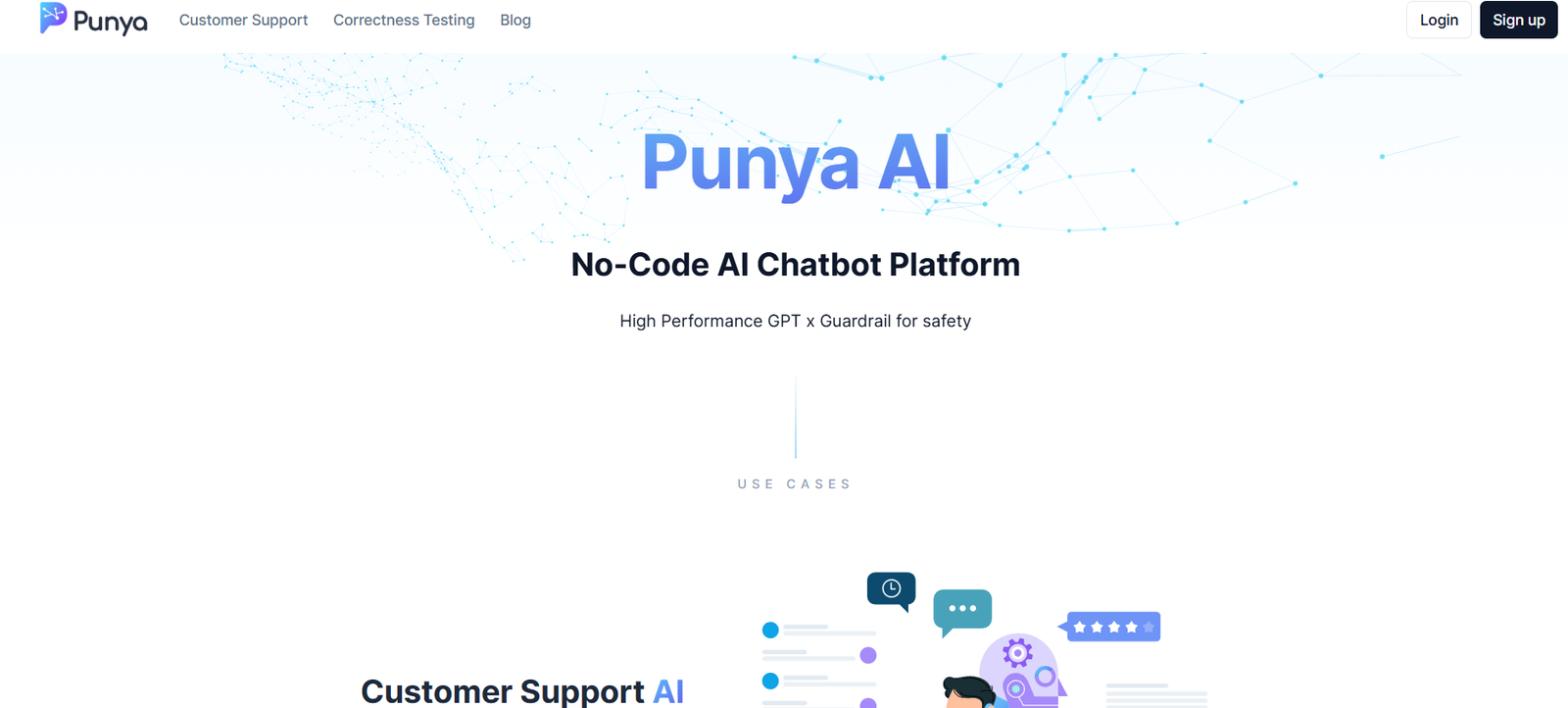
Punya AI is an enterprise-focused platform that enables businesses to automate complex workflows using advanced, custom-built AI agents. Designed for teams in operations, customer success, product management, and finance, Punya AI allows organizations to deploy AI agents that can handle repetitive tasks, interact with tools and data, and operate across multiple workflows.
The platform acts as a bridge between natural language inputs and backend systems, enabling teams to build agents that can execute commands, summarize information, respond to requests, and streamline cross-functional operations. Punya AI aims to eliminate manual processes and improve efficiency by providing smart, reliable, and secure agents tailored to business needs.
What sets Punya AI apart is its focus on enterprise-grade integration, security, and performance, with the ability to work across systems like Slack, Notion, Salesforce, internal wikis, and custom databases. It’s not just another chatbot — it’s a platform to build true workflow-native agents that augment team productivity at scale.
Features
Punya AI offers a wide range of enterprise-focused features designed to make agent-based automation accessible, secure, and powerful.
Custom AI Agents: Users can create AI agents that are purpose-built for specific workflows such as triaging support tickets, onboarding customers, updating CRM records, or summarizing product feedback.
Workflow Engine: Punya agents don’t just generate text — they execute tasks using structured logic and business rules. The system supports multi-step workflows, data processing, and integrations with external systems.
Natural Language Interface: Team members can interact with AI agents using plain English through Slack, email, web apps, or embedded UI components.
Multi-Tool Integration: The platform integrates with SaaS tools like Notion, Salesforce, Google Workspace, Slack, Intercom, and custom APIs. Agents can retrieve data, update records, send messages, and execute workflows.
No-Code and Low-Code Builder: Teams can design agents using a visual interface or leverage code snippets for advanced behavior and integrations.
Secure by Design: Enterprise-grade data protection, role-based access control (RBAC), audit logs, and environment isolation are core to the platform’s infrastructure.
Continuous Learning: Agents improve over time by learning from user feedback and task performance, making them more effective with each interaction.
Deployment Options: Agents can be deployed to internal dashboards, embedded in customer portals, or made accessible through messaging tools.
How It Works
Punya AI operates through a streamlined three-step process that allows businesses to define workflows, train agents, and deploy them in real-world environments.
Step 1: Define the workflow that needs automation. This could be a customer onboarding checklist, support escalation process, or cross-functional handoff task.
Step 2: Build the AI agent using Punya’s no-code or low-code interface. Users can define triggers, logic paths, integrations, and task dependencies.
Step 3: Deploy the agent to internal teams via Slack, dashboard, or API. The agent begins executing tasks, responding to input, retrieving and updating data, and learning from user feedback.
Agents can be continuously updated to reflect changes in business rules, data sources, or internal policies. They are designed to augment teams, not replace them — operating alongside human input for context-aware automation.
Use Cases
Punya AI is designed to handle complex, cross-functional workflows typically found in high-growth or large-scale organizations. Key use cases include:
Customer Onboarding: Automate onboarding workflows for SaaS platforms by integrating with CRM, email, and internal knowledge bases to guide customers step-by-step.
Customer Success: Agents can summarize feedback, flag churn risks, and trigger success workflows based on product usage or ticket sentiment.
Support Operations: Triaging tickets, routing issues to the right team, escalating bugs, and updating knowledge base content can be automated by intelligent agents.
Product Feedback Loop: Punya AI can collect product feedback from multiple channels, summarize key themes, and push insights to Notion or product management tools.
Revenue Operations: Automate deal desk workflows, quote approvals, and data enrichment by connecting to Salesforce, billing tools, and finance software.
Internal Tools Automation: Build internal assistants that surface data from internal databases, monitor operational tasks, and report on KPIs in real time.
Pricing
As of October 2025, Punya AI does not publicly list its pricing on the website. The platform is primarily designed for enterprise use, and pricing is likely customized based on:
Number of agents required
Workflow complexity
Number of users or seats
Integration needs
Support and onboarding level
To get a quote, businesses must request a demo or contact the Punya AI team directly via the official website. This approach is common for platforms offering deep integration and customization.
Early-stage startups may also inquire about pilot programs or startup-tier access.
Strengths
Punya AI’s main strength is its ability to go beyond text generation and into true workflow automation using AI. While many tools provide conversational AI, Punya provides actionable AI agents that can perform tasks, access systems, and streamline operations.
Its enterprise-grade security and integration capabilities make it suitable for large organizations with strict compliance requirements.
The platform is highly customizable, allowing teams to build and refine agents for specific use cases without needing to write large amounts of code.
Another key strength is its focus on real business impact — helping teams reduce manual work, cut down turnaround times, and improve cross-team collaboration through smart agent-based automation.
Drawbacks
Despite its advanced capabilities, Punya AI may have a few limitations depending on user needs.
No Public Self-Service Access: The lack of a free tier or public sandbox limits its accessibility for individual users or small businesses wanting to experiment.
Enterprise Focused: Punya AI is built for mid-sized to large enterprises, which means the onboarding process and pricing may not suit startups or solo operators.
Limited Documentation: Public-facing documentation or tutorials are currently minimal, making it difficult to evaluate technical details or setup processes without a demo.
Learning Curve: While the platform offers no-code tools, designing complex workflows and agents may still require some training or support from the Punya team.
Comparison with Other Tools
Punya AI competes with a new wave of AI workflow automation platforms. Compared to tools like Zapier or Make.com, Punya focuses less on simple event-triggered automation and more on intelligent, context-aware decision-making through AI agents.
Unlike Slack GPT or Notion AI, which enhance a single tool’s functionality, Punya serves as a cross-platform workflow engine. It integrates with multiple systems to create agents that can act across them.
When compared to UiPath or Automation Anywhere, which specialize in robotic process automation (RPA), Punya leans into natural language-driven workflows and agent reasoning rather than rule-based task scripts.
For companies looking to build AI copilots or AI team members, Punya offers more flexibility than chat-based assistants like ChatGPT Enterprise, with the ability to embed agents into tools and automate execution, not just provide answers.
Customer Reviews and Testimonials
As of October 2025, Punya AI has not been widely reviewed on public platforms like G2, Capterra, or Product Hunt. However, based on available customer feedback shared through the website and startup ecosystems, early adopters praise the platform for its enterprise reliability, flexibility, and time-saving automation.
Users from SaaS companies and operational teams highlight that Punya AI reduced manual coordination across functions, especially for onboarding, support, and customer handoffs.
One testimonial mentions using Punya to “replace dozens of manual Slack workflows with a single AI agent that runs 24/7 and never misses a handoff.”
Companies also appreciate the white-glove onboarding support and ability to customize agents for their internal tools and data systems.
Conclusion
Punya AI is a next-generation enterprise platform that transforms how businesses approach operational efficiency. By enabling the creation of workflow-native AI agents that understand, act, and improve over time, Punya helps teams eliminate repetitive work, improve cross-functional alignment, and accelerate decision-making.
Its focus on enterprise security, multi-tool integration, and no-code customization makes it a valuable asset for modern teams handling complex internal processes. Although it’s not aimed at casual users or startups, it is a strong contender for mid-to-large organizations investing in AI transformation.
If your business is looking to deploy AI not just for chat, but for execution and automation, Punya AI offers one of the most robust and forward-looking solutions on the market today.