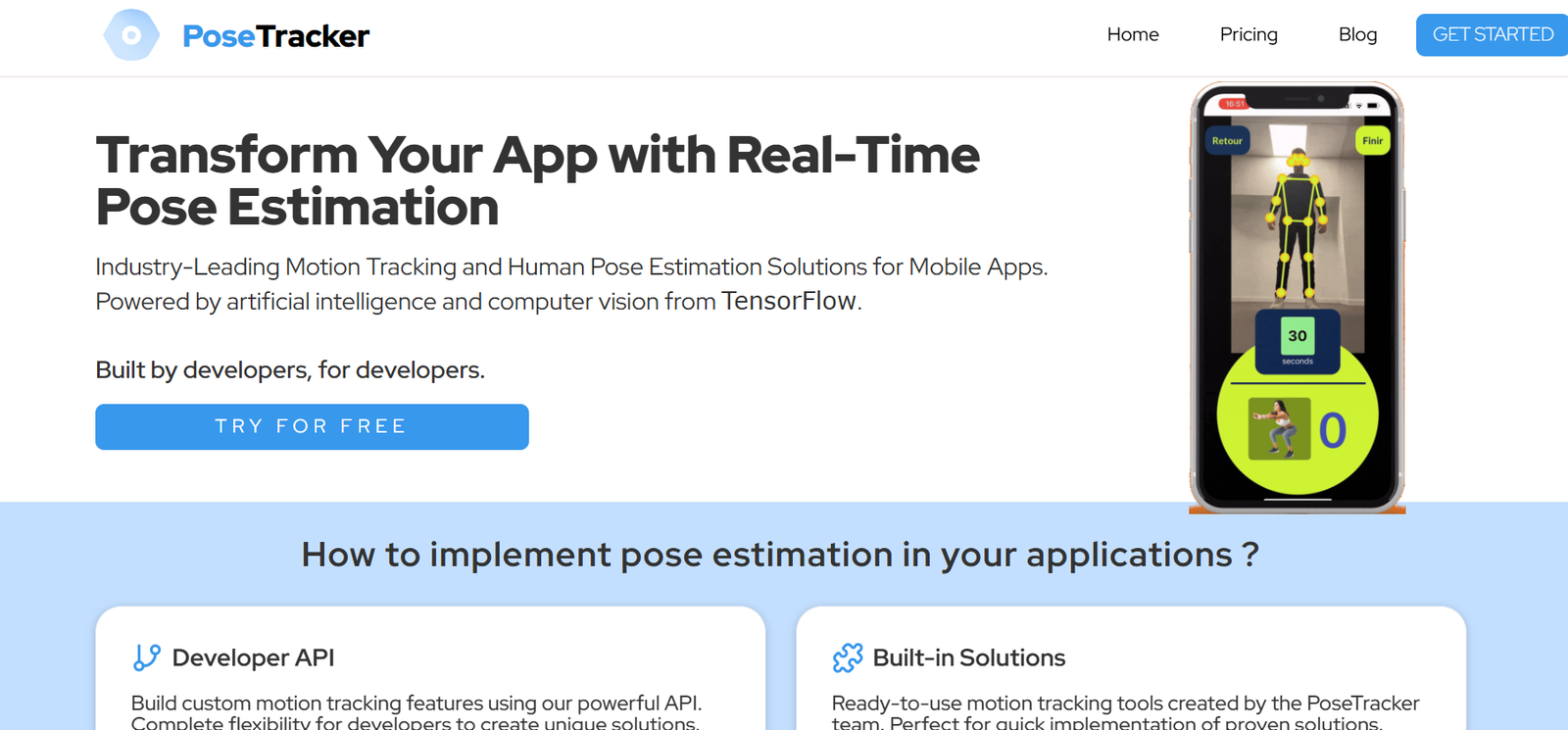
PoseTracker is an advanced AI solution for real-time human pose estimation and motion tracking using computer vision. Built for developers, researchers, and companies working in fields like fitness, sports analytics, healthcare, gaming, and robotics, PoseTracker allows users to capture full-body pose data from video input with high accuracy and speed.
By leveraging deep learning models and multi-camera setups, PoseTracker transforms 2D and 3D video data into meaningful skeletal representations of human movement. This enables precise analysis of physical activities, gestures, and biomechanics without the need for wearable sensors or motion capture suits.
PoseTracker is available as both a cloud-based solution and on-premise SDK, making it accessible to startups, large enterprises, and academic institutions alike.
Features
PoseTracker delivers a wide range of AI-driven features to support motion tracking, pose recognition, and body analytics.
Real-Time Human Pose Estimation: Detects key points of the human body (head, shoulders, elbows, hips, knees, ankles, etc.) from 2D and 3D video input.
Multi-Camera Support: Uses multiple synchronized cameras for higher accuracy and depth perception in pose estimation.
3D Pose Tracking: Converts 2D video frames into spatially accurate 3D skeletal models of the subject.
Device Agnostic: Works with standard webcams, smartphones, and depth cameras without requiring special hardware.
Developer SDK and API: Offers software development kits for integration into custom apps and platforms across various environments.
Cloud and Local Deployment: Available as a hosted cloud solution or can be installed and deployed on-premise for greater control and data privacy.
Activity Recognition: Built-in AI models can recognize specific movement patterns, actions, or exercise types based on the tracked poses.
Privacy-Preserving Processing: Optional configurations to anonymize subjects and focus purely on skeletal motion data for GDPR and HIPAA compliance.
How It Works
PoseTracker uses computer vision algorithms and deep learning models to analyze video input in real time and detect human body keypoints. The process begins with the camera capturing video frames of a person performing physical movement. These frames are processed by the AI model, which identifies body joints and reconstructs them into a digital skeleton.
When used with multiple cameras, PoseTracker applies triangulation to generate 3D pose estimations, offering a more accurate and robust representation of human motion. This is particularly useful in biomechanics, rehabilitation, and performance training applications where precision is critical.
For developers, PoseTracker offers an SDK that can be embedded into existing apps, software platforms, or workflows. The API allows users to control camera feeds, access real-time pose data, and integrate activity recognition logic into their own systems.
Whether deployed on the cloud or locally, PoseTracker ensures fast processing, low latency, and scalability for real-world use cases.
Use Cases
PoseTracker is designed for diverse industries where motion tracking and pose analysis are essential.
Fitness and Wellness: Enables apps to provide real-time feedback on posture, form, and movement during workouts, yoga, or physical therapy sessions.
Healthcare and Rehabilitation: Helps clinicians monitor patient recovery by tracking limb mobility, balance, and progress in physical therapy.
Sports Performance: Coaches and athletes use pose data to analyze form, optimize technique, and prevent injury in real-time.
Gaming and AR/VR: Powers motion-controlled games, virtual avatars, and immersive experiences by translating body movement into digital commands.
Human-Computer Interaction (HCI): Supports gesture recognition systems for hands-free interaction in public displays, kiosks, or smart home devices.
Robotics and Automation: Provides robots or AI agents with contextual understanding of human movement for safe, responsive interaction.
Academic Research: Used in studies involving biomechanics, kinematics, and behavioral science where human movement data is required.
Pricing
PoseTracker does not display fixed pricing on its website. The pricing model depends on factors such as:
Deployment type (cloud vs. on-premise)
Usage volume (real-time vs. batch processing)
Number of cameras and endpoints
API call volume and developer support requirements
Feature access (2D tracking only vs. full 3D and activity recognition)
To get detailed pricing, users must contact PoseTracker’s sales or support team via the contact form on https://www.posetracker.com. Custom quotes are provided based on technical needs and business scale.
Strengths
PoseTracker offers several strengths that make it a preferred solution for pose estimation and movement analysis:
High Accuracy: The system supports both 2D and 3D tracking with sub-centimeter precision using advanced multi-camera calibration.
Real-Time Processing: Designed for minimal latency, enabling live applications such as motion coaching and interactive gaming.
Hardware Flexibility: Compatible with standard camera devices, eliminating the need for proprietary hardware or suits.
Developer-Friendly: Rich SDK and API access allow developers to build custom applications on top of PoseTracker’s engine.
Modular Deployment: Offers both cloud-based and on-premise installation, giving flexibility based on data sensitivity and infrastructure.
Cross-Industry Applicability: Suitable for diverse fields such as sports, healthcare, gaming, and industrial safety.
Privacy-Conscious: Designed to anonymize user data by focusing on skeletal output rather than raw video or facial recognition.
Drawbacks
While PoseTracker offers advanced capabilities, there are some limitations to be aware of:
No Public Trial: Users must request a demo or contact the company for access. There is no open-access version or freemium model.
Limited Public Documentation: Technical resources such as API docs, integration guides, or developer forums are not openly accessible.
Advanced Setup Required: Multi-camera calibration and 3D tracking may require technical expertise and setup time.
Enterprise-Focused: PoseTracker is designed primarily for organizations rather than individual or hobbyist users.
Cost Transparency: Lack of upfront pricing may be a barrier for smaller businesses or researchers on a tight budget.
Comparison with Other Tools
PoseTracker competes in the AI pose estimation space alongside tools like OpenPose, MediaPipe, and Move.ai. However, it stands out with several distinctions.
Compared to OpenPose: PoseTracker offers commercial support, real-time 3D pose estimation, and cleaner SDK integration for product use cases, whereas OpenPose is research-focused and open-source.
Compared to MediaPipe: MediaPipe is free and developer-friendly but is limited mostly to 2D estimation and mobile devices. PoseTracker supports full 3D workflows and cloud or enterprise deployment.
Compared to Move.ai: Both offer multi-camera 3D tracking, but PoseTracker provides on-premise deployment, making it more suitable for privacy-sensitive industries like healthcare.
Overall, PoseTracker’s combination of real-time 3D tracking, SDK/API access, and privacy features position it as a premium, enterprise-ready solution.
Customer Reviews and Testimonials
PoseTracker does not currently publish customer reviews or testimonials on its website. However, the tool is actively marketed to healthcare, sports, and tech industries, with demos available upon request.
Industry professionals and developers who have interacted with the platform report that it offers high accuracy and a well-structured developer experience once integrated.
Since customer references are provided on request, prospective clients should contact the company for technical case studies, performance benchmarks, or customer success stories.
You may also find unofficial discussions about PoseTracker’s capabilities on AI and computer vision forums, research papers, or through partnerships in academic or sports institutions.
Conclusion
PoseTracker is a robust AI solution for real-time pose estimation and movement tracking. With support for 2D and 3D pose analysis, camera flexibility, and developer integration, it serves a wide array of industries—from fitness and sports to robotics and healthcare.
Its emphasis on precision, privacy, and customization makes it a strong choice for organizations looking to incorporate advanced human motion tracking into their workflows or products. While it is not built for hobbyists or casual use, its enterprise-grade infrastructure and flexible deployment options make it a serious contender in the AI pose tracking space.