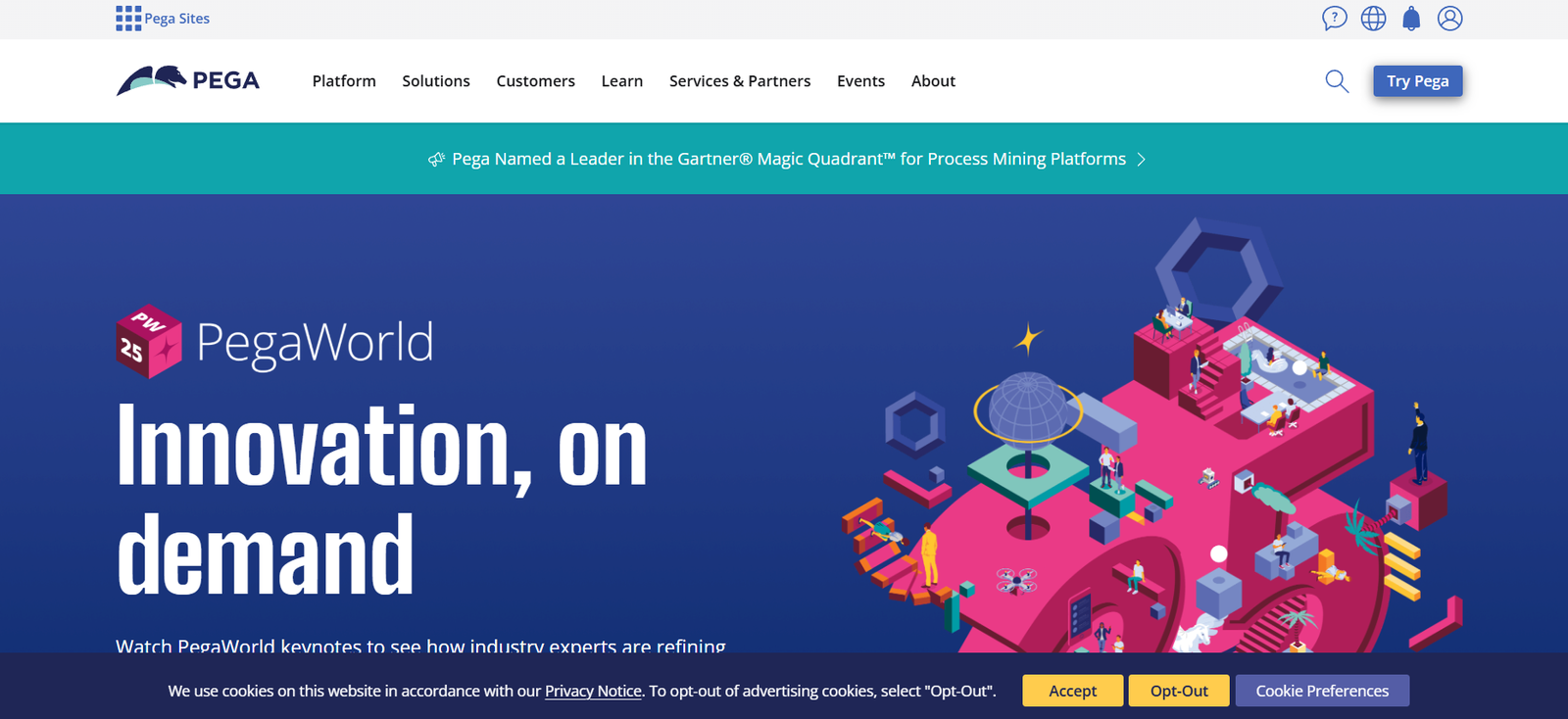
Pega (by Pegasystems Inc.) is a leading enterprise-grade low-code platform that combines workflow automation, AI-powered decisioning, and CRM capabilities to help organizations digitally transform their operations. With a strong focus on operational efficiency, personalized customer experiences, and agility, Pega serves global enterprises across sectors like finance, insurance, healthcare, telecommunications, and government.
The platform stands out for its ability to unify business processes, customer engagement, and real-time decision-making in one powerful system. By integrating artificial intelligence, machine learning, and case management, Pega enables companies to automate complex operations and optimize outcomes at scale.
Features of Pega
Low-Code Application Development
Pega provides a model-driven, visual interface that empowers both developers and business users to build applications without writing extensive code.
Workflow and Case Management
Design, orchestrate, and manage end-to-end workflows for customer service, onboarding, claims, compliance, and more.
AI-Powered Decisioning
Pega’s decision hub uses real-time AI to recommend next-best actions, personalize engagement, and optimize business decisions across channels.
Customer Service and CRM
Deliver proactive, personalized support across voice, chat, email, and social channels with Pega Customer Service, part of its CRM suite.
Intelligent Automation
Combine robotic process automation (RPA), business rules, and machine learning to automate both structured and unstructured work.
Pega Process AI
A set of AI tools that continuously monitor and analyze business operations to predict bottlenecks, prioritize work, and recommend improvements.
Cloud Choice and Scalability
Run Pega apps on Pega Cloud, AWS, Microsoft Azure, Google Cloud, or on-premises. Offers full flexibility and enterprise-grade performance.
DevOps and Continuous Delivery
Integrated tools for version control, automated testing, and pipeline management to support agile development practices.
Unified Architecture
Pega’s single platform supports multi-channel workflows, customer interactions, decisioning, and data across departments and touchpoints.
How Pega Works
Model-Driven App Building
Users design applications using visual models that define user interfaces, data relationships, workflows, and business rules.Automated Decisioning
Pega’s AI analyzes customer behavior, context, and business goals in real time to recommend the most effective actions.Unified Data Access
Integrates data from disparate systems and presents a 360-degree view of processes or customers.Omnichannel Execution
Applications and decisions built in Pega work seamlessly across digital and human channels—mobile apps, web portals, call centers, and chatbots.Continuous Optimization
Built-in analytics and AI tools measure performance and suggest improvements in business processes and decision strategies.
Use Cases for Pega
Banking and Financial Services
Automate onboarding, KYC, fraud detection, and customer service operations while ensuring regulatory compliance.
Healthcare and Life Sciences
Streamline prior authorizations, claims processing, care management, and patient engagement.
Insurance
Modernize policy management, claims workflows, and underwriting decisions using low-code tools.
Government Agencies
Improve service delivery, automate case management, and enhance constituent engagement across digital channels.
Telecommunications
Unify customer interactions, automate network service workflows, and reduce churn through predictive analytics.
Customer Engagement Hubs
Deliver consistent, personalized experiences across channels using Pega’s centralized decisioning engine.
Pricing of Pega
As of June 2025, Pega does not publish public pricing on its website due to its enterprise customization model. Pricing is typically based on:
Number of applications or modules (e.g., Pega Customer Service, Pega Sales Automation)
Number of users and environments
Deployment method (cloud vs. on-premises)
Support and service tiers
Integration scope and customization
Organizations interested in using Pega must request a custom quote or schedule a demo via https://www.pega.com.
Strengths of Pega
Unified platform for decisioning, automation, and CRM
Enterprise-grade scalability and security
Powerful AI capabilities built into workflows
Low-code development accelerates time to value
Cloud-agnostic with hybrid deployment support
Proven in complex, regulated industries
Strong support for continuous improvement and DevOps
Drawbacks of Pega
Complex platform with a steep learning curve for new users
Enterprise pricing and implementation may be cost-prohibitive for SMBs
Requires skilled Pega developers for large-scale customization
Integration with legacy systems can require effort
UI/UX flexibility is more limited than pure front-end frameworks
Comparison with Other Tools
Pega vs. Salesforce
Salesforce is stronger in traditional CRM and marketing automation, while Pega shines in end-to-end process automation and real-time AI decisioning.
Pega vs. ServiceNow
ServiceNow is often used for ITSM and operations, while Pega focuses more on business process automation, customer service, and decisioning.
Pega vs. Appian
Both offer low-code automation platforms. Pega has a deeper CRM and decisioning layer, while Appian emphasizes UI/UX simplicity and quick deployments.
Pega vs. Microsoft Power Platform
Power Platform is accessible and integrates well with Microsoft ecosystems. Pega offers more robust enterprise-level workflow and AI capabilities.
Customer Reviews and Testimonials
Pega has been trusted by Fortune 500 companies and government agencies for decades. Here’s what users are saying:
“Pega allowed us to move from legacy mainframes to a fully digital claims platform—without sacrificing compliance or speed.” – CIO, Global Insurance Firm
“Our customer satisfaction scores improved by 35% after integrating Pega’s decisioning engine with our contact center.” – VP of Operations, Telecom Provider
“Pega’s low-code tools let us empower business users to build solutions faster, while IT ensures governance and security.” – Digital Transformation Lead, Government Agency
Pega is recognized as a leader in Gartner Magic Quadrants for CRM and Intelligent Business Process Management Suites (iBPMS).
Conclusion
Pega is more than just a low-code platform—it’s a comprehensive system for digital transformation, AI-driven decisions, and customer-centric automation. With its ability to unify customer journeys, automate complex workflows, and provide actionable AI insights, it enables enterprises to operate with agility and scale in a rapidly evolving landscape.