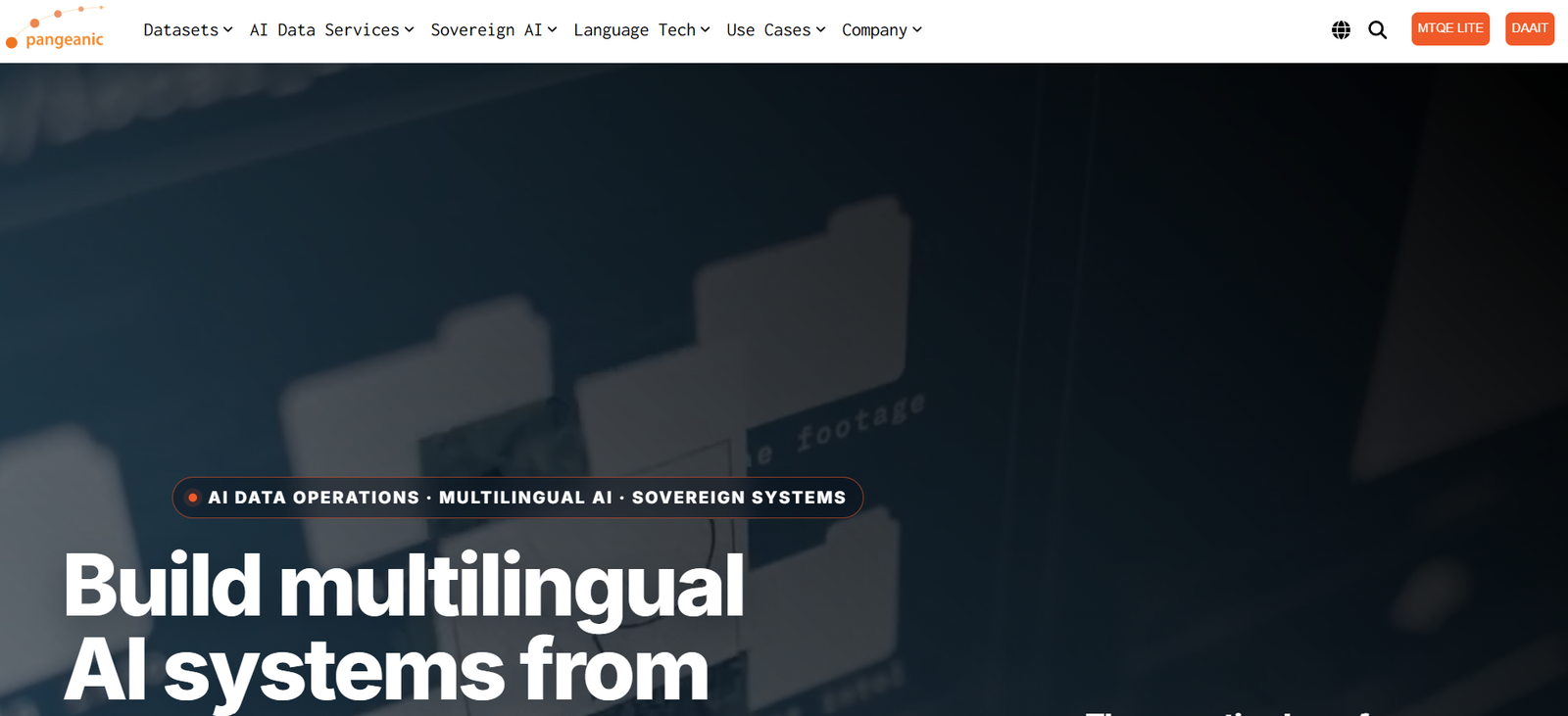
Pangeanic is a multilingual AI and language technology company that helps enterprises, AI developers and public organizations build and operate AI systems using trusted multilingual data and secure infrastructure. Its services cover AI datasets, data annotation, model evaluation, RLHF, machine translation, anonymization, multilingual retrieval and sovereign AI deployment.
A major part of Pangeanic’s technology ecosystem is the ECO Intelligence Platform. ECO provides a controlled environment for multilingual AI workflows, bringing together document processing, translation, multilingual retrieval, anonymization, model orchestration and AI assistants.
Pangeanic is particularly focused on organizations that need greater control over sensitive information and AI infrastructure. Its solutions can operate through private cloud, on-premises and air-gapped environments, making the platform relevant for enterprises, government organizations and regulated sectors.
The company also provides multilingual datasets and human AI data services for training, fine-tuning, evaluating and aligning AI models. This makes Pangeanic broader than a traditional machine translation service because it covers several stages of the AI development and deployment process.
Features
Multilingual AI Datasets
Pangeanic provides datasets for developing and evaluating artificial intelligence systems. Available data types include multilingual text, parallel translation corpora, speech and audio, images, video, OCR data, multimodal information and evaluation datasets.
Organizations can license existing datasets or request customized data collection according to their language, domain and AI development requirements.
ECO Intelligence Platform
ECO is Pangeanic’s operational platform for managing multilingual AI processes. It combines translation, document intelligence, retrieval, anonymization, model orchestration and controlled AI assistants within one environment.
It is designed particularly for organizations that need to manage AI workflows while maintaining greater control over data, models and infrastructure.
Deep Adaptive AI Translation
Pangeanic provides adaptive AI translation technology that can use an organization’s existing terminology, translation memories, bilingual data, style requirements and domain knowledge.
Rather than depending entirely on generic machine translation, organizations can adapt translations to their own communication standards and specialized terminology.
Enterprise Document Translation
The platform supports multilingual processing of common business document formats including PDF, Word, PowerPoint and Excel files. It is designed to maintain document structure while applying translation, terminology and privacy controls.
Machine Translation Quality Estimation
Pangeanic provides Machine Translation Quality Estimation, or MTQE, technology for automatically evaluating translated content.
Organizations can establish quality thresholds that determine whether translated material can be released automatically, requires additional processing or should be sent to a human reviewer.
Multilingual RAG
Pangeanic supports multilingual retrieval augmented generation workflows. Organizations can connect AI systems with controlled knowledge sources so information can be searched and retrieved across different languages.
This can be useful when building multilingual enterprise search systems and AI assistants that need to provide answers grounded in approved organizational information.
AI Anonymization and Data Masking
The platform includes technology for detecting and protecting personal or sensitive information before content is translated, retrieved or processed by AI systems.
This feature can be particularly useful for government, healthcare, legal and other organizations working with confidential information.
Data Annotation
Pangeanic provides annotation and metadata services that help convert raw information into structured datasets suitable for AI development.
These services can support tasks such as entity tagging, intent classification, document labeling, QA datasets and retrieval pipelines.
Human Feedback and RLHF
The company supports human feedback and Reinforcement Learning from Human Feedback workflows. Human reviewers can evaluate, rank and assess AI outputs to help organizations improve model behavior and alignment.
AI Model Evaluation
Pangeanic helps organizations create evaluation datasets and quality processes for comparing and validating AI models.
These capabilities can be used for model readiness testing, multilingual evaluation, error analysis, policy alignment and ongoing quality monitoring.
Task-Specific Language Models
Pangeanic can help organizations select, fine-tune and deploy smaller language models for specific business requirements.
Models can be adapted according to an organization’s terminology, languages, proprietary knowledge, policies and infrastructure.
Private and Sovereign AI Deployment
Organizations can deploy Pangeanic technology through private cloud, on-premises or air-gapped infrastructure depending on their security requirements.
This gives organizations greater control over where sensitive information is processed and how their AI systems operate.
API Integration
Pangeanic provides APIs that allow multilingual AI and language services to be integrated into existing applications, portals, document management systems and enterprise workflows.
How It Works
Step 1: Identify the AI Requirement
Organizations begin by defining their requirement, such as multilingual translation, AI training data, anonymization, document processing, model evaluation or enterprise AI deployment.
Step 2: Select Data and Services
Existing datasets can be licensed or customized datasets can be created. Businesses can also select services such as annotation, evaluation, translation or human feedback.
Step 3: Prepare Organizational Data
Data can be collected, cleaned, labeled, reviewed and structured according to the requirements of the AI project.
Step 4: Configure Language and AI Models
Organizations can use translation technology or work with Pangeanic to select and customize task-specific models based on languages, terminology, knowledge and operational requirements.
Step 5: Connect Trusted Knowledge
For retrieval-based applications, organizational knowledge can be connected so AI systems can search and generate responses using controlled information sources.
Step 6: Apply Privacy Controls
Sensitive information can be detected and anonymized before translation or other AI processing when required.
Step 7: Deploy the System
AI services can be deployed through APIs, private cloud, on-premises systems or controlled infrastructure depending on security and operational needs.
Step 8: Evaluate Output
Translation quality estimation, human evaluation and other quality processes can be used to measure output against defined standards.
Step 9: Add Human Review
Content that does not meet required quality thresholds can be routed to human specialists for review and correction.
Step 10: Operate and Monitor Workflows
Organizations can use ECO to coordinate multilingual documents, retrieval, translation, privacy protection, APIs and human intervention within production workflows.
Use Cases
AI Developers and Model Builders
AI companies can obtain multilingual datasets, human feedback and evaluation data for training, fine-tuning and testing language models.
Enterprises
Large organizations can build multilingual AI systems that connect internal knowledge, translation services and document workflows while maintaining control over sensitive information.
Government Organizations
Public administrations can use secure multilingual document translation, anonymization and controlled AI infrastructure where privacy and auditability are important.
Translation and Localization
Organizations managing content across multiple languages can combine machine translation with terminology, translation memories, quality estimation and human review.
Regulated Industries
Legal, healthcare, financial and other regulated organizations can benefit from private deployment and anonymization capabilities when handling sensitive information.
AI Model Training
Developers can use multilingual text, speech, image, video and other datasets to train or improve AI systems.
Model Evaluation and Alignment
AI teams can create evaluation datasets and use human feedback to assess model quality, preferences and alignment.
Multilingual Enterprise Search
Organizations can build retrieval systems capable of finding and presenting information across multiple languages and internal knowledge repositories.
Secure AI Assistants
Businesses can develop AI assistants that access controlled organizational information rather than relying exclusively on general-purpose public knowledge.
Document Processing
Teams dealing with large volumes of multilingual documents can automate translation, extraction, classification, summarization and privacy-related processing.
Pricing
Pangeanic does not clearly display standard subscription prices for its main enterprise AI solutions on the official website.
Pricing is likely to depend on factors such as required datasets, languages, data volumes, translation usage, model customization, infrastructure, integrations, security requirements and deployment method.
Organizations interested in ECO, AI datasets, translation solutions, model customization or sovereign AI infrastructure can contact Pangeanic to discuss their requirements and request appropriate commercial information.
Pricing details are not clearly mentioned on the official website.
Strengths
Pangeanic’s strongest advantage is the breadth of its multilingual AI capabilities. It combines datasets, human feedback, translation, anonymization, retrieval, evaluation and AI deployment rather than concentrating on a single AI function.
Its focus on multilingual technology makes it particularly useful for organizations operating across countries and languages.
Private cloud, on-premises and air-gapped deployment options are valuable for organizations that cannot simply send sensitive information to public AI services.
The combination of automated translation quality estimation and human review can help organizations create more controlled multilingual publishing processes.
Pangeanic also provides both ready-made datasets and customized data services, allowing AI developers to choose according to their project requirements.
Its support for task-specific models, RAG, terminology adaptation and enterprise knowledge allows organizations to create AI systems that are more closely aligned with specific operational requirements.
Drawbacks
Pangeanic is primarily designed for enterprise, institutional and AI development environments. Individual consumers or very small businesses looking for a simple AI translator may find the platform more complex than necessary.
Public pricing information is limited, making it difficult to estimate costs without contacting the company.
Organizations implementing private, sovereign or customized AI systems may require technical expertise and careful planning before deployment.
The broad range of datasets, translation services, AI data operations and deployment options may also require consultation to determine which combination is appropriate for a particular project.
Pangeanic is therefore better viewed as an enterprise AI technology and services ecosystem rather than a simple self-service AI application.
Comparison with Other Platforms
Pangeanic differs from many general-purpose translation platforms because its services extend beyond translating text from one language into another.
Traditional machine translation tools often focus mainly on providing quick translations. Pangeanic combines machine translation with organizational terminology, translation memories, quality estimation, document workflows, anonymization and human review.
It also differs from many general AI platforms by providing multilingual datasets, annotation, model evaluation, RLHF and model alignment services.
Another important distinction is its focus on sovereign and controlled AI deployment. Organizations can operate systems through private cloud, on-premises or isolated infrastructure when stronger control over data and AI processing is required.
For consumers who simply need occasional translations, simpler translation services may be more convenient. For enterprises, AI laboratories and public organizations building multilingual AI infrastructure, Pangeanic provides a much broader set of capabilities.
Customer Reviews and Testimonials
Pangeanic presents several enterprise and institutional use cases on its official website rather than primarily relying on conventional consumer reviews.
Examples include work involving the Barcelona Supercomputing Center, the Spanish Tax Agency, EFE News Agency and Veritone. The website describes applications involving multilingual model alignment, secure document translation, multilingual publishing and enterprise language infrastructure.
These examples provide evidence of real-world deployment, although results from individual projects should not be considered guaranteed outcomes for every organization.
Conclusion
Pangeanic is a comprehensive multilingual AI platform and technology provider for organizations that need more than basic machine translation. It combines multilingual datasets, data annotation, human feedback, model evaluation, adaptive translation, anonymization, RAG and secure AI deployment.
Its ECO Intelligence Platform is particularly relevant for organizations that want to coordinate multilingual AI processes while retaining greater control over their data, models and workflows.
Pangeanic is best suited to enterprises, AI developers, government agencies, research organizations and regulated industries that need multilingual AI at scale. Its combination of AI data services and sovereign deployment capabilities also makes it worth considering for organizations developing their own language models or secure enterprise AI systems.