
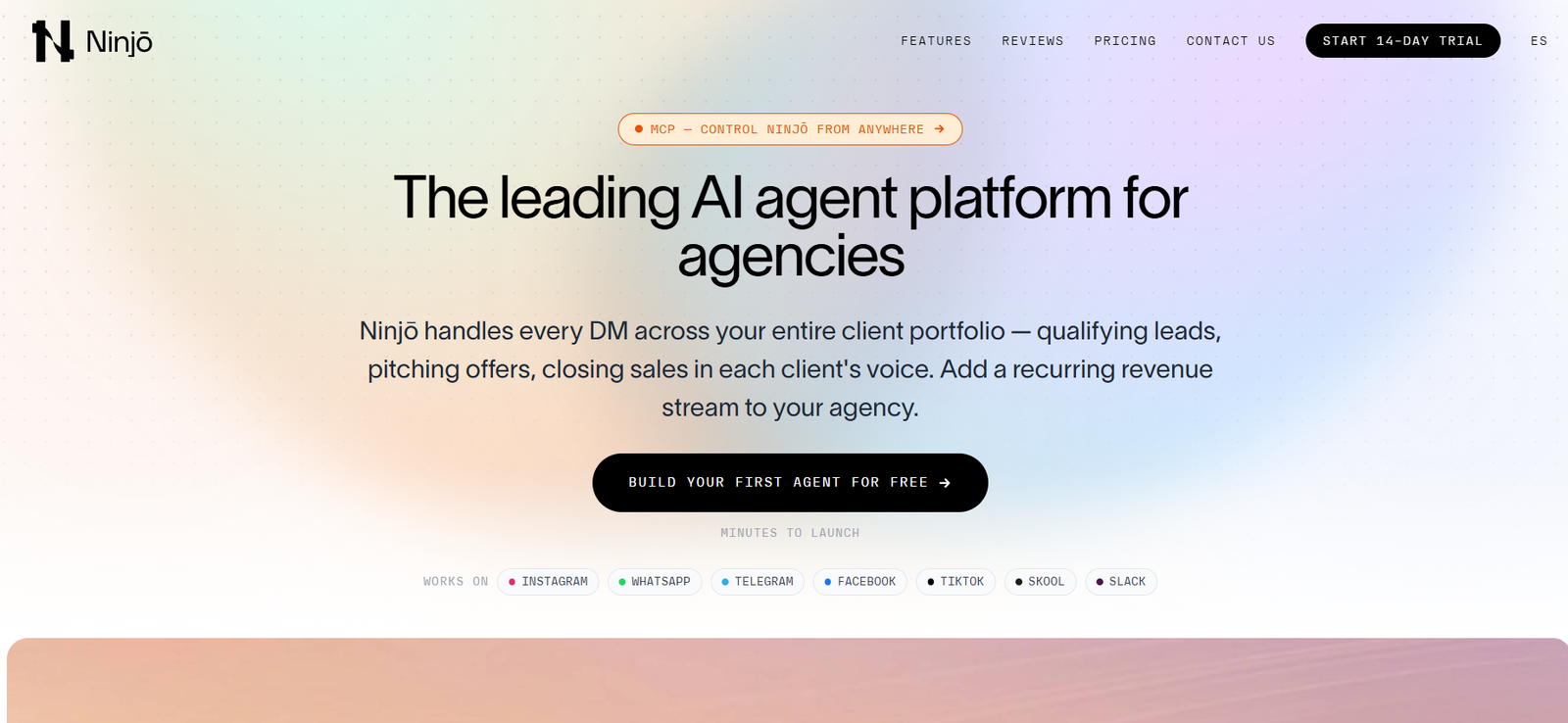
Ninjō is an AI agent platform designed primarily for marketing agencies that want to automate sales, lead management, customer support, and messaging for multiple clients.
Agencies can create a separate AI agent for each client. Every agent can be configured around that client’s brand voice, products, services, offers, sales process, and customer information.
Once deployed, the agents can manage incoming conversations, answer questions, qualify leads, nurture prospects, recommend offers, share payment links, schedule bookings, and support customers.
Ninjō works across several popular communication channels, including Instagram, WhatsApp, Telegram, Facebook, TikTok, Skool, and Slack.
A major part of the platform is its agency-focused architecture. Instead of managing separate automation systems for every client, agencies can create and supervise multiple client agents from a central environment.
Ninjō also supports Model Context Protocol (MCP), allowing users to manage aspects of the platform through compatible AI assistants such as Claude and ChatGPT.
This makes Ninjō particularly relevant to marketing agencies, lead-generation businesses, creators, coaches, consultants, and other organizations that receive substantial numbers of customer conversations through social media and messaging platforms.
Features
AI Agents for Client Accounts
Agencies can create individual AI agents for different clients.
Each agent can be configured around the client’s specific business, audience, offers, communication style, and objectives.
Multi-Client Agency Dashboard
Ninjō is built for agencies managing multiple businesses.
The company positions the platform as suitable for portfolios ranging from a few clients to hundreds of client accounts.
Instagram DM Automation
Agents can handle incoming conversations through Instagram and respond to prospects automatically.
WhatsApp Automation
Ninjō supports WhatsApp for sales, support, lead nurturing, and other customer communication workflows.
Facebook Support
Agents can participate in supported Facebook messaging workflows.
Telegram Integration
Businesses using Telegram can incorporate Ninjō agents into their communication processes.
TikTok Support
Ninjō also lists TikTok among its supported communication channels.
Skool Integration
Creators, educators, coaches, and community businesses using Skool can incorporate Ninjō into supported workflows.
Slack Integration
Slack can be used for internal notifications and team coordination.
For example, an agency can configure a workflow that alerts the team when an AI agent completes a sale.
Lead Qualification
Ninjō agents can ask questions and evaluate whether a prospect matches the client’s offer.
This helps businesses focus human attention on higher-value conversations.
Automated Sales Conversations
Agents can move prospects through sales conversations rather than simply answering frequently asked questions.
Offer Pitching
An agent can introduce the appropriate product or service based on the prospect’s needs and conversation context.
Payment Links
Agents can provide payment links during supported sales conversations, helping move qualified prospects toward conversion.
Lead Nurturing
Ninjō can continue conversations with prospects who are interested but not yet ready to purchase.
Customer Support
Agents can also be configured to handle customer-service questions.
This can include questions about access, payments, purchases, and other common support issues.
Human Escalation
When an agent cannot resolve an issue, the conversation can be escalated to a human team member through supported workflows.
Client Voice Customization
Agents can be trained to communicate in the style and tone associated with each client’s brand.
This is particularly important for agencies managing businesses with very different audiences.
Sales Pipeline Management
Ninjō provides tools for monitoring prospects and conversations as they move through the sales process.
Automatic Reports
Agencies can use automated reporting to understand agent activity and performance across client accounts.
Agent Templates and Playbooks
Ninjō provides accumulated playbooks and templates based on workflows that have already been used with production agents.
These can help agencies launch new client agents more quickly.
MCP Integration
Ninjō supports Model Context Protocol.
This allows compatible external AI assistants to interact with the Ninjō platform.
Claude Integration
Users can manage supported Ninjō operations through Claude using MCP.
For example, they can ask Claude to create an agent, adjust prompts, review a pipeline, or retrieve reports.
ChatGPT Integration
Ninjō also lists ChatGPT among the AI environments that can connect to the platform through MCP.
Natural-Language Agent Management
Instead of opening the dashboard for every configuration change, users can perform supported management tasks by chatting with a connected AI assistant.
Prompt Tuning
Agencies can modify and improve agent prompts as they learn how prospects respond.
Portfolio Reporting
Users can retrieve reports and examine performance across multiple client agents.
How It Works
Step 1: Create an Account
Start by creating a Ninjō account and setting up the agency environment.
Step 2: Add a Client
Create a workspace or agent for the business whose conversations will be automated.
Step 3: Define the Client’s Offer
Provide information about the client’s products, services, audience, sales process, and objectives.
Step 4: Configure the Brand Voice
Tell Ninjō how the client communicates so the agent can respond in an appropriate style.
Step 5: Connect Messaging Channels
Connect supported platforms such as Instagram, WhatsApp, Telegram, Facebook, TikTok, Skool, or Slack depending on the workflow.
Step 6: Configure the Sales Process
Determine how the agent should qualify leads, answer objections, present offers, provide payment information, and escalate conversations.
Step 7: Test the Agent
Review its responses before allowing it to manage live customer conversations.
Step 8: Activate the Agent
Once approved, the agent can begin responding to prospects and customers.
Step 9: Monitor the Pipeline
Track conversations, leads, sales activity, and agent performance.
Step 10: Expand Across Clients
Agencies can repeat the process for additional clients and manage the growing portfolio from the same platform.
Use Cases
Marketing Agencies
Agencies can provide AI sales and messaging automation as an additional service to their clients.
Instagram Lead Management
Businesses receiving large numbers of Instagram DMs can use AI agents to respond and qualify leads automatically.
WhatsApp Sales
Agents can communicate with prospects, answer questions, nurture interest, and support conversion through WhatsApp.
Lead Qualification
Ninjō can separate high-intent prospects from casual inquiries before human salespeople become involved.
Sales Automation
Businesses can automate significant parts of repetitive conversational selling.
Lead Nurturing
Agents can continue engaging prospects who require more information or time before purchasing.
Customer Support
Ninjō can handle routine questions and escalate more complicated cases to human staff.
Creators and Coaches
Creators selling courses, memberships, coaching programs, or digital products can automate repetitive conversations with followers.
Online Education Businesses
Agents can answer questions about course access, payments, enrollment, and related issues.
Multi-Client Operations
Agencies can manage AI agents for multiple brands without building an entirely separate automation stack for every customer.
Recurring Agency Revenue
Agencies can package AI agent management as an ongoing service for their clients.
Pricing
Ninjō provides a dedicated pricing section on its website, but complete standardized public plan prices are not clearly available in the accessible official information reviewed.
The platform encourages agencies to build their first agent for free.
Because Ninjō is designed around agencies, multiple client agents, messaging volume, and production usage, the appropriate cost may depend on the intended deployment.
Prospective customers should therefore check the current pricing page or contact Ninjō directly for the latest subscription prices, usage limits, client allowances, and messaging-related charges.
Pricing details should be confirmed before purchase because plans and allowances can change as the platform develops.
Strengths
Built Specifically for Agencies
Ninjō is not simply a generic chatbot with agency branding added later. Its product structure is designed around managing AI agents across a portfolio of clients.
Multi-Channel Messaging
Support for Instagram, WhatsApp, Telegram, Facebook, TikTok, Skool, and Slack provides broad coverage for conversational businesses.
Sales-Oriented Agents
The platform focuses on qualification, nurturing, pitching, and conversion rather than only answering FAQs.
Individual Client Voices
Every client agent can be configured around its own communication style and offer.
Centralized Management
Agencies can supervise multiple client agents from the same platform.
Customer Support Capabilities
The same agents can help with post-purchase and support conversations.
Human Escalation
Complex issues can be transferred to human team members when AI cannot resolve them appropriately.
MCP Support
Claude and ChatGPT connectivity gives users another way to create, configure, and monitor agents.
Natural-Language Management
Agencies can perform supported management tasks by talking to an external AI assistant instead of navigating the dashboard for every action.
Established Production Usage
Ninjō reports that its agents are already being used in live production environments at meaningful scale.
Drawbacks
Ninjō is highly specialized around agencies and conversational sales. Businesses looking for a general-purpose AI assistant may find its focus too narrow.
The effectiveness of an agent depends heavily on the quality of the client’s offer, prompt configuration, business information, and sales process.
Automated sales conversations should be monitored carefully. AI can misunderstand a prospect, provide an inappropriate response, or mishandle an unusual situation.
Businesses should also ensure automated messaging complies with the rules of Instagram, WhatsApp, Facebook, TikTok, and other connected platforms.
Pricing is not sufficiently clear in the publicly accessible official information reviewed, making it difficult to calculate costs for agencies before discussing their requirements with Ninjō.
Human oversight remains important for sensitive customer-service issues, refunds, disputes, unusual payment situations, and high-value sales.
Comparison with Other Platforms
Ninjō sits between conversational AI platforms, social-media automation software, AI sales agents, and agency management tools.
Traditional chatbot platforms generally focus on answering predefined questions or moving users through structured conversation flows.
Ninjō takes a more sales-oriented approach. Its agents are designed to understand conversations, qualify prospects, nurture leads, present offers, and help move customers toward a purchase.
Its agency architecture is another important distinction. Instead of focusing on one business account, Ninjō is designed so agencies can deploy and manage separate AI agents for many clients.
MCP support further differentiates the platform. Users can connect Ninjō with compatible AI assistants and perform supported management operations conversationally.
For agencies whose clients generate substantial sales opportunities through social-media DMs and messaging applications, this combination of multi-client management and conversational sales automation may be particularly useful.
Customer Reviews and Testimonials
A substantial collection of independently verified customer reviews is not clearly presented on the official Ninjō website.
Instead, Ninjō publishes aggregated production statistics showing how its agents are being used.
At the time of review, the company reports more than 1.9 million conversations handled by agents in production, more than 120 agents in production, over 10,000 bookings handled, and more than $750,000 in revenue generated for clients.
Ninjō also states that its agents can save approximately 250 hours per client per month in DM management.
These are company-reported figures rather than independently audited customer-review data. They should therefore be treated as Ninjō’s own performance claims rather than guaranteed results for future customers.
Conclusion
Ninjō is an AI agent platform built specifically for marketing agencies that want to automate conversational sales and customer communication across multiple clients.
Agencies can create a separate agent for each business, configure it around the client’s voice and offer, and connect it with channels such as Instagram, WhatsApp, Telegram, Facebook, TikTok, Skool, and Slack.
The agents can answer inquiries, qualify leads, nurture prospects, present offers, support customers, provide payment links, and escalate difficult situations to human staff.
Its centralized agency architecture is particularly important. Instead of maintaining isolated automation tools for every client, agencies can manage an expanding portfolio of AI agents from one environment.
MCP support also allows compatible AI assistants such as Claude and ChatGPT to become an additional interface for creating agents, adjusting prompts, reviewing pipelines, and retrieving reports.
The main limitations are its specialized focus, the need for careful supervision of automated sales conversations, and limited publicly accessible pricing information.
For marketing agencies that want to turn AI-powered DM management and conversational sales into a scalable client service, Ninjō offers a purpose-built platform rather than a generic chatbot solution.


