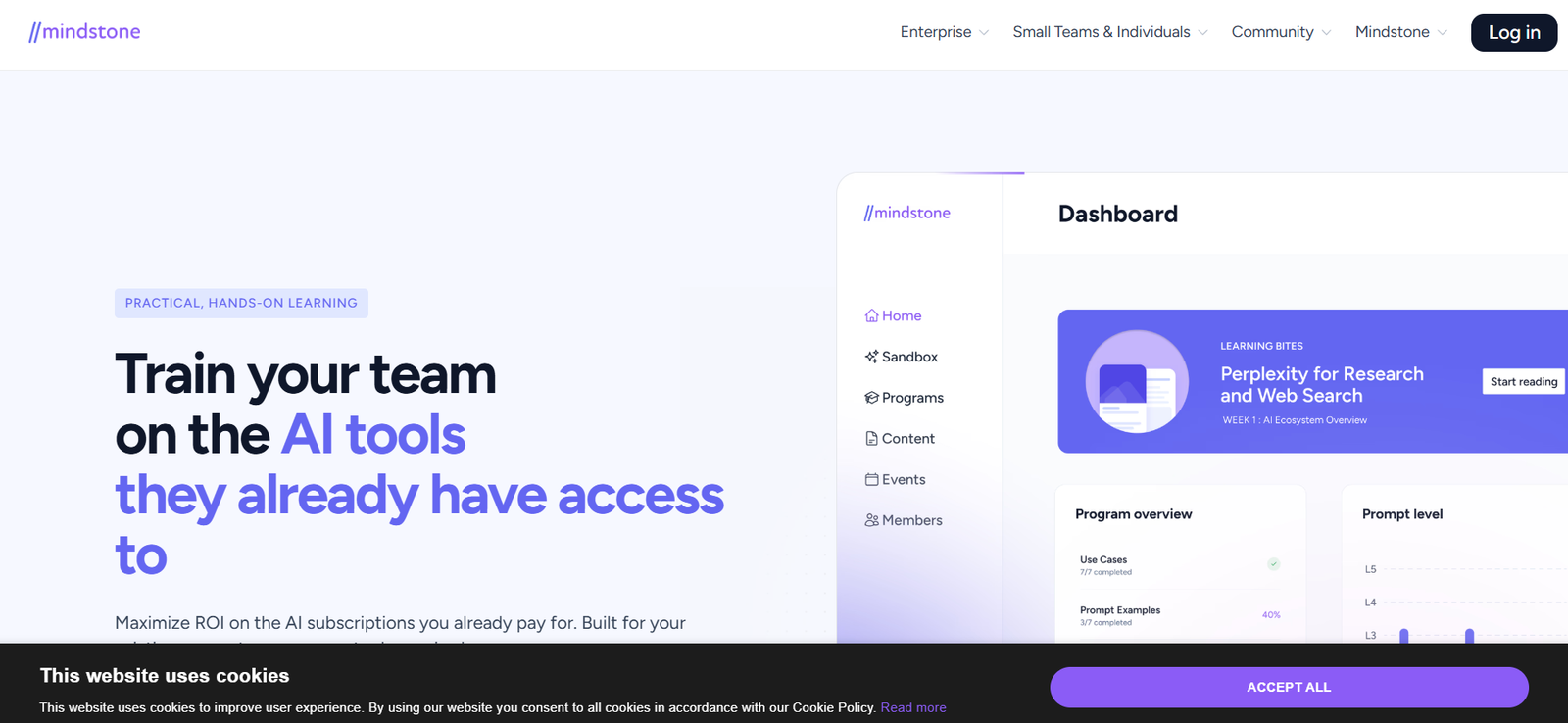
Mindstone is an AI-powered learning platform that helps users turn everyday content—like articles, videos, and podcasts—into structured, personalized learning experiences. Designed for professionals, lifelong learners, and teams, Mindstone makes it easier to retain, understand, and organize information by converting informal content into formal learning pathways.
By combining artificial intelligence with proven learning science, Mindstone enables users to highlight, summarize, and generate flashcards from any web content. The platform is ideal for learners who want to make the most of their time and transform casual browsing or research into intentional, knowledge-building habits.
Features
Mindstone offers a robust set of features that combine AI, productivity tools, and learning science to enhance how people absorb and retain knowledge.
AI-Powered Summarization: Mindstone’s AI automatically summarizes long-form content such as articles, videos, and PDFs, helping users understand key ideas quickly.
Smart Highlighting: Users can highlight text across any type of content—articles, PDFs, or notes—and Mindstone intelligently groups related highlights for better organization and review.
Flashcard Generation: Based on highlights and AI summaries, Mindstone can automatically generate spaced-repetition flashcards to reinforce learning and improve memory retention.
Audio and Video Integration: Mindstone supports learning from podcasts and YouTube videos. Users can import transcripts, highlight segments, and turn them into review materials.
Learning Paths: Users can curate collections of resources into structured learning paths. This is ideal for building knowledge around specific topics or sharing curated content with teams.
Collaborative Learning: Mindstone enables users to share resources, notes, and flashcards with others, making it ideal for teams or learning communities.
Personal Knowledge Library: All highlights, summaries, and notes are stored in one place, turning fragmented learning into an organized knowledge base.
Progress Tracking: The platform tracks reading time, learning progress, and flashcard performance, allowing users to measure their growth over time.
Multiplatform Support: Mindstone works on web and mobile, including a Chrome extension, so users can learn and capture insights anywhere online.
How It Works
Users start by signing up for a free or paid account on the Mindstone platform. Once logged in, they can begin importing content using the browser extension or by uploading files and links directly.
The platform then processes the content and allows users to read, highlight, or annotate it. As users engage with the material, Mindstone’s AI begins generating summaries and learning prompts. Highlights can be turned into flashcards with a click, which are then added to the user’s spaced repetition learning schedule.
Users can group related resources into learning paths and invite others to collaborate. Mindstone then tracks learning activity, time spent, and mastery levels to help users focus on areas that need improvement.
Because Mindstone is built with both individual and team-based learning in mind, it supports content curation, knowledge sharing, and asynchronous collaboration—all powered by intelligent automation.
Use Cases
Mindstone supports a wide range of learning scenarios for individuals and organizations.
Lifelong Learners: People committed to personal development use Mindstone to organize content and retain insights from books, articles, podcasts, and more.
Professionals: Knowledge workers can convert industry research, reports, and online articles into digestible learning units, boosting professional development.
Students: Mindstone supports academic research and study with summarization, annotation, and flashcard tools for more effective review.
Founders and Executives: Leaders can structure personal learning on key topics like leadership, market trends, or product development using curated learning paths.
Remote Teams: Companies can organize internal knowledge, create shared learning journeys, and reinforce skills through collaborative reading and spaced-repetition flashcards.
Content Creators and Educators: Thought leaders can build and share structured learning paths based on articles, videos, or their own content to educate and grow their audiences.
Onboarding Programs: Organizations can design role-specific learning journeys to onboard employees with curated external content and internal documentation.
Pricing
Mindstone offers both free and paid plans, with pricing tailored for individuals and teams. As of the latest information available on the Mindstone pricing page, the plans include:
Free Plan:
Access to AI summarization
Highlighting and note-taking
Flashcard creation
Learning path creation
Chrome extension
Pro Plan – £9/month (or local currency equivalent):
Unlimited flashcards and spaced repetition
Advanced summarization
Enhanced PDF annotation
Progress tracking across all devices
Priority support
Team Plans – Custom pricing:
Designed for teams and organizations
Includes admin features, shared libraries, team learning paths, and usage analytics
Requires direct contact with the sales team for a custom quote
A free trial is available for new users, allowing them to explore premium features before upgrading.
Strengths
Mindstone’s biggest strength is its ability to transform unstructured web content into structured learning experiences. The integration of AI, summarization, and flashcard tools makes it ideal for modern learners overwhelmed by digital information.
It is highly flexible, supporting text, video, audio, and PDFs, which means users can learn from any format. The seamless workflow—from highlighting to spaced repetition—encourages active recall and better retention, based on established learning science principles.
The collaborative features also give it a unique edge, making it one of the few learning tools suitable for teams, educators, and knowledge-sharing groups. Its intuitive design and web-based approach make it accessible to users across industries and education levels.
Drawbacks
Mindstone, while powerful, is still relatively new and may lack some of the integrations and automation offered by more mature learning management systems.
Offline functionality is limited, meaning users need an internet connection to access content and flashcards. Some users may also find the flashcard creation less customizable compared to dedicated flashcard tools like Anki.
The current pricing structure may be less appealing for casual users who only need occasional summarization or note-taking features, especially with more basic alternatives available.
Additionally, Mindstone currently emphasizes self-curated learning paths, which may not appeal to users looking for pre-built courses or guided curriculums.
Comparison with Other Tools
Compared to tools like Notion, Readwise, or Anki, Mindstone offers a more complete learning workflow. Where Notion focuses on note-taking and organization, Mindstone combines reading, summarizing, and active recall into one platform.
Readwise excels at syncing and resurfacing highlights, but it lacks Mindstone’s flashcard generation, AI summaries, and learning path capabilities.
Anki is a powerful spaced-repetition tool but requires manual input and lacks integration with modern web content formats. Mindstone automates this process with AI, making it more efficient for casual and professional learners alike.
Compared to learning platforms like Coursera or Udemy, Mindstone offers a non-linear, self-directed approach. It empowers users to create their own curriculum based on real-world content rather than enrolling in predefined courses.
Customer Reviews and Testimonials
Users consistently highlight how Mindstone helps them stay organized, retain more information, and make better use of their time online. Many professionals report that it has transformed how they consume content, allowing them to turn passive reading into active learning.
Students appreciate the AI-powered flashcard and summarization features, noting how it helps them cut down on study time while improving comprehension.
On platforms like Product Hunt and social media, Mindstone has received praise for its elegant user interface and focus on learning productivity. Users often mention that it feels like “a second brain” for structured knowledge retention.
Educators and content creators have also shared positive feedback about using Mindstone to curate and share resources with learners in a more engaging way.
Conclusion
Mindstone is a forward-thinking learning platform that turns the content you already consume—articles, podcasts, videos—into structured learning experiences with the help of AI. By combining summarization, highlighting, flashcards, and progress tracking, it helps learners retain more knowledge with less effort.
Whether you’re a lifelong learner, student, professional, or team leader, Mindstone offers tools to help you learn smarter, faster, and more intentionally. Its modern approach to knowledge management, backed by learning science, sets it apart from both traditional note-taking apps and formal learning platforms.