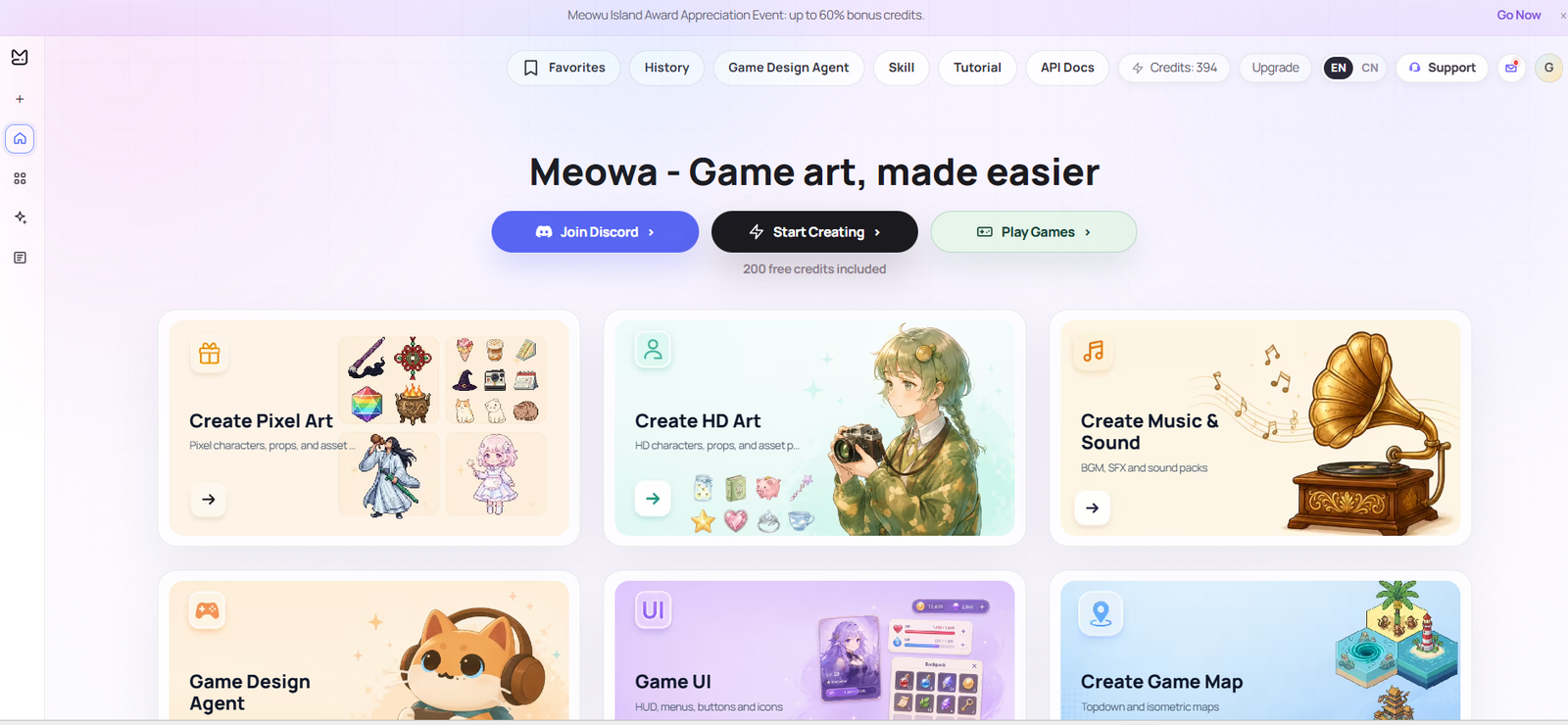
Meowa is an AI-powered game art creation platform designed primarily for indie game developers, solo creators and small art teams. It helps users generate pixel characters, sprites, props, tilesets, environment assets, UI elements and other visual resources for 2D games.
Unlike a general AI image generator, Meowa focuses on game production workflows. Users can create related groups of assets while maintaining a consistent visual direction across characters, environments and objects. This can be useful when building an entire game world rather than generating individual images that look unrelated.
The platform supports different game styles and workflows, including RPGs, platformers, top-down games, retro games and prototypes. Developers can describe characters, classes, camera angles, palettes, environments and other requirements through prompts.
Meowa can also assist with animation planning by generating key poses, movement directions and sprite sheet concepts before developers complete final frame-by-frame polishing in their preferred game development tools.
Features
AI Pixel Art Generator
Meowa can generate pixel-art characters, environments, props and tilesets from text instructions. Users can describe the desired character, object, visual style, palette and game context.
AI Sprite Generator
The sprite generator helps developers create characters and game objects with clear silhouettes and consistent visual characteristics.
It can be used for heroes, NPCs, enemies, items and other game elements.
Sprite Packs
Instead of creating every asset separately, Meowa can generate groups of related assets that share a common visual direction.
This can help developers create characters, props and environment pieces that look as though they belong to the same game.
Character Design
Developers can generate protagonists, NPCs, enemies and faction variations based on roles, weapons, costumes, palettes and other creative instructions.
Tileset Generation
Meowa can create visual directions for environment tiles used to construct towns, dungeons, interiors, landscapes and other game areas.
Environment and Prop Generation
Users can create items such as signs, furniture, barrels, lanterns, market stalls, weapons, pickups, decorations and environmental objects.
Game Asset Generator
Meowa supports broader asset creation beyond characters. Developers can generate character kits, environment packs, GUI elements, item icons, scene pieces and related visual resources.
Animation Direction
The platform can help users explore idle, walking, running, attack and other movement directions.
It is particularly useful during animation planning and key-pose exploration before final production work.
Style Consistency
One of Meowa’s main strengths is its focus on maintaining a shared palette, mood and visual language across different game assets.
This can reduce the problem of generating individual AI images that do not visually match one another.
RPG Maker Workflows
Meowa provides workflows aimed at retro RPG development, including overworld characters, towns, dungeon assets, interiors and props.
Users can target visual directions such as 8-bit, 16-bit, SNES-inspired and other retro game styles.
Public UGC Gallery
The platform includes a public gallery containing prompts and generated results from Meowa users.
Creators can browse examples across categories such as illustrations, character designs, videos and storyboards, product designs, UI layouts and sound effects.
Custom Templates
Paid plans allow users to create custom templates. These can help maintain recurring styles and workflows across a game project.
How It Works
Step 1: Open Meowa Studio
Users start by accessing the Meowa Studio workspace and selecting the type of game art they want to create.
Step 2: Define the Asset
Describe the desired character, sprite, prop, tileset, environment or other game asset.
Step 3: Provide Game-Specific Instructions
Users can specify information such as character class, function, camera angle, palette, mood, game genre and visual style.
Step 4: Generate the Asset
Meowa processes the instructions and generates visual options based on the selected workflow.
Step 5: Create Related Assets
Users can continue generating props, environment pieces, character variations and other resources using the same creative direction.
Step 6: Explore Animation Ideas
For animated assets, developers can experiment with movement directions and key poses before moving to final animation production.
Step 7: Refine the Results
Generated assets can serve as starting points for further cleanup and refinement in dedicated pixel-art, graphics or game development software.
Step 8: Move Assets Into the Game Workflow
Finalized assets can then be prepared for game engines and development environments such as Unity, Godot, RPG Maker and other 2D workflows.
Use Cases
Indie Game Developers
Independent developers can create preliminary game art without needing a large dedicated art team.
Game Artists
Artists can use Meowa to explore character concepts, environmental styles, item variations and different creative directions before final production.
RPG Developers
Creators working on RPGs can generate heroes, NPCs, enemies, towns, dungeon assets, props and tiles while maintaining a common visual direction.
Pixel Art Games
Developers creating retro or pixel-style games can use the platform for characters, tilesets, props and other game resources.
Game Prototyping
Teams can quickly generate temporary or concept assets when testing gameplay ideas before investing in final artwork.
Small Game Studios
Small studios can use AI-assisted generation to explore more visual concepts before assigning selected ideas to artists for refinement.
Godot and Unity Developers
Developers using popular game engines can use Meowa to establish an art direction and create assets that can later be prepared for their production pipeline.
RPG Maker Creators
Users building retro RPGs can generate character and map-related concepts designed around traditional RPG visual styles.
Pricing
Meowa uses a credit-based pricing system with credit packs, monthly memberships and yearly memberships.
The official website currently lists discounted yearly pricing as follows.
Starter
The Starter plan is listed at $4.80 per month when billed yearly, excluding VAT, with $57.60 charged annually.
It provides 600 base credits plus bonus trial credits each month, up to 5 custom templates and commercial ownership of generated assets.
Creator
The Creator plan is listed at $12 per month when billed yearly, excluding VAT, with $144 charged annually.
It provides 1,600 base credits plus bonus trial credits each month, up to 10 custom templates, two simultaneous queued tasks and commercial ownership.
Adventurer
The Adventurer plan is listed at $48 per month when billed yearly, excluding VAT, with $576 charged annually.
It provides 7,000 base credits plus bonus trial credits each month, up to 20 custom templates, five simultaneous queued tasks and commercial ownership.
Archmage
The Archmage plan is listed at $120 per month when billed yearly, excluding VAT, with $1,440 charged annually.
It provides 18,000 base credits plus bonus trial credits each month, up to 100 custom templates, ten simultaneous queued tasks, priority support and commercial ownership.
Meowa also provides credit packs, monthly billing and enterprise solutions.
The website currently mentions promotional bonus credits and daily trial credits associated with a limited-time appreciation event. Since promotional offers can expire or change, users should check the current pricing page before purchasing.
Strengths
Built for game development: Meowa focuses specifically on game art rather than general AI image creation.
Consistent asset families: Developers can create related characters, props and environments while maintaining a shared visual direction.
Strong pixel-art focus: The platform is particularly relevant for developers working on retro, pixel-art and 2D games.
Broad asset coverage: Users can create characters, tilesets, props, environments, UI elements and sprite packs.
Animation planning: Meowa can help establish key poses and movement directions before final animation work.
Custom templates: Paid plans allow developers to establish reusable workflows for recurring asset styles.
Public gallery: Users can explore real prompts and generated results for inspiration.
Commercial ownership: Paid membership plans state that users receive commercial ownership of generated assets.
Drawbacks
AI-generated game assets may still require manual editing before they are ready for a polished commercial game.
Developers requiring strict pixel dimensions, perfect animation frames or highly controlled character consistency may need to refine generated results using dedicated graphics software.
The platform uses credits, so frequent generation and experimentation can consume the available allowance.
Meowa’s strong focus on game assets means it may be less suitable for users who primarily need photorealistic images or general-purpose AI graphic design.
Final integration into a game engine may still require additional work involving sizing, sprite sheets, collision areas, animation timing and other technical preparation.
Comparison with Other Platforms
Meowa competes broadly with AI image generators and specialized AI game asset creation platforms.
General-purpose image generators can produce pixel-art images, but Meowa is more specifically structured around game production needs. Its workflows emphasize characters, asset families, tilesets, props, GUI elements and animation directions rather than isolated artwork.
This focus may make Meowa more convenient for indie developers who need multiple assets to share a consistent visual identity.
Compared with traditional pixel-art software, Meowa can speed up concept generation and experimentation. However, dedicated tools still provide greater manual control over individual pixels, animation frames and final production details.
The platform therefore works best as an AI-assisted creation and ideation environment that can complement, rather than completely replace, traditional game art tools.
Customer Reviews and Testimonials
Customer reviews and testimonials are not clearly available on the official website.
Meowa does provide a substantial public UGC gallery containing prompts and generated results published by users. This can help prospective users evaluate the type and range of content being created with the platform, but these examples should not be considered formal customer testimonials.
Conclusion
Meowa is a specialized AI game art platform for indie developers and small teams that want to create visual assets more quickly while maintaining a coherent style across their game.
Its focus on pixel characters, sprite packs, props, tilesets, environments, UI elements and animation planning makes it more targeted than a general AI image generator. The ability to build related asset families can be particularly valuable when creating an entire game world.
Meowa is best suited to indie game developers, RPG creators, pixel artists, solo developers and small studios that want AI assistance during concept development, prototyping and asset production. For teams willing to refine AI-generated work before final release, it can provide a useful starting point for building a consistent 2D game art pipeline.