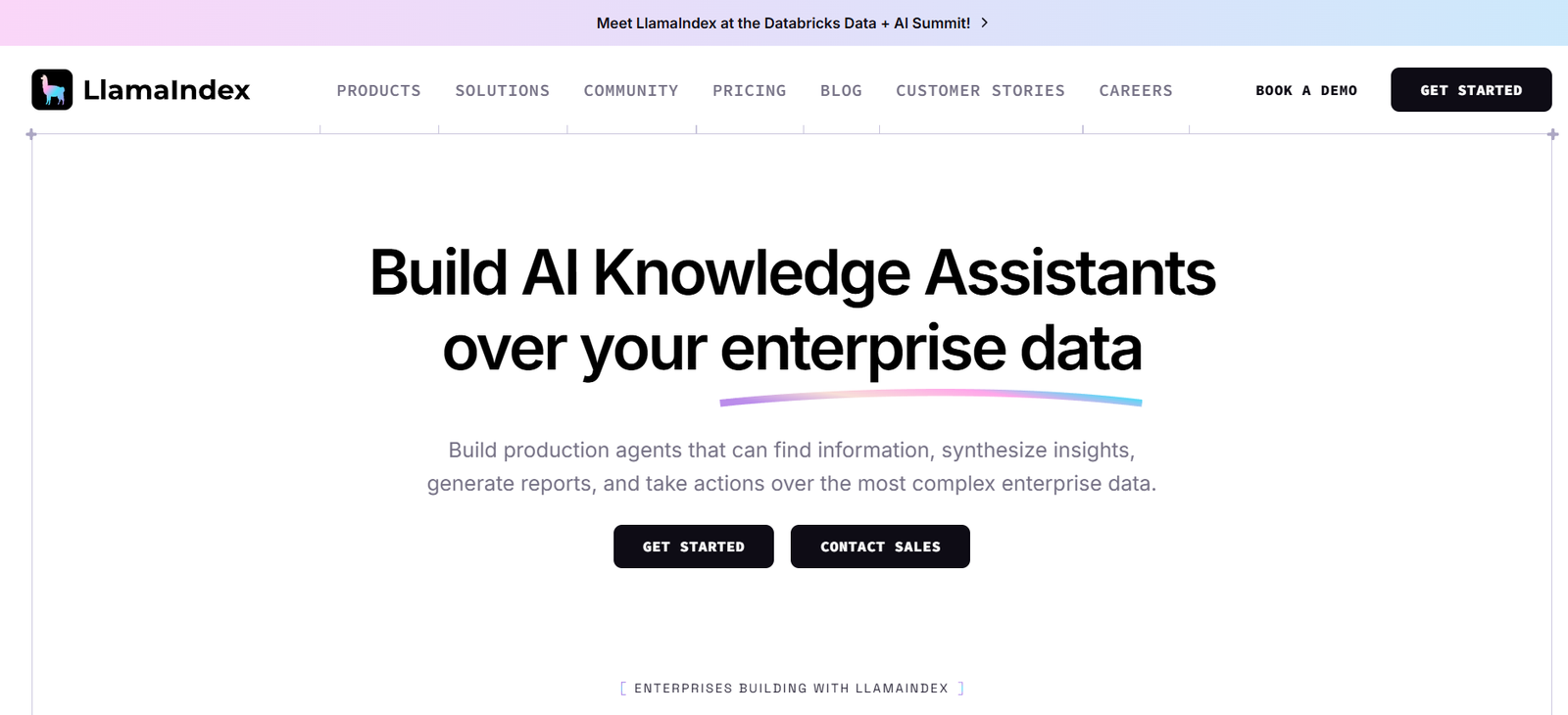
LlamaIndex (formerly known as GPT Index) is a powerful data framework for building context-aware applications with large language models (LLMs) like GPT-4. It enables developers to connect LLMs to their custom, private, and structured data sources—such as PDFs, databases, APIs, Notion pages, and more—unlocking more relevant, secure, and dynamic outputs from AI systems.
Designed for AI engineers, data scientists, and startups, LlamaIndex simplifies the integration of diverse data with LLMs through a modular pipeline, allowing AI apps to pull in up-to-date, context-rich information that the base model might not have seen during training.
Features of LlamaIndex
Data Connectors
Out-of-the-box connectors for numerous data sources, including PDFs, websites, Notion, Google Docs, SQL, APIs, and more—making ingestion easy and scalable.
Indexing Framework
Supports various index types—tree, list, vector, keyword—to structure and store ingested data in a way that optimizes retrieval and query efficiency.
Query Engines
Provides flexible and customizable query engines to retrieve relevant information from indexed data and feed it into LLM prompts.
Memory and Context Handling
Includes memory integration to maintain conversational context across long sessions, essential for chatbots and multi-turn applications.
Modular Pipeline Design
Developers can customize how data is loaded, transformed, stored, and queried using a modular component framework.
Streaming and Real-Time Support
Supports real-time updates and streaming, enabling applications that need live information or time-sensitive content delivery.
Multi-Modal Support
Early support for incorporating structured data, embeddings, and potential future modalities into LLM queries.
Integration with LangChain and OpenAI
Plays well with popular LLM frameworks like LangChain, OpenAI API, and Hugging Face, making it easy to build on existing tools.
Security and Access Control
Supports private and enterprise-grade deployments with data sandboxing, encryption, and access restrictions.
How LlamaIndex Works
Data Ingestion
Developers use LlamaIndex’s prebuilt or custom connectors to ingest data from structured or unstructured sources.Index Construction
The data is parsed, chunked, and indexed into structures optimized for retrieval (e.g., vector indexes, tree indexes).Query Execution
When a user submits a query, LlamaIndex determines the most relevant data chunks and feeds them to the LLM via a prompt.Response Generation
The LLM uses the context provided by LlamaIndex to generate responses grounded in the most relevant and accurate data.Memory and Feedback Loop
In chat-based settings, memory and interaction logs can be used to refine future responses or guide context retention.
Use Cases for LlamaIndex
Enterprise Knowledge Retrieval
Connect internal company documents, wiki pages, and customer support logs to power intelligent Q&A assistants or search tools.
AI-Powered Chatbots
Build contextual chatbots that can answer questions using data from your own systems—like a product catalog, CRM, or documentation.
Academic and Legal Research Assistants
Integrate with large archives of legal cases or academic papers to build AI tools that generate citations and summarize findings.
Healthcare and Clinical AI
Use LlamaIndex to connect LLMs with structured patient data, research journals, and clinical guidelines for context-rich medical applications.
Codebase Exploration Tools
Ingest and index code repositories, enabling LLMs to answer developer queries about specific code files, architectures, or dependencies.
Custom GPT Apps for Clients
Consultants and AI developers can rapidly build tailored GPT-powered applications for niche client datasets using LlamaIndex.
Pricing of LlamaIndex
As of June 2025, LlamaIndex is available as an open-source framework, but also offers paid hosted services and enterprise solutions. Pricing details are as follows:
Open-Source (Free)
Full access to core LlamaIndex libraries via GitHub
Community support on Discord and GitHub
Ideal for developers and hobbyists
LlamaCloud (Hosted Platform)
Usage-based pricing for indexing, storage, and query volume
Includes managed infrastructure, authentication, analytics, and deployment tools
Pricing available upon request via https://www.llamaindex.ai
Enterprise Solutions
Custom integrations, SSO, enhanced security, and SLAs
On-premise or VPC deployment options
Priority support and account management
Users can try LlamaCloud with a free tier, then scale based on application needs.
Strengths of LlamaIndex
Fast and easy way to connect any dataset to LLMs
Open-source with a vibrant developer community
Works with LangChain, OpenAI, and Hugging Face models
Modular, extensible framework for any tech stack
Proven scalability across industries and enterprise use cases
Enables grounded, accurate LLM outputs using your own data
Drawbacks of LlamaIndex
Requires Python development skills to use effectively
Initial setup and customization can be technical for non-engineers
Doesn’t offer prebuilt no-code UI (yet) for non-developers
Performance depends on quality of data chunking and indexing
Hosted LlamaCloud features are still maturing
Comparison with Other Tools
LlamaIndex vs. LangChain
LangChain is an orchestration framework for LLM agents, while LlamaIndex focuses on data indexing and retrieval. They’re often used together.
LlamaIndex vs. Vector Databases (e.g., Pinecone, Weaviate)
Vector DBs store embeddings and handle similarity search. LlamaIndex provides the end-to-end pipeline—including chunking, indexing, retrieval, and query construction.
LlamaIndex vs. Haystack (deepset)
Haystack is more focused on RAG pipelines with traditional search and NLP models. LlamaIndex is designed for modern LLMs and contextual pipelines.
LlamaIndex vs. ChatGPT Plugins / File Uploads
ChatGPT file upload allows querying files in one-off chats. LlamaIndex allows persistent, scalable integration with dynamic and large datasets.
Customer Reviews and Community Feedback
Developers and AI engineers widely regard LlamaIndex as a must-have tool for production-level LLM applications:
“LlamaIndex helped us build an internal knowledge bot for our engineering docs in less than a week.” – Head of AI, Fintech Startup
“It’s the best framework out there for making GPT-4 actually useful with company data.” – AI Consultant
“The open-source community is amazing. LlamaIndex keeps getting better with every release.” – Developer Advocate
With 20K+ GitHub stars and an active Discord community, LlamaIndex continues to gain traction across AI development teams worldwide.
Conclusion
LlamaIndex bridges the gap between powerful large language models and the real-world data that makes them useful. Whether you’re building an internal knowledge assistant, an AI-powered chatbot, or a custom data exploration tool, LlamaIndex offers the data framework and retrieval infrastructure needed to make LLMs context-aware, accurate, and enterprise-ready.
As AI continues to move from lab to production, LlamaIndex stands out as a foundational tool for developers who want to power their LLMs with the right data, at the right time, in the right way.