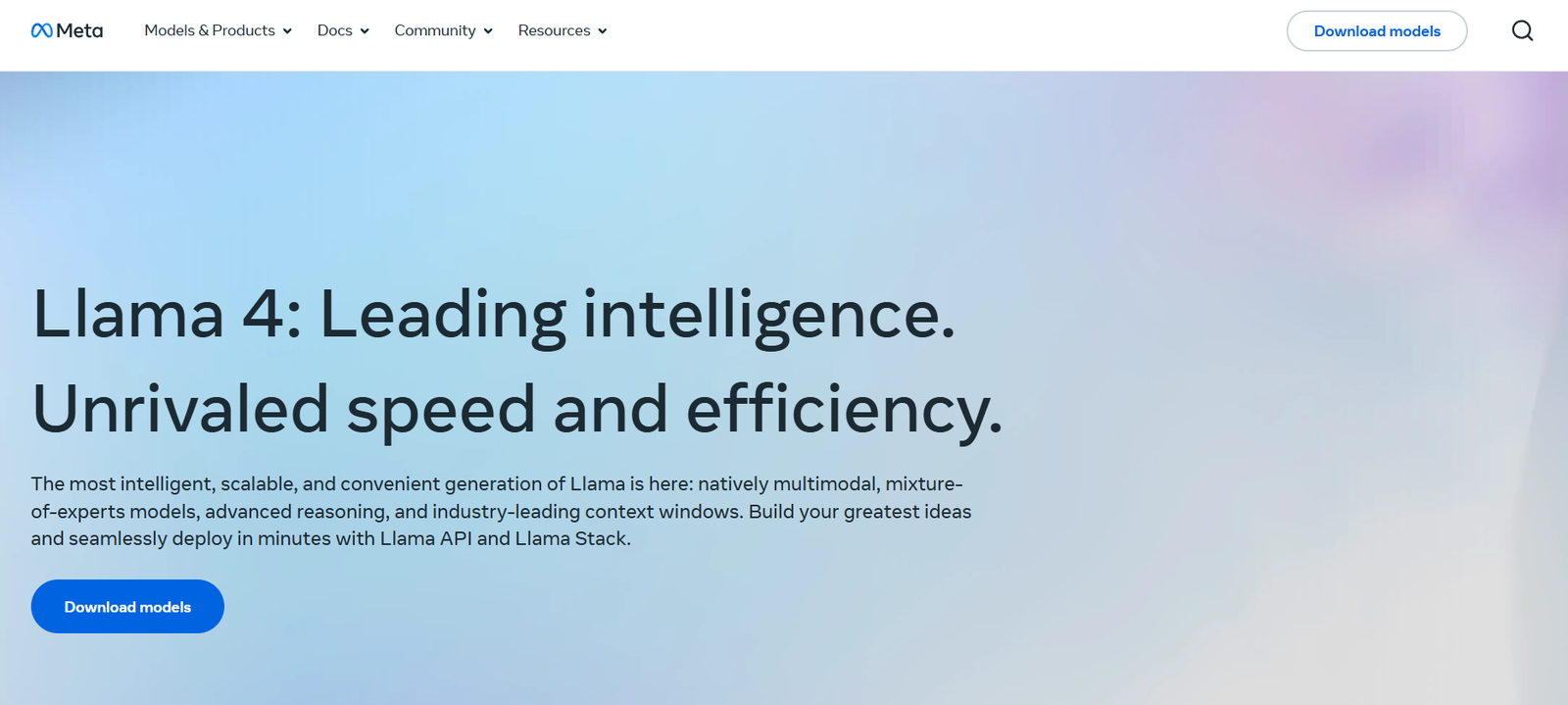
Llama (Large Language Model Meta AI) is a family of open-source large language models developed by Meta AI (formerly Facebook AI). Designed to democratize access to advanced AI capabilities, Llama models are available to researchers, developers, and organizations to build natural language processing (NLP) applications without relying on closed, proprietary platforms.
Llama models are trained on publicly available datasets and released under a permissive license, making them especially attractive to startups, researchers, and enterprises who need transparency, adaptability, and cost-effective deployment. Since its debut in 2023, the Llama series has grown in capability, with the most recent version being Llama 3, released in 2024.
Meta provides these models via www.llama.com, offering access to weights, documentation, and community-driven innovation.
Features
Open-Source Foundation Models
Llama models are available under an open license, giving developers full access to the model weights and training documentation.
Multilingual Capabilities
Llama models are trained on data covering multiple languages, enabling global applications.
Multiple Model Sizes
Llama 3 is available in different sizes (e.g., 8B, 70B), allowing developers to balance performance and infrastructure requirements.
Fine-Tuning Support
Compatible with tools like Hugging Face Transformers and PyTorch, Llama models can be fine-tuned for specific tasks or domains.
Compatible with Meta’s Tools
Optimized for deployment with Meta’s ecosystem, including PyTorch, FAIRSEQ, and LLM compiler stacks.
Chat and Instruction Tuning
Llama 3 models include fine-tuned versions optimized for dialogue and instruction-following, similar to ChatGPT.
Community Collaboration
Ongoing updates, benchmarks, and usage guidelines are shared with the open-source community to drive adoption and innovation.
How It Works
Access the Model
Visit https://www.llama.com to request access or download model weights (subject to licensing terms).Select a Model Size
Choose between various Llama model sizes depending on your use case, compute resources, and performance needs.Set Up the Environment
Use Meta’s documentation to set up your environment with PyTorch, Hugging Face Transformers, or your preferred framework.Fine-Tune (Optional)
Customize the base model with your own datasets for specific applications such as chatbots, summarization, or domain-specific language tasks.Deploy
Use Llama in local, cloud, or edge environments for AI-powered applications.
Use Cases
Enterprise AI Development
Build custom AI assistants, internal tools, or customer service bots using a transparent and modifiable LLM foundation.
Research Institutions
Use Llama models for NLP research, benchmarking, and experimentation.
Startups and AI Builders
Leverage open-source models to reduce dependence on expensive commercial APIs while maintaining model quality.
Government and Education
Create compliant and privacy-focused AI applications using local LLMs with full control over data handling.
Developers and Engineers
Experiment, prototype, or contribute to model improvements and extensions.
Pricing
Llama models are available free of charge under Meta’s open-source license, subject to usage guidelines. Key points include:
Free Use for Research and Commercial Applications
You can download and use Llama models without cost, though commercial use requires acceptance of the license agreement.Self-Hosted Deployment
You need your own infrastructure to run Llama models; Meta does not provide hosted APIs.No Subscription Model
Unlike OpenAI or Anthropic, there is no pay-per-use API for Llama from Meta directly.
Developers can also access Llama 3 via third-party platforms like Microsoft Azure, Amazon Web Services, or Hugging Face, some of which may offer hosted access for a fee.
Strengths
Open-Source and Transparent: Users can view, modify, and fine-tune model weights.
Versatile Deployment: Can be deployed anywhere—on-premise, cloud, or edge.
High Performance: Llama 3 ranks competitively on benchmarks against other state-of-the-art LLMs.
Community-Driven: Extensive contributions from developers around the world.
No Vendor Lock-In: You maintain control of your model and data.
Multilingual Support: Useful for building global and region-specific applications.
Drawbacks
Requires Technical Knowledge: Not beginner-friendly; users must understand ML infrastructure and model deployment.
No Hosted Version by Meta: Users must handle compute, memory, and deployment logistics themselves.
Model Size Can Be Demanding: Larger models like Llama 3 70B require significant hardware resources (e.g., high-end GPUs).
No Built-In Tooling for Low-Code Users: Not accessible to non-developers without integration into third-party platforms.
Comparison with Other Tools
Versus GPT-4 (OpenAI)
GPT-4 is proprietary and API-based. Llama is open-source, allowing for self-hosting and full transparency but requires more setup.
Versus Mistral
Mistral also offers open-source models. Llama has greater multilingual capability and stronger community adoption.
Versus Claude (Anthropic)
Claude provides safer alignment and hosted APIs. Llama gives you control and flexibility, but safety tuning depends on your implementation.
Versus Falcon or BLOOM
All are open-source models. Llama is generally more performant and better maintained with updates and real-world applications.
Customer Reviews and Testimonials
Llama has been widely praised by developers, researchers, and open-source advocates:
“Llama 3 is a serious alternative to GPT-4 for enterprise use—with full transparency.”
“The ability to fine-tune Llama on my own hardware gives me an edge in privacy and cost.”
“Meta’s commitment to open-source with Llama is changing the way we build LLM apps.”
“We deployed a Llama-based internal chatbot that runs fully on-prem and works great for our use case.”
Numerous success stories have been shared on GitHub, Hugging Face, Reddit, and AI developer communities worldwide.
Conclusion
Llama is a powerful and accessible family of open-source language models developed by Meta to enable broader participation in the AI revolution. With high performance, strong multilingual capabilities, and a permissive license, Llama is a compelling choice for developers and organizations that value transparency, control, and innovation.
Whether you’re building enterprise AI tools, conducting research, or experimenting with next-gen NLP, Llama provides the flexibility and capability to accelerate your work—without vendor constraints.