
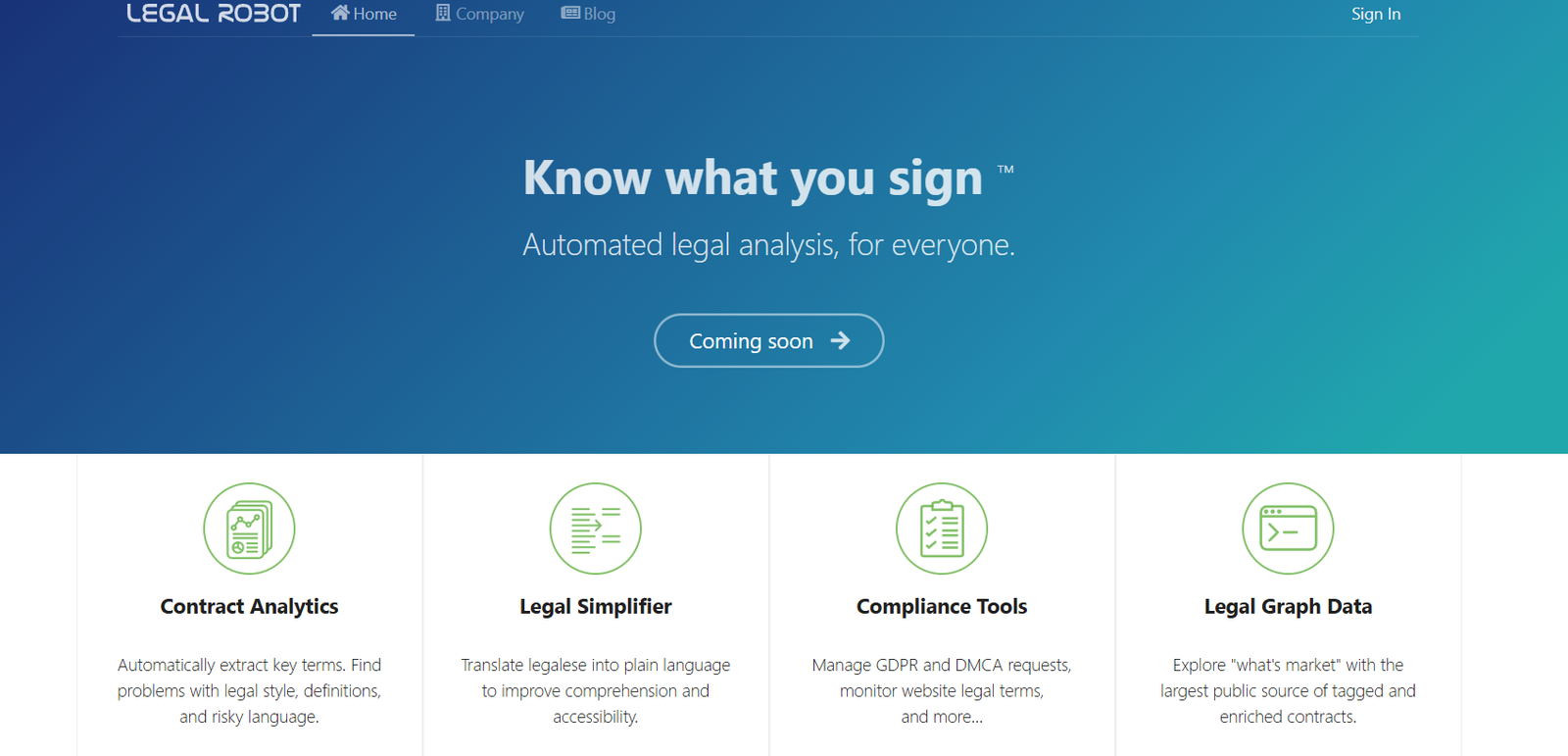
Legal Robot is an AI-powered contract analysis tool designed to help legal professionals and businesses understand, evaluate, and improve the quality of their legal documents. The platform applies machine learning and natural language processing to assess contracts for clarity, consistency, legal standards, and potential risk.
Legal Robot was developed to bring transparency and accessibility to legal documents by identifying problematic clauses, suggesting clearer language, and comparing contract terms to industry norms. It helps users understand the readability and enforceability of their contracts without needing extensive legal training, making it particularly useful for startups, small businesses, and in-house legal teams.
Rather than generating contracts from scratch, Legal Robot focuses on analyzing existing documents to ensure they meet legal and linguistic best practices.
Features
Legal Robot offers a focused set of features for contract review, language analysis, and legal compliance evaluation.
Contract Analysis: Reviews uploaded contracts to highlight ambiguous language, high-risk terms, and deviations from standard practices.
Readability Scoring: Uses linguistic metrics to evaluate the clarity of contract language and suggests improvements for better understanding.
Legal Consistency Check: Identifies inconsistent terms, cross-references, or formatting issues that may reduce enforceability.
Machine Learning Comparison: Compares clauses and language with a database of millions of documents to highlight how standard or non-standard a contract is.
Multilingual Support: Analyzes contracts in several languages, providing feedback based on localized legal standards and linguistic structures.
Legal Definitions and Explanations: Offers contextual explanations for complex legal phrases to improve user understanding.
No Legal Advice Model: Instead of replacing attorneys, Legal Robot assists by enhancing document transparency and identifying areas for further review.
Data Privacy and Security: All documents are encrypted during upload and analysis, ensuring user confidentiality and compliance with data protection regulations.
How It Works
Legal Robot operates as a cloud-based platform accessible through any web browser. Users begin by uploading a legal document, such as a contract, service agreement, or lease. Once uploaded, Legal Robot uses its proprietary AI models to scan the document for structural, linguistic, and legal patterns.
The system then generates a report showing various metrics, such as readability scores, risk indicators, and clause comparisons. Each section of the document is color-coded and explained, allowing users to understand which parts may be problematic or legally unclear.
Unlike contract generators, Legal Robot does not create new contracts. Instead, it enhances existing documents by identifying areas where clarity, compliance, or consistency can be improved. The platform is not a replacement for a lawyer but serves as a valuable aid in preparing contracts for review or negotiation.
Use Cases
Legal Robot serves a broad range of use cases across legal and business environments.
Startups and Small Businesses: Quickly review contracts such as NDAs, vendor agreements, and terms of service to identify risks before signing.
In-House Legal Teams: Perform preliminary analysis on large volumes of contracts to highlight potential issues for legal review.
Freelancers and Contractors: Understand client contracts without requiring full legal representation.
Law Firms: Use Legal Robot to support junior lawyers in identifying clause-level issues or inconsistencies in lengthy documents.
Procurement and Compliance Teams: Assess contracts for alignment with company standards, vendor terms, and regulatory language.
Non-Legal Professionals: Gain insights into legal documents without needing a legal background, reducing dependence on outside counsel for every review.
Pricing
Legal Robot offers flexible pricing depending on user needs and organization size. While exact prices are not publicly detailed, the platform follows a tiered model.
Free Trial:
New users can explore a limited version of the tool to assess its features before purchasing a subscription.
Individual Plans:
Offer pay-as-you-go or monthly subscriptions for freelancers, small businesses, or individual legal professionals needing occasional analysis.
Business Plans:
Include higher usage limits, team access, and enhanced reporting features for legal departments or law firms.
Enterprise Licensing:
Custom pricing is available for large organizations that require integration, API access, or processing of high document volumes.
All plans include access to contract analysis tools, readability scoring, and clause comparison features.
Strengths
Legal Robot provides several compelling benefits for professionals involved in contract management and review.
Clarity and Transparency: Translates legal complexity into accessible language and scores, improving document understanding.
Risk Identification: Highlights high-risk or non-standard terms that may need renegotiation or legal counsel review.
Standardization: Helps teams align contracts with internal standards by comparing clauses against broader datasets.
Time-Saving: Speeds up contract review for busy legal departments or small businesses that lack dedicated legal staff.
Non-Legal User Friendly: Designed for use by non-lawyers, making it ideal for startups and operational teams.
Data Privacy: Encrypts all uploaded documents, protecting sensitive contract information from third-party access.
No Legal Advice Risk: Clearly positions itself as a support tool, reducing compliance risks associated with unlicensed legal guidance.
Drawbacks
Despite its advantages, Legal Robot may not suit every user or legal scenario.
Not a Drafting Tool: It does not generate contracts from scratch, which may limit utility for users looking to create new documents.
Limited Jurisdictional Customization: Legal standards and enforceability vary by region, and Legal Robot may not offer deep jurisdiction-specific insights.
Not a Replacement for Legal Advice: Complex or high-stakes contracts still require review by qualified legal professionals.
Free Version Limitations: The free trial offers only partial access to the platform’s full analytical capabilities.
Focus on Language Over Law: While it offers legal insight, much of the analysis is focused on linguistic rather than strictly legal interpretation.
Comparison with Other Tools
Legal Robot differs from platforms like Law Insider, which provide clause libraries and real contract examples, by focusing more on the analysis of uploaded documents. While Law Insider helps with drafting by example, Legal Robot helps with understanding and risk assessment.
Compared to AI legal assistants like Spellbook or Casetext CoCounsel that generate legal text or conduct deep research, Legal Robot centers on document evaluation and readability.
Unlike contract lifecycle tools like Ironclad or PandaDoc, which handle the full contract process including approvals and e-signature, Legal Robot specializes in pre-signature analysis and quality assurance of contract language.
Its closest competitors are readability tools like BriefCatch, though Legal Robot adds legal risk analysis and clause comparison, making it more suitable for contract-specific evaluations.
Customer Reviews and Testimonials
Users of Legal Robot often highlight its value in improving understanding and clarity during the contract review process. Testimonials from small business owners, freelance professionals, and legal operations teams frequently emphasize its speed and accessibility.
A startup founder noted that “Legal Robot helped me realize a key clause in a vendor contract gave them more termination rights than we expected. We were able to renegotiate based on that insight.”
A freelance designer shared, “I used Legal Robot to review my client agreement before signing. It flagged complex language that I didn’t understand and helped me feel more confident about the deal.”
Overall, user feedback reflects appreciation for the platform’s ability to simplify legal text and empower more informed decision-making, particularly for non-lawyers.
Conclusion
Legal Robot is a practical AI tool for contract analysis and compliance review. It offers an accessible, insightful way for legal professionals and businesses to evaluate contract language, identify risks, and improve the clarity of legal documents. While it does not draft contracts or replace attorneys, it serves as an excellent first line of review, saving time and increasing document quality.
For startups, in-house teams, or solo professionals handling contracts without the constant support of legal counsel, Legal Robot provides a valuable layer of protection and insight. Its focus on readability, consistency, and risk reduction makes it a unique offering in the legal tech landscape.


