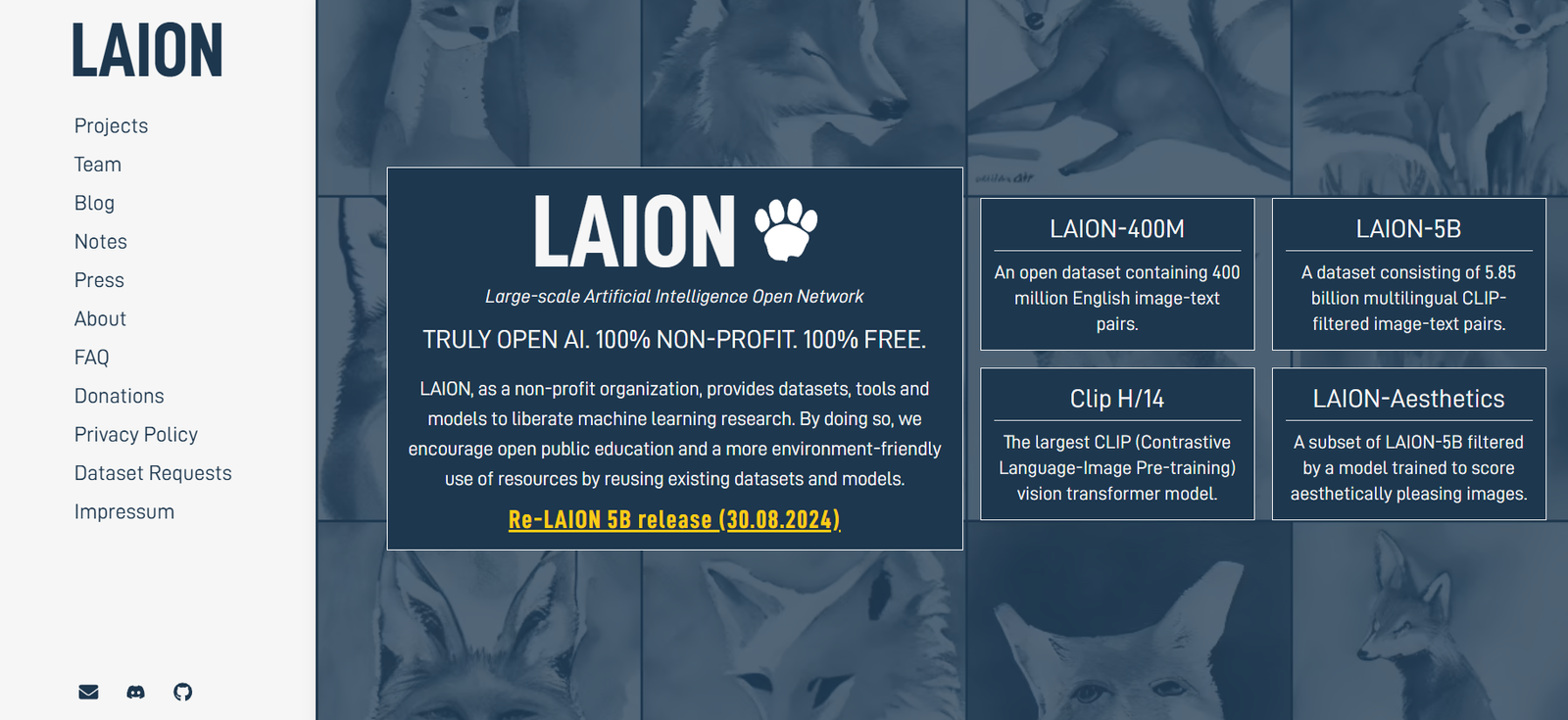
LAION (Large-scale Artificial Intelligence Open Network) is a non-profit organization dedicated to advancing artificial intelligence by providing large-scale, open-source datasets, models, and research tools to the global community. LAION promotes transparency, accessibility, and collaboration in AI by offering freely available resources that help researchers and developers build, evaluate, and improve machine learning models.
Best known for powering foundational datasets like LAION-400M and LAION-5B—used to train large models such as CLIP and Stable Diffusion—LAION plays a critical role in democratizing access to AI training data. The organization also contributes to AI safety, benchmarking, and the development of multilingual and multimodal tools.
Features
LAION’s primary feature is its open-access AI datasets. These datasets are designed for training large-scale machine learning models in computer vision, natural language processing, and multimodal learning. The most well-known datasets include LAION-400M, LAION-5B, and LAION-Aesthetics, which provide billions of image-text pairs scraped from the web.
These datasets are cleaned, filtered, and publicly released under permissive licenses to enable reproducible AI research. Each dataset includes metadata such as resolution, language, and aesthetic score, giving researchers greater control over their training input.
In addition to datasets, LAION offers tools like OpenCLIP, an open-source implementation of the CLIP model, optimized for flexibility and community collaboration. LAION also contributes to multimodal search engines, semantic similarity APIs, and visual embedding models.
Another feature is the dedicated benchmarking and evaluation tools, which help users assess model performance across tasks and datasets. LAION encourages responsible AI development and supports global education initiatives in machine learning.
How It Works
LAION’s datasets are compiled using large-scale web crawling techniques. Publicly available image-text pairs are collected, filtered for quality, deduplicated, and stored with accompanying metadata. The datasets are released in formats compatible with modern deep learning frameworks like PyTorch and TensorFlow.
Users can download datasets directly via LAION’s GitHub repositories or through linked storage services like Hugging Face, AWS, and academic mirrors.
Developers and researchers can fine-tune models using LAION datasets or use them for pretraining tasks. LAION’s open-source tools, such as OpenCLIP, enable users to replicate or extend state-of-the-art models.
LAION operates through a community-driven model, welcoming contributions and collaboration from AI researchers, data scientists, and institutions. All datasets and code are freely available under open-source licenses.
Use Cases
LAION serves a wide range of applications in machine learning and artificial intelligence.
Computer vision research teams use LAION datasets to train models for image classification, object detection, and scene understanding.
Multimodal AI developers utilize the image-text pairs to train vision-language models such as CLIP or Stable Diffusion, which require large-scale, diverse datasets.
NLP researchers can study semantic alignment between text and image inputs, using LAION’s multilingual capabilities.
Educational institutions leverage LAION’s resources for AI curriculum development, allowing students to learn on real-world datasets.
Startups and open-source developers use LAION’s tools to build applications in creative AI, such as text-to-image generation, visual search, and AI art.
Ethics and safety researchers rely on LAION to audit dataset bias, assess model fairness, and study AI transparency in large language and vision models.
Pricing
LAION’s datasets and tools are completely free and open-source. The organization operates under a non-profit model and releases all resources under licenses such as CC-BY or Apache 2.0.
Users can download datasets, access source code, and integrate LAION tools without payment or subscriptions.
Support for hosting, bandwidth, and development is funded by donations, grants, and community support. LAION encourages contributions to sustain its mission and maintain the infrastructure required for serving multi-billion-item datasets.
Strengths
LAION’s biggest strength is its commitment to open access and transparency in artificial intelligence. In an era where many large datasets are held by corporations, LAION provides public alternatives that foster reproducibility and innovation.
Its datasets are massive in scale and optimized for training cutting-edge AI models. LAION also provides tools that match or exceed the functionality of proprietary alternatives, such as OpenCLIP.
Community involvement is another strength. LAION’s projects are developed with input from global contributors and are frequently updated to reflect research needs.
Its impact is evident—many foundational AI models used today were trained using LAION datasets. By remaining vendor-neutral and academic-friendly, LAION helps level the playing field in AI research and development.
Drawbacks
While LAION is a leading force in open data, it faces several limitations.
The image-text pairs are collected from the public web, meaning some data may contain inaccuracies, copyright concerns, or low-quality content. LAION provides filters, but curation is still limited compared to proprietary datasets.
Another challenge is infrastructure dependency. Hosting petabyte-scale datasets requires robust cloud support, which can sometimes limit access speeds or cause interruptions.
Users with limited computational resources may struggle to train models on such large datasets without specialized hardware.
Finally, while LAION emphasizes ethics and safety, it remains a neutral provider. Users are responsible for how they apply and filter the data, which raises questions about responsible use in sensitive applications.
Comparison with Other Tools
LAION is most often compared to proprietary datasets like Google’s JFT-300M, OpenAI’s internal training data, or Facebook’s ImageNet extensions.
Unlike these closed datasets, LAION is fully open and freely available, which makes it uniquely valuable to independent researchers, educators, and startups.
Compared to Common Crawl or The Pile (for language models), LAION focuses on vision and multimodal data, carving a niche in image-text pairing.
Hugging Face provides similar community-driven datasets, but LAION specializes in large-scale, web-scraped content with multimodal focus and is often used to pretrain vision-language models.
Its OpenCLIP tool also competes with OpenAI’s CLIP but is entirely open-source and extensible, making it more accessible for experimentation and modification.
Customer Reviews and Testimonials
While LAION is not a commercial product, it is widely respected in the research and developer communities.
Academic papers and AI conferences frequently cite LAION datasets as foundational to their experiments. Researchers praise the availability, scale, and openness of LAION resources.
Developers working on generative models like Stable Diffusion or Midjourney often credit LAION datasets for enabling their training pipelines.
Online testimonials highlight LAION’s role in supporting open-source development, AI education, and the democratization of high-performance computing.
Some users request more user-friendly documentation or filtering options, but the consensus is overwhelmingly positive regarding the mission and value LAION provides.
Conclusion
LAION is a transformative force in the AI ecosystem, offering open datasets, tools, and research that empower global innovation. By providing massive, high-quality, freely available image-text datasets, LAION lowers barriers to entry and fosters ethical, inclusive, and transparent AI development.
Whether you are a machine learning researcher, educator, startup founder, or open-source contributor, LAION gives you access to the tools needed to build and train advanced AI models.
As artificial intelligence continues to grow, organizations like LAION play a critical role in ensuring that innovation remains accessible to all.
If you’re looking for large-scale training data or open-source AI tools, LAION is an indispensable resource worth exploring.