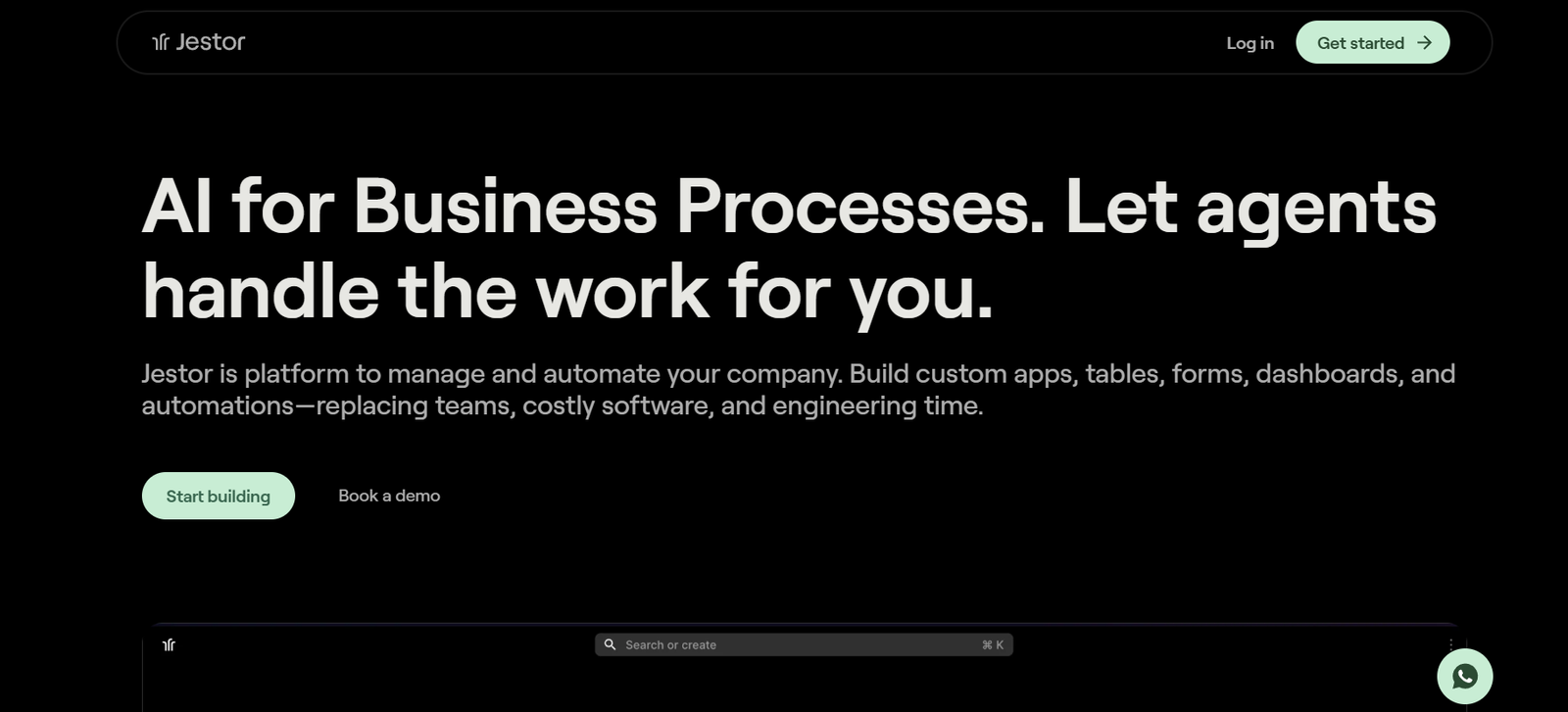
Jestor is a no-code and low-code platform that enables non-technical teams—especially in operations, finance, and product—to build internal tools, automate workflows, and centralize business data without relying on engineering resources. Designed to replace spreadsheets, scattered apps, and legacy tools, Jestor gives teams full control over how they create and manage their own software tools.
Jestor combines the flexibility of databases like Airtable, the process power of project tools like Asana, and the automation capability of platforms like Zapier—all within a unified environment tailored to business users.
Features
No-Code Internal App Builder
Create dashboards, custom forms, internal tools, and tables without writing code. Drag-and-drop components make building tools intuitive.
Relational Databases
Store structured business data and connect multiple datasets (like leads, tasks, vendors) with relational logic.
Workflow Automation
Automate repetitive tasks using a visual automation builder or custom code blocks, supporting triggers and actions.
Built-In Permissions and Access Control
Set granular permissions for users, teams, and external partners—ensuring data security across roles.
Native Integrations
Connect with Slack, WhatsApp, Gmail, Discord, Google Sheets, and other tools to extend your workflows.
Custom Scripts (Low-Code)
Add business logic or advanced operations using JavaScript, expanding flexibility for tech-savvy users.
Mobile App Support
Manage internal operations on the go via mobile, with responsive dashboards and input forms.
How It Works
Start with a Template or from Scratch
Choose a pre-built template (CRM, finance tracker, help desk, etc.) or create a board or table from scratch.Design Your Database and UI
Set up tables with fields (text, number, dropdown, formula, date) and design views with charts, forms, or Kanban boards.Automate Workflows
Define automation triggers (e.g., “when a task is created”) and actions (e.g., “send a Slack message” or “update a record”).Add Users and Set Permissions
Invite team members, define roles, and ensure users see only what they need.Integrate with Tools
Connect third-party services to push and pull data or automate cross-platform actions.
Use Cases
Operations Management
Replace spreadsheets and static checklists with live dashboards and real-time status tracking.
Finance and Accounting
Build budget trackers, invoice systems, approval workflows, and vendor management dashboards.
Customer Support and Success
Create internal CRMs, ticketing tools, or onboarding trackers customized to your team’s workflow.
Product and Engineering Teams
Coordinate product launches, manage feature roadmaps, or track sprints using custom Kanban boards and automations.
Startups and Venture Builders
Quickly create MVP tools for internal teams without the need to code or hire developers.
Pricing
As of June 2025, Jestor offers tiered pricing based on features, user volume, and level of customization.
Free Plan
For individuals or testing
1 user
Basic boards and fields
Limited automations
Community support
Starter Plan – $9/user/month
For small teams
Unlimited boards and tables
100+ automations/month
Slack & WhatsApp integration
Email support
Business Plan – $29/user/month
For scaling teams
Advanced workflows and automations
Role-based permissions
Custom formulas and code blocks
API and webhook access
Enterprise Plan – Custom Pricing
SSO & custom branding
Dedicated customer success
SLA and security compliance
Unlimited automation actions
Priority support
For full pricing details, visit: https://jestor.com/pricing
Strengths
No-Code Meets Low-Code: Combines easy visual building with coding options for flexibility.
Ops-Focused: Tailored specifically for business operations, not just generic project management.
Unified Platform: Replaces multiple tools (spreadsheets, CRMs, dashboards) in one ecosystem.
Rich Templates and Onboarding: Fast start with templates for sales, HR, logistics, etc.
Granular Permission Controls: Enterprise-grade user management built-in.
Drawbacks
UI May Feel Dense at First: Can be overwhelming for users unfamiliar with databases or complex tools.
Learning Curve for Advanced Features: Full platform potential requires some onboarding or training.
Limited Public Sharing: More focused on internal tools, not external portals or client-facing apps.
Pricing Adds Up with Larger Teams: Cost can scale quickly as user count grows.
Comparison with Other Tools
Jestor vs. Airtable
Airtable is spreadsheet-first. Jestor focuses more on business logic, workflow automation, and access control.
Jestor vs. Notion
Notion is best for content and docs. Jestor is purpose-built for operational use cases with relational data and scripting.
Jestor vs. Retool
Retool requires coding and targets developers. Jestor bridges no-code and low-code for business users.
Customer Reviews and Testimonials
“Jestor helped us replace five different tools across finance, ops, and HR.”
– Operations Lead, Logistics Startup
“We created an internal CRM and onboarding tool in less than a week—with no engineering support.”
– Head of Customer Success, SaaS Company
“Perfect for fast-growing companies that outgrow spreadsheets but can’t build full apps yet.”
– COO, Startup Studio
Conclusion
Jestor is a powerful internal tool builder designed for business teams that need more than spreadsheets but don’t want the complexity of traditional development. With its blend of no-code simplicity and low-code extensibility, Jestor enables operations, finance, product, and support teams to build flexible, scalable solutions tailored to their needs—without waiting on dev resources.
If you’re looking to centralize operations, automate processes, and empower your teams to move faster, Jestor is a versatile and modern platform worth trying.