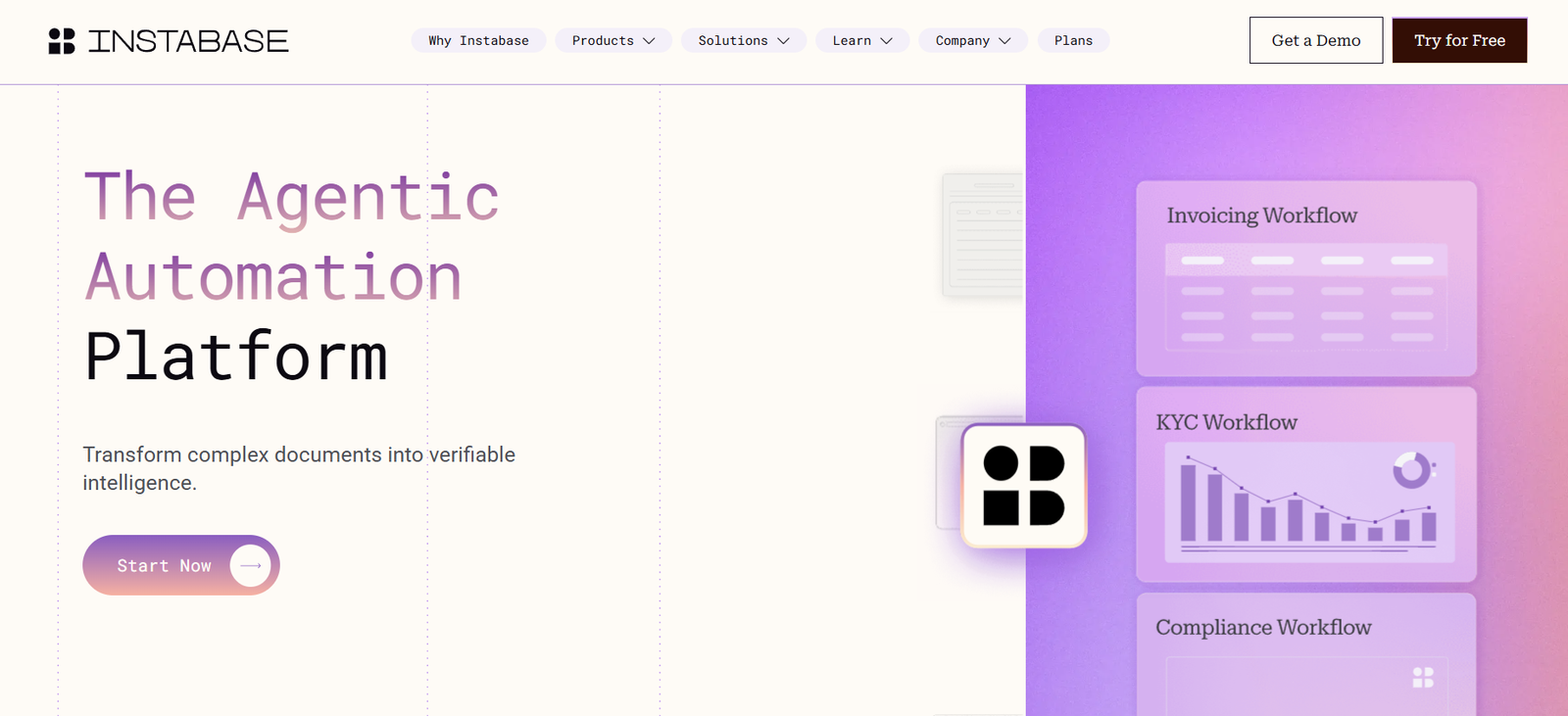
Instabase is an enterprise-grade AI platform designed to automate complex business processes involving unstructured documents. It offers end-to-end intelligent document processing (IDP) capabilities by using advanced artificial intelligence and machine learning to extract, classify, and understand data from documents such as invoices, contracts, tax forms, and more.
Founded in 2015, Instabase enables large organizations—particularly in industries like banking, insurance, and healthcare—to build custom AI workflows that streamline operations, reduce manual work, and improve accuracy. The platform empowers developers and non-technical users alike to create tailored solutions by leveraging a suite of modular AI building blocks.
Features
Instabase provides a wide range of features centered around document understanding and automation.
Its AI Hub offers pre-built foundation models trained for enterprise use cases, such as document classification, information extraction, and semantic search.
The platform includes Instabase Studio, a no-code/low-code visual environment that allows users to design and deploy AI-powered workflows without extensive programming knowledge.
It supports integration with enterprise systems and databases, enabling seamless automation across existing business processes.
Instabase also provides tools for custom model training, allowing organizations to fine-tune models on their proprietary data for improved performance.
With governance and security capabilities built in, Instabase ensures compliance with enterprise-grade data handling standards.
How It Works
Instabase operates as a cloud-based platform where users can build intelligent workflows to process unstructured data. The process typically begins with document ingestion through APIs, file uploads, or third-party integrations.
Once documents are ingested, they are automatically classified by type. For example, Instabase can distinguish between a W-2 tax form and a bank statement using AI classification models.
After classification, data is extracted from the documents using pre-trained or custom extraction models. These models understand the context of the document, not just layout-based information.
The extracted data can then be validated, enriched, and routed to downstream systems such as CRM platforms, databases, or document repositories. Users can configure these workflows using Instabase Studio or write code in Python for more advanced customizations.
The platform continuously learns and improves through human-in-the-loop feedback, enabling better model accuracy over time.
Use Cases
Instabase is particularly useful in industries where document-driven workflows are critical.
In the banking sector, it automates loan processing by extracting and validating information from income statements, ID proofs, and credit reports.
Insurance companies use Instabase to accelerate claims processing by understanding forms like FNOL (First Notice of Loss) and medical reports.
In healthcare, it is used to automate prior authorization and patient onboarding processes by extracting data from insurance cards, clinical notes, and consent forms.
Government agencies and legal departments use Instabase to analyze complex documents such as court rulings, contracts, and policy documents.
The platform is also employed for fraud detection, regulatory compliance, and KYC/AML processes by analyzing large volumes of unstructured data.
Pricing
Instabase does not list public pricing on its official website. As an enterprise solution, pricing is customized based on the size of the organization, volume of documents processed, and the complexity of workflows.
Interested clients must contact Instabase’s sales team to schedule a demo and receive a custom quote tailored to their specific requirements.
While pricing is not openly disclosed, Instabase positions itself as a premium solution for large enterprises and government institutions.
Strengths
Instabase’s strength lies in its ability to handle highly unstructured and complex document types with high accuracy using foundation AI models.
Its modular and flexible architecture allows users to build tailored automation workflows suited to their unique business needs.
The platform is enterprise-grade, offering robust scalability, compliance, and security features necessary for handling sensitive data.
Instabase’s no-code/low-code environment enables cross-functional teams—including business analysts, operations teams, and developers—to collaborate effectively.
It also offers rapid deployment with minimal need for AI expertise, reducing time to value in document-heavy use cases.
Drawbacks
Instabase is geared primarily toward large enterprises, making it less accessible for small to mid-sized businesses that may not have the resources for enterprise-scale deployment.
Its pricing transparency is limited, which could be a barrier for organizations that require upfront budgeting information.
While powerful, the platform may present a learning curve for users unfamiliar with document AI workflows, particularly if they are not using the no-code environment.
Customization of complex workflows may still require technical knowledge, especially for organizations that want to integrate deeply into legacy systems or build custom models.
Comparison with Other Tools
Instabase competes with other intelligent document processing platforms such as UiPath Document Understanding, Abbyy FlexiCapture, and Microsoft’s AI Builder.
Compared to UiPath, which integrates tightly with RPA, Instabase offers deeper capabilities in document AI and more flexibility in building custom workflows.
Unlike Abbyy FlexiCapture, which focuses primarily on template-based data extraction, Instabase uses foundation models that generalize across multiple document types, reducing the need for predefined templates.
Compared to Microsoft AI Builder, Instabase is more enterprise-focused, offering greater customization, advanced model training options, and a broader suite of developer tools.
While each platform has its strengths, Instabase is particularly suited for organizations looking for end-to-end automation of unstructured document workflows with a high degree of accuracy and flexibility.
Customer Reviews and Testimonials
Customer testimonials available through industry case studies and third-party platforms like Gartner Peer Insights, LinkedIn, and company press releases highlight Instabase’s impact on operational efficiency and automation scalability.
Clients often report significant reductions in processing time for manual document tasks, improved compliance reporting, and increased throughput without additional headcount.
Financial institutions have praised Instabase for its ability to adapt to complex document types and regulatory requirements, while insurance companies appreciate the fast deployment and ease of integrating with legacy systems.
Developers and data scientists note the platform’s flexibility and extensibility, especially the ability to fine-tune AI models and integrate with enterprise data pipelines.
Conclusion
Instabase is a leading intelligent document processing platform that enables enterprises to automate complex workflows involving unstructured data. By combining powerful AI models, a modular architecture, and user-friendly development environments, Instabase helps organizations increase efficiency, accuracy, and scalability across critical document-driven processes.
Although the platform is designed primarily for large enterprises, its flexibility and impact make it a strong contender in the document automation space. For companies in banking, insurance, healthcare, and government, Instabase offers a future-ready solution to the challenges of managing and extracting insights from massive volumes of unstructured documents.