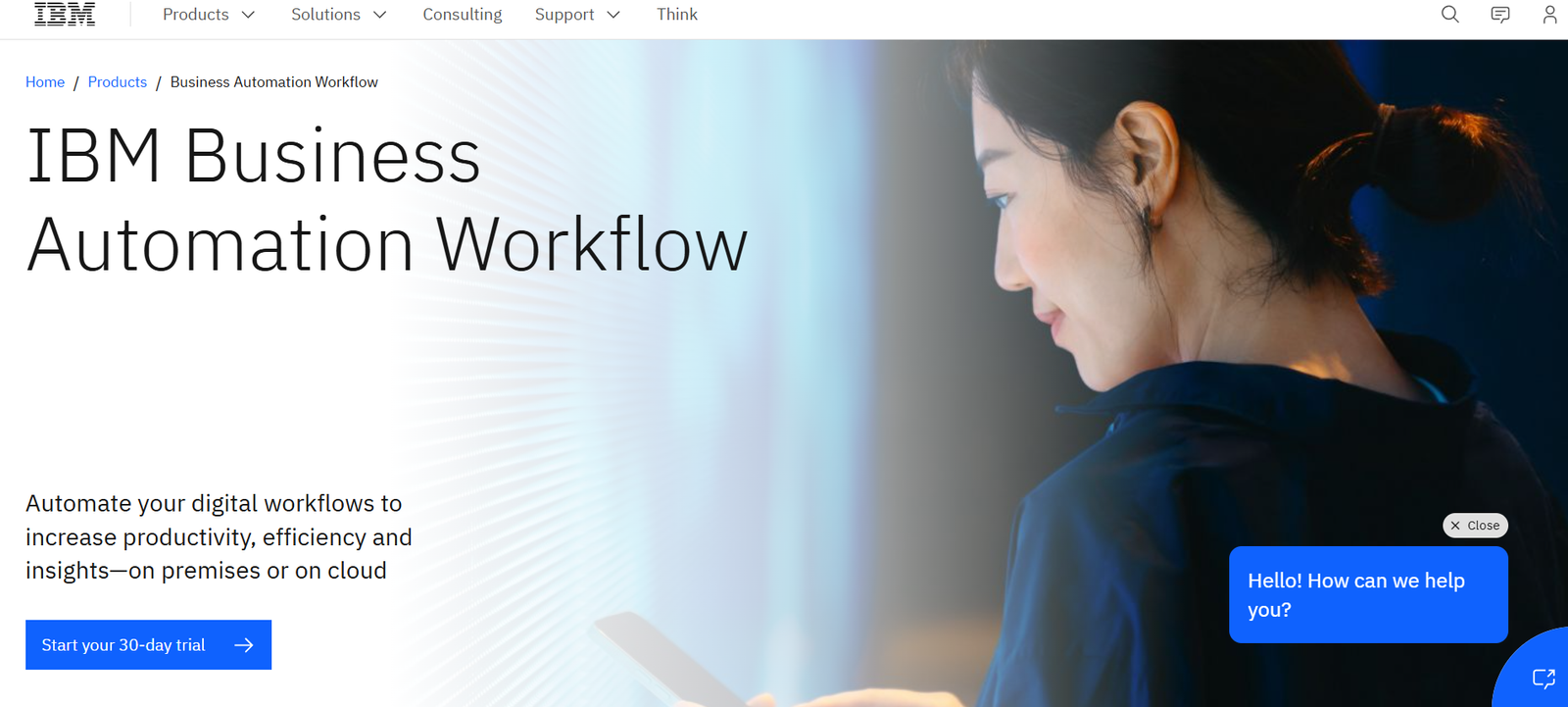
IBM Watson is a comprehensive suite of enterprise AI tools and services developed by IBM, designed to help organizations automate processes, derive insights from unstructured data, and improve decision-making with artificial intelligence. Built for businesses of all sizes and tailored for industry-specific use cases, IBM Watson combines natural language processing (NLP), machine learning, data visualization, and automation tools into a powerful ecosystem.
Since its public debut on Jeopardy! in 2011, IBM Watson has evolved into a scalable AI platform integrated across industries such as healthcare, financial services, customer service, government, and manufacturing. Watson’s capabilities span chatbots, AI-powered document processing, fraud detection, language translation, and more.
Features
Watsonx.ai
A next-generation platform for training, validating, and deploying machine learning and foundation models—built for enterprise-scale AI.
Watson Assistant
An advanced conversational AI tool used to build intelligent virtual agents and chatbots for customer support and internal automation.
Watson Discovery
An AI-powered search and document understanding tool that extracts insights from large volumes of unstructured data.
Watson NLP Library
A collection of pre-trained, domain-specific language models for industries like legal, financial services, and healthcare.
AutoAI
Automatically prepares data, selects models, and tunes hyperparameters to accelerate the development of machine learning pipelines.
Watson OpenScale
Monitors and explains AI models deployed in production—ensuring fairness, transparency, and compliance.
Watson Knowledge Studio
A collaborative environment for building custom NLP models with domain-specific annotations and ontologies.
Watson Orchestrate
A productivity AI tool that helps employees automate everyday tasks by integrating with existing enterprise applications.
Foundation Models with watsonx.ai
Offers access to large-scale foundation models for NLP, code generation, and domain-specific tasks (e.g., FM.code, FM.geospatial).
How It Works
IBM Watson operates through the watsonx platform—a unified AI and data ecosystem that includes:
watsonx.ai – AI development studio for building, training, and fine-tuning machine learning and foundation models.
watsonx.data – A data lakehouse optimized for governed, high-performance analytics and AI workloads.
watsonx.governance – A framework for managing risk, ensuring compliance, and tracking AI model behavior.
The typical AI workflow includes:
Ingesting structured and unstructured data.
Preprocessing and labeling datasets using IBM’s AutoAI or Watson NLP tools.
Training and evaluating models within Watson Studio or Watsonx.ai.
Deploying models into production via APIs or integrations.
Monitoring fairness, drift, and performance using Watson OpenScale.
Use Cases
Customer Support Automation
Deploy chatbots and virtual assistants using Watson Assistant to handle FAQs, reduce wait times, and personalize support.
Healthcare AI
Extract clinical insights from patient records, automate diagnosis support, and assist medical researchers with NLP tools.
Financial Risk Management
Use Watson NLP and predictive modeling to detect fraud, assess credit risk, and improve audit processes.
Legal Document Analysis
Accelerate contract review, identify clauses, and surface legal risks using Watson Discovery and custom NLP models.
Employee Productivity
Use Watson Orchestrate to help employees automate routine tasks across tools like Slack, SAP, Salesforce, and Microsoft 365.
Regulatory Compliance
Monitor and explain AI decision-making with OpenScale, ensuring models remain compliant with regulatory frameworks (e.g., GDPR, SOX).
Pricing
IBM offers a modular pricing structure, with each Watson product available under a usage-based or subscription model. Pricing varies by product:
Watson Assistant: Starts with a free Lite plan (up to 1,000 messages/month), then moves to Plus and Enterprise tiers.
Watson Discovery: Priced based on document ingestion volume and query usage.
watsonx.ai and watsonx.data: Priced according to compute capacity, storage usage, and service tier.
Watson OpenScale: Requires a separate subscription, often bundled with enterprise deployments.
For custom enterprise pricing and packages, contact IBM at https://www.ibm.com/contact/us/en.
Strengths
Enterprise-Grade Infrastructure
Built for scalability, security, and compliance across highly regulated industries.
Integrated Ecosystem
Watson tools are designed to work seamlessly with IBM Cloud, Red Hat OpenShift, and popular enterprise platforms.
Strong NLP Capabilities
Pre-trained language models and NLP pipelines are tailored for real-world business documents and use cases.
Governance and Trust
Watson OpenScale and watsonx.governance provide visibility into model performance, fairness, and explainability.
Custom AI Workflows
Flexible for both citizen developers (via AutoAI) and expert ML engineers using Watsonx.ai.
Support for Foundation Models
Watsonx.ai brings access to IBM’s own and partner foundation models, fine-tuned for industry needs.
Drawbacks
Learning Curve
Due to its broad feature set, Watson may require training or support for new users unfamiliar with enterprise AI tooling.
Complex Pricing Structure
With different pricing per module, budgeting may be complex for organizations not using IBM Cloud extensively.
Not Always Plug-and-Play
Compared to smaller AI platforms, Watson’s tools often require configuration, especially for industry-specific needs.
Heavier for Small Teams
Ideal for large or mid-sized enterprises; may be excessive for startups or smaller projects.
Comparison with Other Tools
IBM Watson vs. Microsoft Azure AI
Both offer enterprise AI suites. IBM stands out with Watsonx’s industry-specific focus and stronger AI governance features.
IBM Watson vs. Google Cloud Vertex AI
Google excels in AutoML and native ML infrastructure. IBM offers more integrated process automation and NLP for business users.
IBM Watson vs. OpenAI (ChatGPT + API)
OpenAI provides pre-built LLMs via API. IBM Watson allows enterprises to build, govern, and deploy their own models with compliance tools.
IBM Watson vs. AWS SageMaker
SageMaker is powerful for custom ML dev. Watson provides enterprise-ready tools for automation, NLP, and data integration.
Customer Reviews and Testimonials
IBM Watson is used by major enterprises across industries:
“Watson Assistant allowed us to reduce support costs by 30% while improving response accuracy and customer satisfaction.”
— VP of Customer Experience, Telecom Company
“With Watson Discovery, our legal team reviews contracts 60% faster than before.”
— Legal Operations Lead, Global Consulting Firm
“Watsonx gives our data science team the flexibility to train LLMs while keeping control over compliance and security.”
— Head of AI, Financial Services Enterprise
Explore IBM Watson client stories at: https://www.ibm.com/watson/customers
Conclusion
IBM Watson offers a mature, secure, and scalable AI ecosystem purpose-built for enterprises looking to harness the power of machine learning, NLP, and automation. Whether you’re automating customer support, mining business documents, or deploying foundation models, Watson provides the tools and governance needed to do AI at scale and with trust.
With the launch of watsonx, IBM reinforces its commitment to responsible AI, open architecture, and enterprise readiness—making it a top choice for organizations pursuing long-term digital transformation.