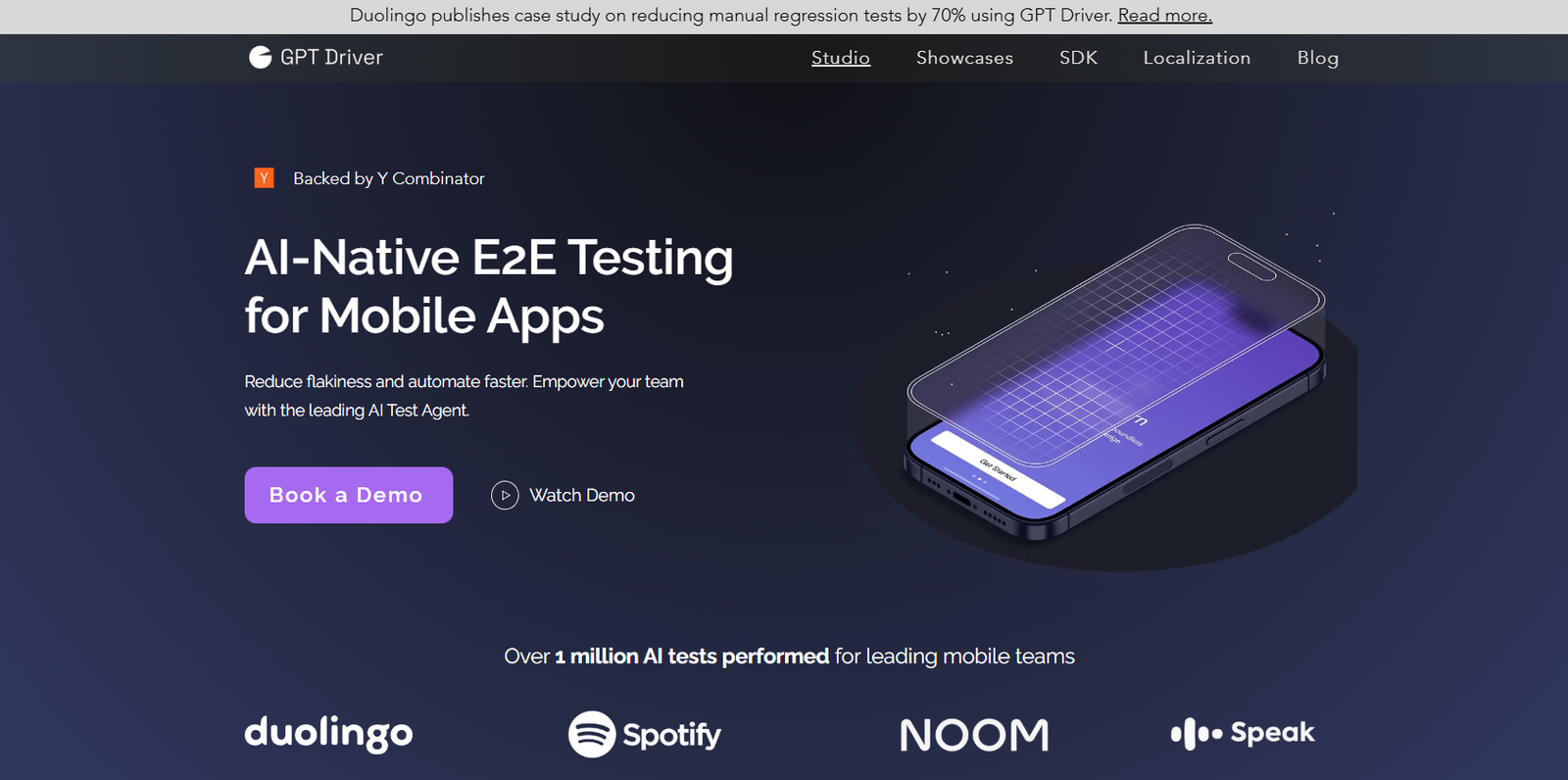
GPT-Driver is an AI-native mobile test automation platform built to streamline and stabilize testing for iOS, Android, and mobile web applications. By combining deterministic testing commands with AI-based visual recognition, GPT-Driver ensures reliable test execution, even in complex or unstable user interface scenarios. It is especially suited for large-scale test automation, continuous integration (CI) environments, and fast-paced development teams seeking high test coverage with minimal maintenance.
Mobile test automation has long struggled with flaky tests, brittle selectors, and inconsistent environments. GPT-Driver addresses these problems head-on by offering a dual-layer approach: standard commands where possible, and fallback to AI-powered computer vision when needed.
Features
GPT-Driver offers a robust set of features designed to improve the efficiency, reliability, and coverage of mobile test automation.
AI Vision-Based Fallback
If a UI element is not accessible via traditional locators or commands, GPT-Driver uses computer vision to interact with it reliably—reducing test failures due to minor UI changes.
Deterministic Commands for Speed and Stability
Tests are written using consistent, predictable commands that offer high-speed execution and minimal flakiness.
Cross-Platform Support
Supports automation for native iOS, Android apps, and mobile web across devices and simulators.
CI-Friendly Architecture
Built to run large regression test suites in continuous integration pipelines with minimal overhead.
Low Maintenance Automation
GPT-Driver adapts to UI changes through intelligent fallback, reducing the need for constant script updates.
Test Complex Flows with Ease
Handles dynamic UI changes, animations, multi-screen workflows, and edge cases without custom handling.
AI-Based Element Recognition
Accurately identifies UI elements even when underlying identifiers or layouts change.
Parallel Test Execution
Supports concurrent test execution for faster results, making it suitable for fast-moving dev teams.
End-to-End Regression Testing
Automates full user journeys across screens and conditions to ensure application functionality.
Debugging and Reporting Tools
Includes rich logging, screenshots, and failure context to assist with faster issue resolution.
How It Works
GPT-Driver simplifies mobile test automation by allowing developers and QA engineers to write tests in a deterministic way—using clear, structured commands for common UI interactions like clicks, text input, swipes, or validations.
However, when standard automation frameworks fail—due to missing selectors, UI transitions, or inconsistencies—GPT-Driver automatically falls back on AI vision-based recognition. This approach mimics how a human would interact with the screen visually, identifying buttons, text, or layout components using deep learning.
As tests are executed, GPT-Driver dynamically chooses the best method for each interaction, maximizing reliability while maintaining speed. The result is a smoother automation process that reduces test flakiness and enables larger, more stable regression suites to run continuously.
Use Cases
GPT-Driver is ideal for teams that develop and maintain mobile applications and want scalable, robust test automation.
Mobile App Development Teams
Automate daily regression testing across iOS and Android apps with high stability and low maintenance.
Quality Assurance Engineers
Use AI-driven fallback to reduce test failures from UI changes and avoid repetitive script updates.
Continuous Integration Pipelines
Run large test suites in CI/CD environments with confidence that tests will be stable and fast.
Agile Product Teams
Enable faster release cycles by verifying builds frequently without manual testing.
Startups and Enterprises
Scale testing coverage without scaling QA headcount by relying on automated and adaptive tests.
Cross-Platform Application Teams
Test the same user flows across mobile web, iOS, and Android using a unified approach.
Pricing
As of now, GPT-Driver’s official website does not publicly list specific pricing tiers. It is likely that pricing is available on request and may depend on team size, platform usage, and number of test executions.
Custom Plans Likely
Most platforms of this type offer usage-based pricing or enterprise agreements depending on testing volume and CI integration needs.
To inquire about a quote or schedule a demo, you should visit the official GPT-Driver website (note: check for updated domain if applicable) or contact their sales team.
Strengths
Stabilizes Flaky Tests
Combining standard automation with AI fallback significantly reduces test failure due to UI instability.
Reduces Maintenance Overhead
Fewer brittle locators and more intelligent element recognition reduce time spent fixing tests.
AI Vision Integration
Unique AI layer adds human-like recognition of UI, allowing for more flexible and resilient testing.
Optimized for CI/CD
Designed with continuous delivery in mind, allowing tests to run reliably at scale.
Supports Complex Workflows
Handles multi-screen journeys, pop-ups, and non-standard UI behavior better than traditional tools.
Cross-Platform Capability
Works seamlessly across mobile platforms, enabling unified test strategies.
Drawbacks
No Public Pricing Transparency
Lack of upfront pricing may be a barrier for small teams or early adopters.
Requires AI Model Familiarity
Teams may need onboarding or initial guidance to understand fallback behavior and AI settings.
Not Ideal for Desktop Apps
GPT-Driver is focused on mobile automation and does not target desktop or native PC applications.
Limited Community Resources
As a specialized tool, documentation, tutorials, and third-party resources may be limited compared to mainstream testing frameworks.
Potential Black-Box AI Behavior
While AI fallback is powerful, some teams may desire more visibility into how vision-based decisions are made.
Comparison with Other Tools
GPT-Driver competes in the test automation space with tools like Appium, Detox, Espresso, and XCUITest.
Versus Appium
Appium is open-source and widely used but is prone to flakiness and slow execution. GPT-Driver improves stability with AI fallback and faster deterministic commands.
Versus Espresso/XCUITest
Native tools for Android and iOS are reliable but require platform-specific code. GPT-Driver offers a unified and cross-platform approach.
Versus TestProject or Katalon
These offer codeless solutions but may lack the AI vision fallback that GPT-Driver provides for unstable UIs.
Versus Cypress (for Web)
Cypress excels for web apps but doesn’t support mobile. GPT-Driver covers native mobile and mobile web with visual AI integration.
GPT-Driver’s dual-mode testing and AI fallback give it a distinct edge in mobile environments where UI changes frequently break conventional tests.
Customer Reviews and Testimonials
As GPT-Driver is a newer AI-native platform, direct user reviews may be limited online. However, early adopters emphasize the stability and scalability the tool brings to mobile test automation.
From preliminary feedback:
“Our mobile tests used to fail randomly due to small UI changes. With GPT-Driver, the AI fallback just works.”
“We run nightly regression across two apps in CI. GPT-Driver made it possible without increasing our QA team.”
“The AI vision engine handled animations and screen transitions much better than Appium. Test maintenance dropped by 60%.”
Conclusion
GPT-Driver is a next-generation test automation platform purpose-built for mobile environments. By combining deterministic command execution with AI-powered vision fallback, it solves one of the biggest challenges in mobile testing: flaky and fragile UI tests.
Ideal for teams running large regression suites, operating in agile workflows, or working across multiple platforms, GPT-Driver enables consistent, low-maintenance testing that scales with product velocity. Its AI-native design ensures your tests are resilient, adaptive, and production-ready.
If you’re seeking a smarter and more stable alternative to traditional mobile test frameworks, GPT-Driver offers a reliable path to automation without the usual frustration.