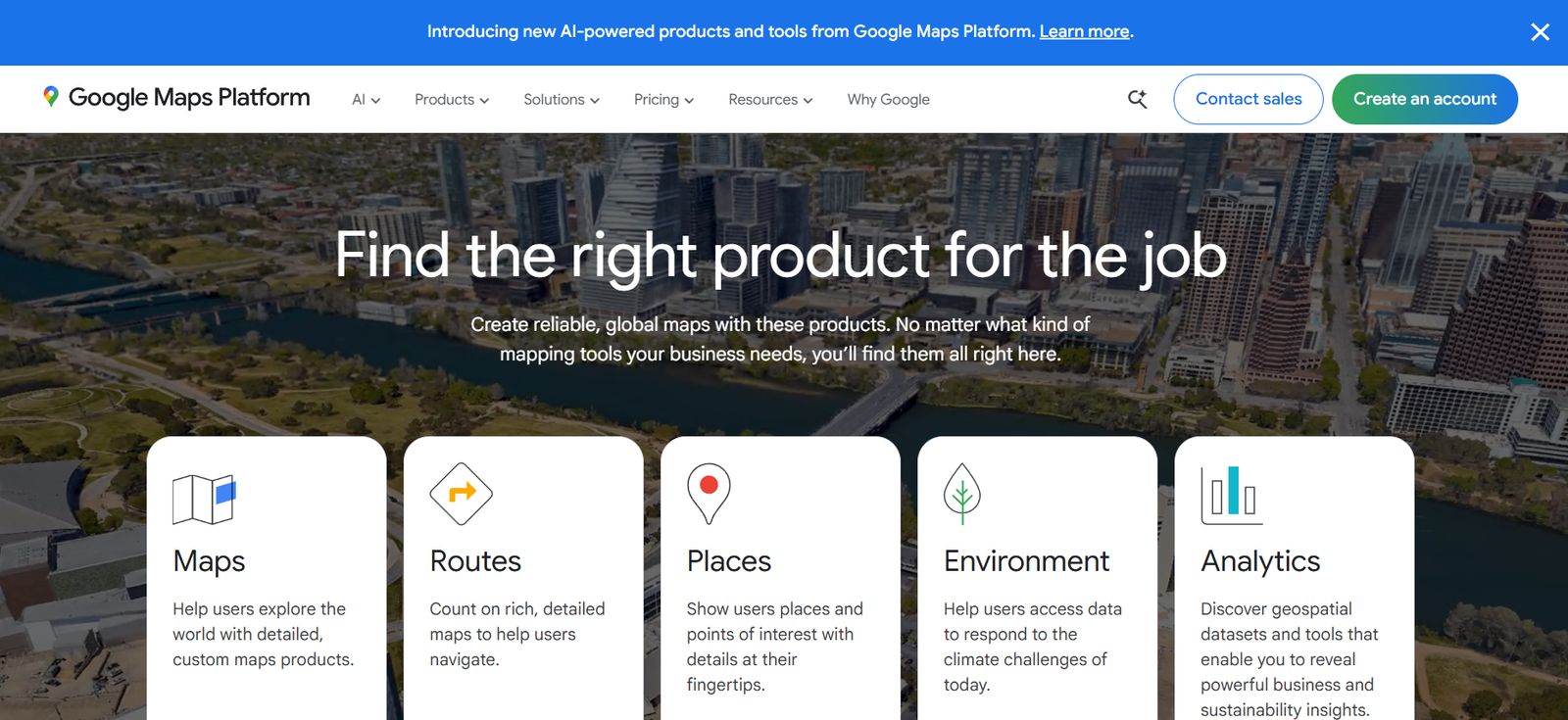
Google Maps Platform is a comprehensive suite of APIs and SDKs provided by Google to help developers integrate real-time location, mapping, navigation, and geospatial data into their web and mobile applications.
From interactive maps to advanced route optimization, Google Maps Platform delivers industry-leading accuracy, scalability, and ease of integration. It serves businesses across logistics, retail, transportation, real estate, gaming, and more, providing the tools necessary to build location-based experiences powered by Google’s global mapping infrastructure.
With over 1 billion monthly active users on Google Maps, the platform ensures high-performance capabilities and constant data freshness, making it one of the most reliable location-based services available today.
Features
Google Maps Platform is divided into several core product areas, each offering specific functionality to meet diverse business needs.
Maps
Embed customizable interactive maps into apps or websites
Use Street View, Satellite, and Terrain layers
Style maps to reflect brand identity
Real-time map rendering for fast performance
Routes
Access powerful routing capabilities using the Directions API
Optimize routes for distance, time, traffic, and multiple waypoints
Use real-time traffic data for delivery, ridesharing, and logistics apps
Support for biking, walking, driving, and transit directions
Places
Search over 200 million businesses and landmarks worldwide
Autocomplete search bars, location details, and user ratings
Place IDs and geocoding for converting addresses into coordinates and vice versa
Time zone, elevation, and geolocation data access
Environment APIs
Access real-time air quality, pollen levels, and weather data (beta)
Useful for apps in health, travel, agriculture, and public safety sectors
Live Location and Tracking
Track moving assets (e.g., delivery vehicles) in real time
Combine with Firebase or third-party tools for enhanced logistics applications
Geospatial Analytics
Combine with BigQuery or Google Cloud for spatial data analysis
Build location-aware dashboards and visualizations
How It Works
Google Maps Platform provides cloud-based APIs and SDKs that developers can integrate into their applications. These tools are hosted on Google’s infrastructure, ensuring speed, uptime, and scalability.
To use the platform:
Developers enable relevant APIs (Maps, Routes, Places, etc.) from the Google Cloud Console.
A billing account and API key are created to authenticate requests.
Using client libraries or direct HTTP requests, developers call APIs to display maps, calculate routes, fetch place details, and more.
Responses are returned in JSON format, ready to be integrated into the application’s user interface.
SDKs are available for JavaScript, iOS, Android, and other platforms, making integration seamless for most use cases.
Advanced users can also combine Google Maps data with other Google Cloud services like Firebase, BigQuery, or AI/ML tools for customized solutions.
Use Cases
Google Maps Platform serves a wide range of industries and application types:
Logistics & Transportation
Real-time vehicle tracking
Route optimization and delivery ETA predictions
Dynamic rerouting based on traffic
Retail & eCommerce
Store locator maps
Geofencing for promotions or offers
Curbside pickup and last-mile navigation
Travel & Hospitality
Hotel and attraction mapping
Location-based content recommendations
Travel planning tools with interactive routes
Real Estate
Property maps and neighborhood analysis
Location scoring based on schools, transport, or amenities
Street View for virtual tours
Mobile Apps
Ride-hailing and mobility apps
Food delivery interfaces
Fitness tracking with map overlays
Gaming
Geolocation-based gameplay (e.g., Pokémon GO)
Real-world terrain and landmark integration
Pricing
Google Maps Platform uses a pay-as-you-go pricing model, allowing businesses to scale usage as needed. Each API has different pricing tiers based on usage volume.
Some key pricing highlights:
Maps JavaScript API: $7 per 1000 map loads
Directions API: $5 per 1000 requests (for standard usage)
Places API – Details: $17 per 1000 requests
Autocomplete – Per Character: $2.83 per 1000 character requests
Google offers $200 in free usage every month per billing account, which is sufficient for small projects or development environments.
Enterprises can contact Google for custom pricing and volume discounts.
Pricing details are available at the official page: Google Maps Platform Pricing
Strengths
High Accuracy & Coverage: Global reach with detailed mapping data for over 200 countries.
Scalable & Reliable: Backed by Google Cloud infrastructure for enterprise-grade uptime.
Feature-Rich APIs: Supports diverse applications from basic mapping to complex spatial analysis.
Strong Developer Support: Extensive documentation, SDKs, and community forums.
Cross-Platform Compatibility: Works on web, Android, and iOS with native SDKs.
Real-Time Capabilities: Live traffic, geolocation tracking, and environmental data.
Drawbacks
Cost for High Usage: Pricing can become expensive at scale without optimization.
Billing Complexity: Managing multiple APIs and cost forecasting requires planning.
API Quotas & Limits: Rate limits can affect apps with very high traffic unless upgraded.
Data Privacy Concerns: Some businesses may prefer self-hosted or open-source alternatives due to data control.
Comparison with Other Tools
Mapbox: Offers similar mapping capabilities with more flexibility in styling and open-source tools. Often preferred for custom map designs.
HERE Technologies: Strong in automotive and logistics, with competitive routing and traffic APIs.
OpenStreetMap: Free and open-source but lacks the real-time data accuracy and enterprise support that Google Maps Platform provides.
Esri ArcGIS: Powerful for geospatial analysis but better suited to GIS professionals and government use cases rather than app development.
Google Maps Platform stands out for ease of use, global data accuracy, and integration with the broader Google ecosystem.
Customer Reviews and Testimonials
Google Maps Platform is trusted by companies like Uber, Lyft, Instacart, Zillow, and The New York Times.
Uber relies on the platform for real-time routing and location accuracy in hundreds of cities worldwide.
Zillow uses Google Maps to enhance property listings with interactive maps and Street View.
Developers praise the reliable APIs, rich documentation, and responsive map rendering, making it a top choice for fast, location-based application development.
Conclusion
Google Maps Platform remains a leader in location intelligence and mapping services, offering developers and enterprises the tools they need to build dynamic, geospatially-aware applications.
With its powerful APIs, scalable infrastructure, and continuously updated global data, Google Maps Platform is the go-to solution for businesses seeking to enhance their products with maps, routing, and location analytics.