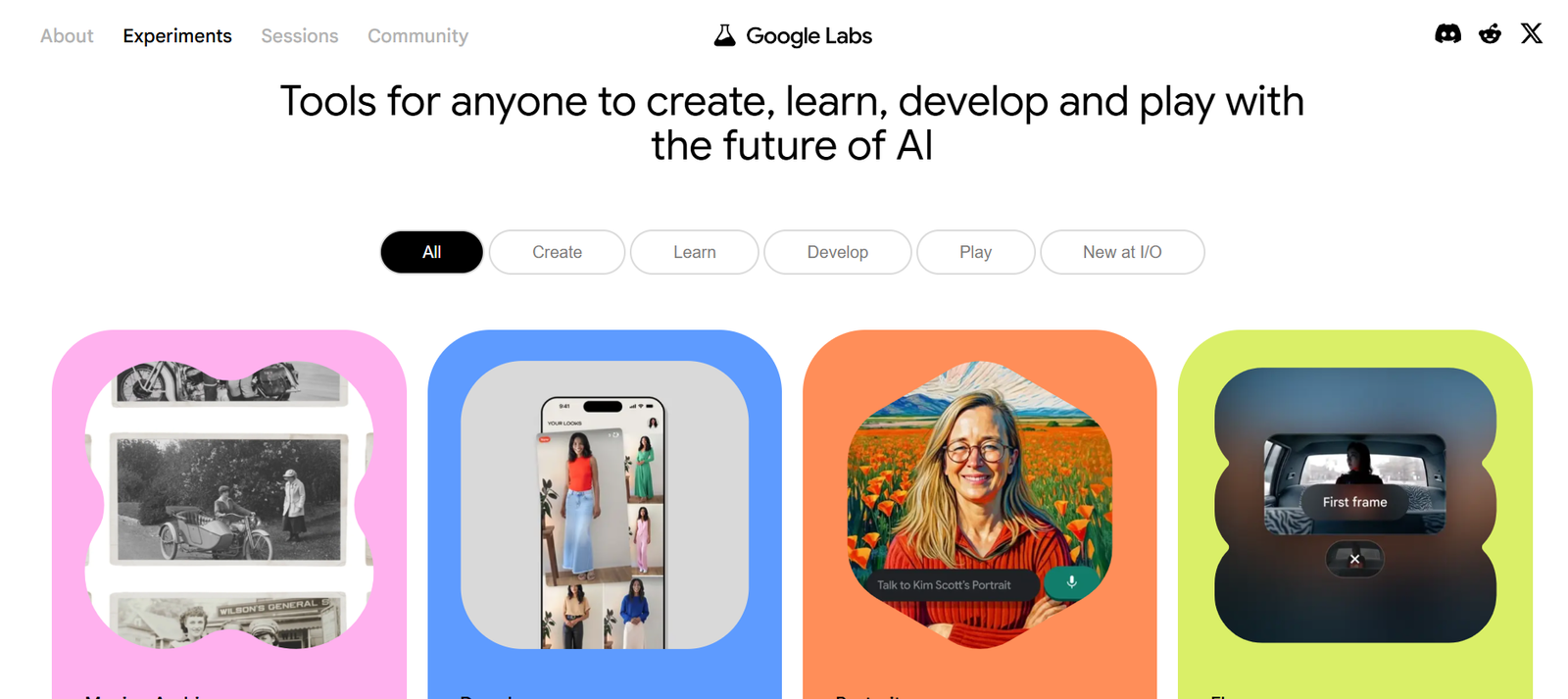
Google Labs is Google’s public-facing innovation platform that gives users early access to experimental AI tools, features, and research-based projects. It serves as a testing ground for emerging technologies developed by Google’s product and research teams before they are integrated into mainstream products like Search, Docs, Gmail, and Android.
Revived in 2022 (after the original Google Labs shut down in 2011), the new Google Labs is focused on AI-first experiences, offering tools that showcase advances in natural language processing, generative AI, search, and productivity. From AI-assisted writing to conversational search, Google Labs enables curious users and developers to try out the future of Google products today.
By opening these tools to public testers, Google gathers feedback to refine its products and prioritize the most promising technologies. Labs projects are free to use, invite-only in some cases, and often include integrations with Google Workspace and Search.
Features
AI Test Kitchen
An app that lets users interact with experimental language models developed by Google DeepMind and Google Research.
NotebookLM
An AI-powered research and writing assistant that helps users explore, summarize, and interact with their own uploaded documents.
Search Generative Experience (SGE)
A reimagined version of Google Search that integrates generative AI to provide conversational answers, summaries, and suggested follow-ups.
Project IDX
A web-based, AI-enhanced development environment for building full-stack applications with live collaboration and smart code completion.
MusicFX and TextFX
AI-driven creative tools for musicians, writers, and poets. Generate lyrics, melodies, or explore text-based creativity with large language models.
ImageFX
Text-to-image generation tool that turns written prompts into high-quality visuals using Google’s Imagen model.
Workspace Labs
Experimental AI tools integrated into Google Docs, Sheets, Gmail, and Slides—helping users write, summarize, visualize data, and more.
Waitlist-Based Access
Many tools require joining a waitlist, giving early testers a preview before wider rollout.
How It Works
Visit Google Labs
Go to https://labs.google to view available projects.Join Waitlists or Apply
Click on the desired tool or project and join the waitlist. Some tools are immediately accessible, while others require invitations.Use the Tools
Once granted access, you can explore each tool in its web interface, mobile app, or Workspace integration.Submit Feedback
As part of the Labs experience, users are encouraged to share their feedback to help shape future product development.
Use Cases
Writers and Researchers
Use NotebookLM or Workspace Labs to generate outlines, summaries, or content ideas from personal documents and notes.
Developers and Engineers
Experiment with Project IDX for building web and mobile apps using Google’s experimental cloud-based IDE.
Students and Educators
Interact with AI models in AI Test Kitchen to learn about natural language processing and responsible AI development.
Content Creators
Use MusicFX or ImageFX to experiment with AI-generated lyrics, melodies, or visuals for projects.
Knowledge Workers
Improve productivity in Docs, Sheets, and Gmail with Workspace Labs features like smart summarization and formula generation.
Early Tech Adopters
Stay ahead of the curve by testing features like SGE, which is shaping the future of online search.
Pricing
Google Labs tools are free to use, but access is often limited through waitlists or invites. Some tools are available immediately, while others may require approval or be restricted to specific regions.
There are no premium plans for Google Labs projects. However, many Labs features—especially Workspace Labs—require a Google Workspace or personal Google account for use.
Strengths
Access to Emerging AI Tools: Try cutting-edge AI technologies before public release.
Wide Variety of Use Cases: From writing and coding to music and visual generation.
Direct Feedback Loop: Users can influence future product development through active participation.
Integration with Google Ecosystem: Seamless compatibility with Docs, Gmail, Sheets, and Search.
Free Access: All experimental tools are free for testers during the Labs phase.
Drawbacks
Waitlist Access for Many Tools: Users may need to wait weeks or months for approval.
Limited Availability: Some tools are geo-restricted or available only in English.
Experimental Stability: As early-stage products, tools may experience bugs or incomplete functionality.
Short-Term Access: Not all projects graduate; some may be discontinued or absorbed into larger Google services.
No Developer Customization: Currently limited to internal testing environments with no open-source release.
Comparison with Other Tools
Versus OpenAI ChatGPT or Anthropic Claude
While platforms like ChatGPT provide standalone conversational AI, Google Labs offers experimental integrations across various domains including search, writing, and creative arts. It emphasizes human-AI collaboration and ties closely with Google’s services.
Versus Microsoft Copilot (M365)
Microsoft integrates AI into Word, Excel, and Outlook under a paid enterprise model. Google Labs provides similar AI support in Docs and Sheets for free during the testing phase, making it more accessible to individual users.
Versus Hugging Face Spaces
Hugging Face offers community-driven AI demos. Google Labs provides official first-party prototypes from Google Research and DeepMind, often with higher resource support and enterprise focus.
Customer Reviews and Testimonials
While there is no dedicated testimonial page on the site, Labs projects like NotebookLM and SGE have received positive feedback from early users and technology reviewers.
From media and early access users:
“NotebookLM is the AI assistant I’ve always wanted for research and studying.”
“SGE feels like the future of Google Search—less clicking, more understanding.”
“ImageFX is surprisingly accurate at capturing the tone of my prompts.”
“Project IDX is promising for cloud-based coding, especially for remote teams.”
Trusted media outlets like TechCrunch, The Verge, and Wired have praised Google Labs for its transparent approach to experimental releases and commitment to responsible AI deployment.
Conclusion
Google Labs is Google’s experimental playground for AI innovation. From search to coding and content creation, the platform offers a rare chance for users to experience the next generation of Google technologies before public launch. It reflects Google’s long-term vision of making AI helpful, safe, and integrated into everyday tools.
Whether you’re a developer, student, creator, or curious user, Google Labs provides a front-row seat to the future of AI-powered productivity and creativity.