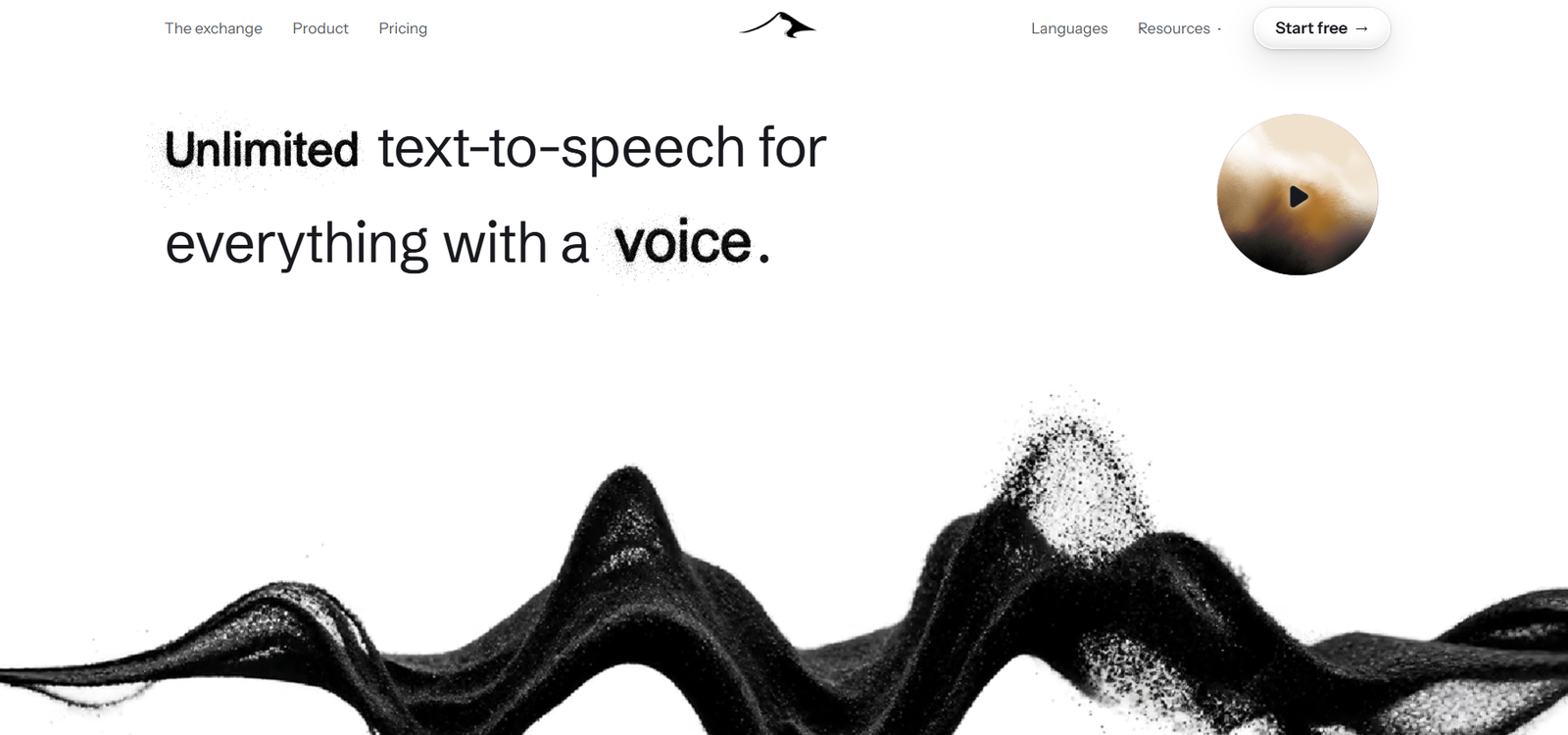
Gandr is an AI powered text to speech and voice cloning platform built for developers, startups, agencies and businesses that need speech generation inside applications and digital services. Its speech engine, Spex-TTS, can generate natural sounding audio from text and supports both real time conversations and longer narration workflows.
The platform is designed around an API based approach. Developers can connect Gandr with voice agents, customer support systems, applications, games and other software. It supports WebSocket connections for conversational applications as well as HTTP based workflows for narration and dubbing.
One of Gandr’s main capabilities is instant voice cloning. A short reference recording of around ten seconds can be used to create a working voice clone without a separate voice training process. The cloned voice can then be used across the supported languages.
Gandr currently supports speech in 23 languages and provides different delivery methods for live conversations, streaming audio and complete audio files.
Features
AI Text to Speech
Gandr converts written text into spoken audio through its Spex-TTS engine. It can be used for short conversational responses as well as longer narration.
Instant Voice Cloning
Users can provide a short reference recording to create a cloned voice. Gandr states that around five to ten seconds of clean speech is generally sufficient, eliminating the need for a lengthy voice training process.
23 Language Support
The speech engine supports 23 languages. A cloned voice can speak across the supported languages, making the technology useful for multilingual applications and localization.
Streaming Text to Speech
Gandr supports streaming audio, allowing speech playback to begin while the complete response is still being generated. This is particularly useful for conversational AI applications.
WebSocket Support
Developers can use WebSockets for live voice interactions. This makes Gandr suitable for AI agents, receptionists, customer service applications and other real time conversational systems.
HTTP and SSE Options
The API provides multiple ways to generate and deliver audio, including complete WAV output and streaming through server sent events.
Expression Controls
Gandr provides controls that developers can use to influence how generated speech is delivered. This gives applications more flexibility when producing different types of spoken content.
Voice Watermarking
The company states that every synthesized audio sample contains an inaudible watermark. This provides a way to identify audio produced through its system.
Privacy Focus
According to Gandr, customer reference audio and submitted content are not used to train its models.
API Integration
The platform uses a relatively simple API structure with one base system supporting multiple speech delivery methods. This can make integration easier for development teams already working with voice based applications.
How It Works
Step 1: Create an Account
Users sign in to Gandr and obtain an API key. A free option is available for initial testing.
Step 2: Add Text
The application sends the text that needs to be converted into speech through the Gandr API.
Step 3: Select a Voice
Users can select an available voice or provide a short reference audio clip to create a cloned voice.
Step 4: Choose a Language
Select one of the supported languages depending on the application or audience.
Step 5: Generate Speech
Gandr processes the request through its text to speech engine and returns generated audio.
Step 6: Choose the Delivery Method
Developers can receive a complete audio file, stream audio progressively or use WebSockets for live conversational applications.
Step 7: Integrate the Audio
The generated speech can be incorporated into voice agents, applications, videos, games, learning platforms, customer service systems and other digital products.
Use Cases
AI Customer Support
Businesses can integrate Gandr with AI customer service agents to provide spoken responses during customer conversations.
AI Receptionists
Companies developing virtual receptionists can use streaming speech to create real time voice interactions with callers.
Voice Agents
Developers can add speech capabilities to conversational AI agents that need to respond quickly during live conversations.
Video Dubbing
Gandr can generate multilingual voices for video localization and dubbing workflows.
Audiobook Narration
Publishers and content creators can use text to speech and cloned voices for long form narration.
E-Learning
Educational platforms can convert lessons, course materials and training content into spoken audio.
Live Translation
The multilingual speech capabilities can support applications where translated text needs to be converted quickly into spoken output.
Game Development
Game studios can experiment with AI generated voices for characters and interactive experiences.
Startups and Developers
Development teams can integrate speech generation into new products without building their own text to speech infrastructure.
Pricing
Gandr provides several pricing options based on tokens or concurrent speech streams.
Free: $0
The free option includes 50,000 tokens for users who want to test the platform. Gandr defines one token as one character.
Take a Gandr: $10 per month
This plan provides 1 million tokens per month. The token allowance resets monthly.
Pro: $50 per month
The Pro plan provides 5 million tokens per month, with the allowance resetting each month.
Scale / Flat Rate: $150 per month
This option provides one unlimited speech stream when purchased on an annual plan. The published month to month price is $180 per stream.
With a stream, speech usage is not charged according to characters, minutes, voices or individual requests.
For larger deployments, Gandr lists volume pricing. Annual pricing for 51 to 499 streams is published at $135 per stream per month.
Enterprise
Enterprise pricing applies to deployments of 500 lines and above. Pricing is arranged directly with Gandr based on factors such as volume, burst capacity and failover requirements.
Additional burst streams are listed at $10 per stream per day.
Prices are stated in US dollars and may be subject to applicable taxes.
Strengths
Gandr combines text to speech, multilingual generation, voice cloning and real time streaming within the same platform.
Its instant voice cloning feature is useful for applications that need to create customized voices without going through a lengthy model training process.
Support for 23 languages makes the platform relevant for businesses building multilingual applications or producing localized content.
The availability of WebSocket, streaming and complete audio delivery options provides flexibility for different development requirements.
Its flat stream pricing model may also be attractive to organizations with consistently high speech volumes because usage on those streams is not metered by characters or minutes.
The platform also states that generated audio is watermarked and customer data is not added to training datasets.
Drawbacks
Gandr is primarily designed around APIs, so it may not be the easiest option for casual users who simply want a graphical tool for generating occasional voiceovers.
Developers may need technical knowledge to take full advantage of WebSockets, streaming endpoints and API integration.
Although 23 languages provide useful multilingual coverage, users needing languages outside the supported list will need another solution.
Flat stream pricing may make sense for applications with heavy and predictable usage, but smaller users may find token based plans more appropriate.
Voice cloning quality can also depend on the quality of the reference recording. Background noise or unclear speech may affect the generated result.
Comparison with Other Platforms
Gandr competes broadly with AI voice generation and text to speech platforms that provide APIs for developers.
Many AI speech services charge according to characters, tokens, minutes or generated audio usage. Gandr differentiates itself by also providing a flat pricing model based on concurrent streams, where speech generated on an active stream is not individually metered.
Another point of difference is its approach to voice cloning. Users can provide a short reference recording directly with a request rather than going through a separate voice enrollment or training workflow.
Compared with creator focused AI voice platforms that provide visual editing studios, Gandr is more developer oriented. Its strengths are API integration, real time streaming, voice agents and production speech infrastructure rather than a traditional browser based audio editing environment.
Therefore, Gandr may be particularly useful for developers and businesses building speech directly into products rather than users looking mainly for manual voiceover creation tools.
Customer Reviews and Testimonials
Customer reviews and testimonials are not clearly available on the official website.
Conclusion
Gandr is a specialized AI text to speech and voice cloning platform aimed primarily at developers and organizations building voice enabled applications. It combines multilingual speech generation, instant voice cloning, streaming audio and API based integration within a single speech engine.
Its support for 23 languages and multiple audio delivery methods makes it suitable for AI customer support, voice agents, video dubbing, audiobooks, e-learning, games and live conversational applications.
The combination of token based entry plans and flat stream pricing also gives businesses different ways to manage speech generation costs as their usage grows.
For developers, startups and enterprise teams that need programmable text to speech and voice cloning rather than a simple voiceover editor, Gandr is worth considering.