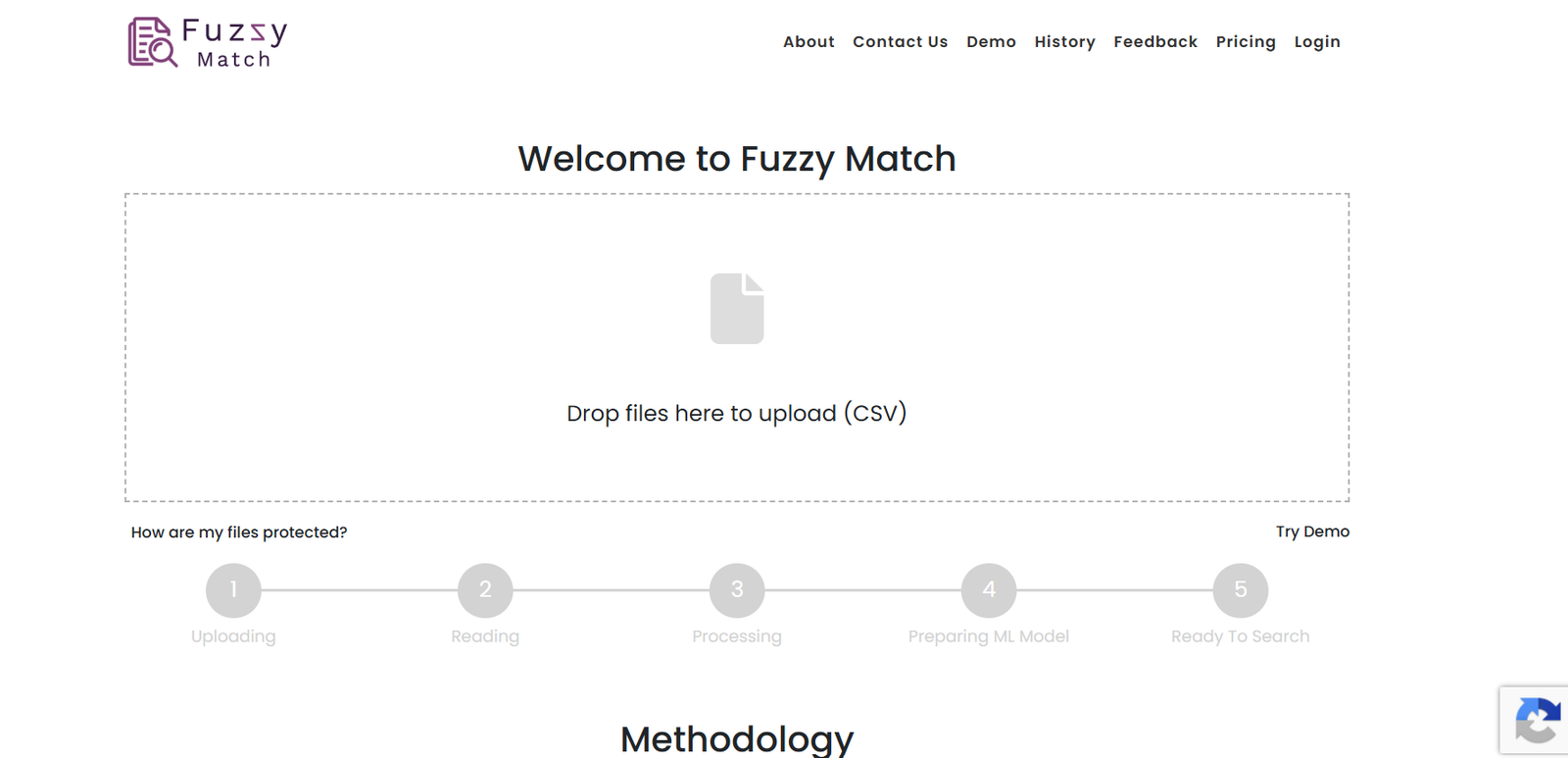
Fuzzy Match is an AI and machine learning-powered data matching platform designed to help users find similar or related records within datasets, even when the information does not match exactly.
The platform is developed by Radix Analytics and focuses on solving a common data problem: records that represent the same or similar information but contain spelling mistakes, different formatting, typographical errors or variations in wording.
Users can upload CSV or Excel files containing textual information and then search across selected columns. Fuzzy Match combines fuzzy text matching, semantic analysis and machine learning to identify relevant records that conventional exact-match searches could miss.
For example, a customer database might contain different spellings or formats of the same company or person’s name. A traditional search may fail to connect those records, while Fuzzy Match is designed to identify similarities despite these variations.
The platform can be useful for data analysts, researchers, businesses and professionals working with large or inconsistent datasets.
Features
AI and Machine Learning Matching
Fuzzy Match uses machine learning algorithms alongside advanced text-matching techniques to compare information within uploaded datasets.
Its models analyze patterns in the data rather than depending entirely on rigid matching rules.
Fuzzy Text Matching
The platform identifies records that are similar without requiring the text to be identical.
This is useful when datasets contain spelling variations, abbreviations or other inconsistencies.
Typo and Misspelling Tolerance
Fuzzy Match is designed to remain effective when words contain typographical errors or misspellings.
For example, two customer records containing slightly different spellings of the same name may still be identified as potential matches.
Semantic Analysis
The platform combines fuzzy matching with semantic analysis.
This means searches can consider broader textual similarities instead of relying only on exact character matching.
CSV File Support
Users can upload CSV datasets directly into the platform for processing and searching.
This makes it convenient for datasets exported from CRM systems, databases, spreadsheets and other business applications.
Excel File Support
Fuzzy Match also supports Excel data, allowing spreadsheet users to work with existing datasets without first creating complicated data pipelines.
Multi-Column Search
Users can select specific columns within their datasets for matching.
Search text can span multiple columns, which is useful when a match depends on several pieces of information rather than one field.
Matching Tolerance Controls
The platform provides controls for adjusting matching tolerance.
Users can choose between exact and fuzzy matching approaches depending on how closely records need to correspond.
Adaptive Matching
According to Fuzzy Match, its machine learning models adapt to the characteristics of the input data rather than relying only on predefined matching rules.
This can help when working with datasets containing different structures and patterns.
Improved Recall
Fuzzy matching can identify relevant records that exact searches overlook.
This can be particularly valuable when searching large datasets where inconsistent data entry creates many near-matches.
Large Text Dataset Search
Fuzzy Match is designed to help users navigate large collections of textual information and retrieve relevant records more efficiently.
Search Result Ranking
The matching process evaluates similarities between a search query and dataset records so that users can focus on more relevant potential matches.
Demo Access
The official website provides a demonstration option that allows visitors to explore how the matching process works before using their own datasets.
Temporary File Storage
Fuzzy Match states that uploaded files are securely stored and automatically deleted after 24 hours.
Users can also delete uploaded files through their History before the automatic expiration period.
How It Works
Step 1: Visit Fuzzy Match
Users open the Fuzzy Match platform and can begin by trying the demo or working with their own data.
Step 2: Upload a Dataset
Upload a CSV or Excel file containing the textual records that need to be searched or compared.
Step 3: File Processing
The platform reads and processes the uploaded information.
Step 4: ML Model Preparation
Fuzzy Match prepares its machine learning model according to the uploaded dataset.
Step 5: Select Columns
Users choose the columns that should be included in the search and matching process.
Step 6: Enter Search Information
Provide the text or information that needs to be matched against the dataset.
Step 7: Select Matching Tolerance
Users can determine whether they need an exact match or a more flexible fuzzy match.
Step 8: Run the Search
Fuzzy Match applies text matching, semantic analysis and machine learning to compare the query with relevant records.
Step 9: Review Potential Matches
Users can examine the returned records and identify relevant or similar entries.
Step 10: Manage Uploaded Data
Uploaded files can be deleted through the History section or left to be automatically deleted after 24 hours.
Use Cases
Data Cleaning
Businesses can identify inconsistent records caused by spelling mistakes, formatting differences and other data-entry problems.
Duplicate Record Detection
Organizations can use fuzzy matching to identify records that may represent the same person, business, product or entity even when the text is not identical.
Customer Database Management
Companies can search customer datasets where names, addresses or other fields contain variations.
CRM Data
Sales and marketing teams can use fuzzy matching when reviewing CRM records containing inconsistent company or customer information.
Researchers
Researchers working with large textual datasets can search across multiple columns and identify related records more efficiently.
Data Analysts
Analysts can use Fuzzy Match as part of data-quality and exploratory analysis workflows.
Information Retrieval
Organizations managing large document or textual datasets can use fuzzy matching to retrieve relevant information that exact keyword searches might overlook.
Product Matching
Businesses can potentially compare product records containing different descriptions, spelling variations or formatting conventions.
Record Reconciliation
Teams working with information from multiple sources can use fuzzy matching to identify records that may correspond to one another despite differences in formatting.
Pricing
Fuzzy Match has a dedicated pricing section that provides options for monthly and yearly billing.
However, specific current plan names, prices, usage limits and included features are not clearly accessible through the public pricing information available on the official website.
Pricing details are not clearly mentioned on the official website.
Users interested in paid access should check the current pricing section or contact Fuzzy Match for the latest subscription information.
Strengths
One of Fuzzy Match’s main advantages is its ability to find relevant records even when text is not identical.
Its tolerance for spelling mistakes and typographical errors can be particularly valuable when working with manually entered business data.
Multi-column matching gives users greater flexibility than simple single-field searches.
The combination of fuzzy matching, semantic analysis and machine learning provides a more intelligent approach than conventional exact text matching.
Support for common CSV and Excel formats makes the platform accessible to business users and researchers without requiring a complex technical setup.
The option to automatically delete uploaded files after 24 hours is also useful for users who do not want datasets stored indefinitely.
Drawbacks
Fuzzy Match is a specialized data-matching tool rather than a complete data management or analytics platform.
The official website provides limited public information about integrations, APIs, automation capabilities and enterprise deployment options.
Clear subscription prices and detailed usage limits are not readily available through the public pricing page.
The quality of fuzzy matching can depend on the structure, consistency and nature of the source data.
Users should manually verify important matches because similarity does not necessarily mean that two records represent the same real-world entity.
Organizations working with sensitive or regulated data should also independently assess the platform’s security, privacy and compliance requirements before uploading datasets.
Comparison with Other Platforms
Fuzzy Match differs from conventional spreadsheet searches and database queries because it does not require information to match exactly.
Standard search tools may fail when one record contains a spelling mistake or a different formatting convention. Fuzzy Match is specifically designed to tolerate these differences.
Compared with manually building fuzzy matching algorithms in Python or other programming languages, Fuzzy Match provides a more accessible interface for users who do not want to develop their own matching system.
More comprehensive data-quality platforms may provide additional capabilities such as automated deduplication, data transformation, integrations and enterprise governance. Fuzzy Match is more focused on intelligent textual matching and search.
Its strongest appeal is therefore for users who need a straightforward way to find similar records in CSV and Excel datasets using fuzzy and semantic matching.
Customer Reviews and Testimonials
The official Fuzzy Match website displays several customer testimonials.
Users describe the platform as helpful for identifying records affected by spelling variations and inconsistent formatting. Other testimonials highlight its usefulness for data manipulation, customized matching and searching relevant information across multiple dataset columns.
A researcher testimonial specifically highlights the ability to search information across several columns, while other users mention improved handling of customer data and inconsistent records.
These testimonials are published on the official Fuzzy Match website and should be considered company-presented user feedback rather than independent third-party reviews.
Conclusion
Fuzzy Match is a focused AI and machine learning tool for finding similar information within datasets where exact matching is not sufficient.
Its ability to handle typos, misspellings, formatting variations and semantic similarities can make it useful for data cleaning, duplicate identification, customer database research and information retrieval.
The platform is particularly suitable for data analysts, researchers, businesses and professionals working with CSV or Excel datasets containing inconsistent textual information.
For users who regularly struggle with records that should match but do not because of small differences in spelling or formatting, Fuzzy Match provides a practical way to apply intelligent matching without having to build custom machine learning algorithms.