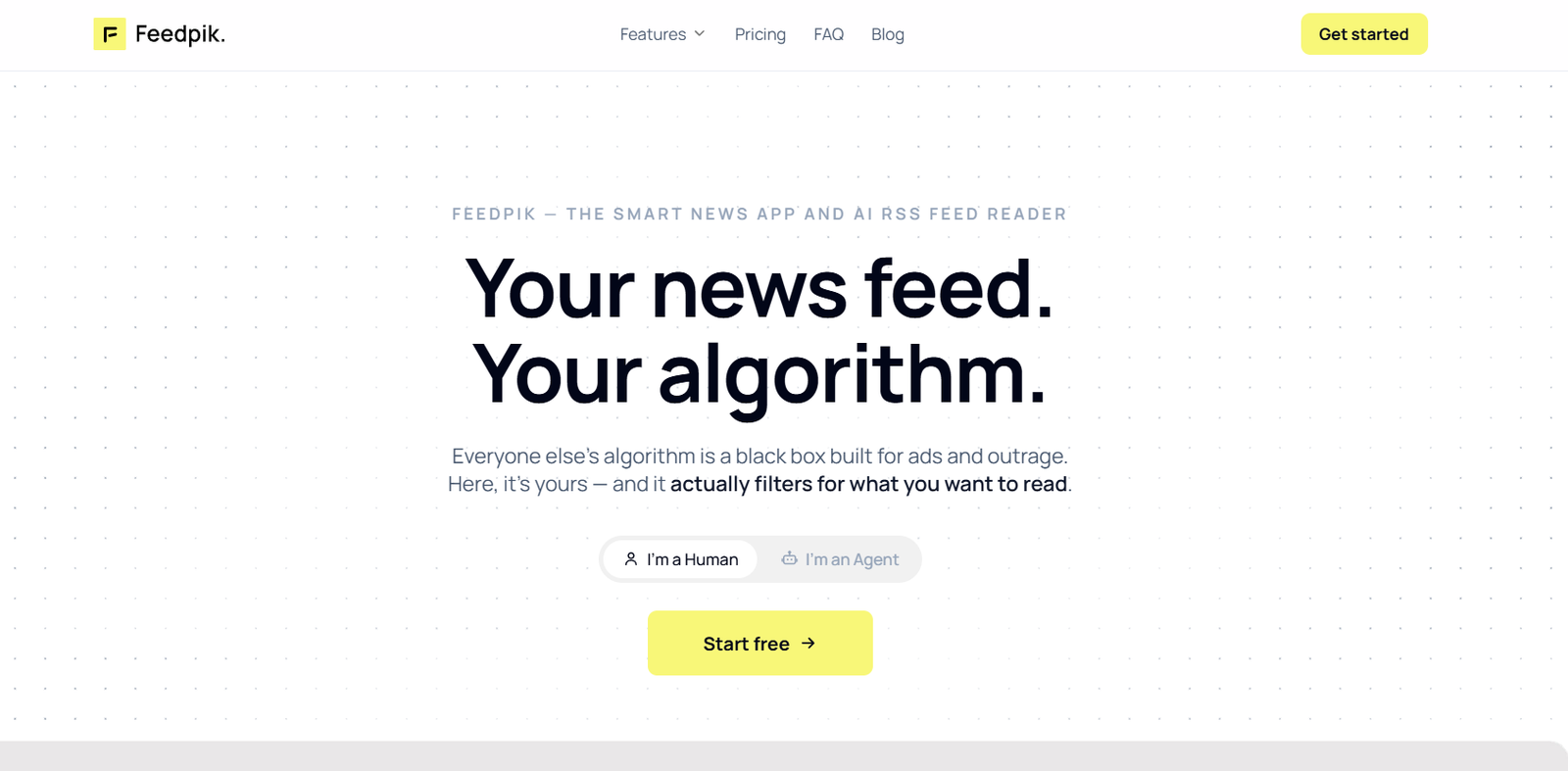
Feedpik is a privacy-first AI RSS feed reader and information-management platform designed to give users greater control over what they read and how content is ranked.
Unlike conventional social feeds where recommendation algorithms are largely hidden, Feedpik allows users to choose their own sources and adjust the ranking algorithm according to their interests.
Users can simply tell the AI what they want more or less of. For example, they can ask for more AI research and startup funding while reducing cryptocurrency or celebrity news. Feedpik proposes changes to the ranking policy, and the user decides whether to apply them.
The platform supports RSS and Atom feeds along with newsletters, podcasts, Reddit, Mastodon, Bluesky, blogs, news publications, and other open-web sources.
Feedpik also uses AI to summarize articles, explain difficult topics, answer questions grounded in an article, discover new sources, create daily briefings, detect emerging stories, track topics, and generate drafts from saved material.
Users can create separate Personas for different interests, such as professional research, investing, technology, entertainment, or personal reading. Each Persona has its own sources and ranking policy.
Feedpik is particularly useful for researchers, investors, journalists, founders, analysts, content creators, developers, and knowledge workers who follow many information sources but want more control than conventional recommendation systems provide.
Features
AI RSS Feed Reader
Feedpik combines traditional RSS technology with AI-powered ranking and reading assistance.
Users select the sources they trust while AI helps organize and prioritize the incoming information.
RSS and Atom Support
Users can subscribe to standard RSS and Atom feeds from websites, blogs, news publications, and other sources.
Automatic Feed Discovery
Users can paste a website address and Feedpik attempts to locate its available feed automatically.
Direct RSS and Atom URLs can also be added.
Discover Sources
Feedpik provides a curated source catalogue containing more than 900 feeds across technology, finance, science, gaming, and other categories.
Users can search by source name or topic.
OPML Import
Existing subscriptions can be imported using OPML.
This makes it easier to move feeds from services such as Feedly, Inoreader, NetNewsWire, and other RSS readers.
OPML Export
Feedpik also allows users to export their subscriptions.
This reduces platform lock-in because users can move their feed collection elsewhere.
Newsletter Reader
Users can receive newsletters inside Feedpik rather than allowing them to clutter their normal email inbox.
Podcast Support
Podcast feeds can be included alongside conventional articles and news sources.
Reddit Support
Users can bring Reddit sources into their information feed.
Mastodon Support
Mastodon accounts and content can be incorporated through open feed standards.
Bluesky Support
Feedpik can also incorporate Bluesky sources.
User-Controlled Algorithm
One of Feedpik’s most distinctive features is that users can influence the ranking system directly.
Instead of accepting a fixed recommendation algorithm, users determine which topics, sources, and signals should receive greater or lower importance.
Plain-Language Algorithm Tuning
Users do not need to edit configuration files manually.
They can tell Feedpik what they want in ordinary language.
The AI proposes ranking changes, which the user can review and apply.
Open-Source Ranking Core
Feedpik’s ranking algorithm is open source.
Users can inspect how the scoring works rather than relying entirely on an opaque recommendation engine.
Versioned Ranking Policies
Changes to ranking policies are saved as versions.
This provides an audit trail and allows previous ranking configurations to be restored.
Personas
Users can create separate information environments called Personas.
Each Persona can contain different feeds and its own ranking rules.
For example, one Persona could focus on investment research while another follows AI developments and a third handles personal interests.
Persona Community
Feedpik allows users to discover and install Personas created by other users.
A published Persona contains a collection of feeds and ranking parameters.
Private reading behavior is not included when a Persona is shared.
AI Source Discovery
AI can help users find relevant publications and feeds for a particular topic.
AI Article Summaries
Long articles can be condensed into shorter summaries highlighting their main points.
AI Explanations
Users can ask Feedpik to explain unfamiliar or complicated topics in simpler language.
Grounded AI Q&A
Users can ask questions about an article.
The AI answers using the article itself as grounding material rather than relying only on general model knowledge.
AI Translation
Feedpik includes AI-assisted translation for reading content in other languages.
Agent Picks
An AI agent can review large numbers of articles and select those most likely to match the user’s interests.
Daily Briefing
Feedpik can consolidate important developments into a shorter daily briefing.
Rather than presenting many duplicate headlines about the same event, the system attempts to group coverage into individual stories.
Trending Radar
Trending Radar detects stories that several of the user’s sources begin covering at the same time.
This can help identify developing topics before they become widely dominant.
Cross-Source Story Detection
Feedpik can recognize when several publications are discussing the same underlying event.
This reduces the need to read many nearly identical articles.
Topic Tracking
Users can monitor specific subjects over time.
Company and Competitor Tracking
A company, competitor, market, or other entity can be monitored for changes in coverage.
Media Mention Tracking
Feedpik can identify changes in the number of mentions a tracked subject receives.
Sentiment Changes
The system can surface changes in the tone of coverage around a tracked topic.
Source Convergence
Feedpik can identify when multiple independent sources begin covering the same subject.
First-to-Report Analysis
For tracked stories, the system can help identify which source reported a development first.
Reading-to-Draft Workflow
Users can collect useful articles into a workspace and ask AI to create a first draft grounded in those materials.
Eligible plans support cited draft generation.
Web Reader
Feedpik currently provides its primary reading experience through the web.
Mobile Reader
A dedicated mobile app reader is currently listed on the product roadmap.
Telegram Delivery
Eligible paid plans can deliver Daily Briefing and Trending Radar updates through Telegram.
Discord Delivery
Users on supported plans can also receive briefings and radar updates through Discord.
Agent Integration
Feedpik is designed to work with external AI agents.
Its website currently highlights compatibility with tools and environments such as Codex, Claude Code, Gemini CLI, OpenClaw, and Hermes.
MCP Server
Feedpik supports the Model Context Protocol.
Compatible AI clients can access ranked content, feeds, Personas, ranking policies, and other Feedpik functions.
Permission-Based Agent Access
Read access is the default for connected agents.
Write permissions, such as changing ranking policies or adding subscriptions, must be explicitly approved.
CLI Access
Developers and AI-agent workflows can also interact with Feedpik through command-line tools.
How It Works
Step 1: Create an Account
Start with the Free plan.
Step 2: Add Sources
Paste websites, RSS feeds, newsletters, podcasts, or supported social sources.
Step 3: Import Existing Feeds
Users moving from another RSS reader can import an OPML file.
Step 4: Create Personas
Separate different interests into dedicated reading environments.
Step 5: Describe Your Preferences
Tell Feedpik what you want to see more or less frequently.
Step 6: Review the Proposed Algorithm Changes
The AI converts those preferences into ranking adjustments.
Step 7: Apply the Changes
Approve the proposed ranking policy.
Step 8: Read the Ranked Feed
Feedpik prioritizes incoming articles according to the user’s selected sources and ranking preferences.
Step 9: Use AI Reading Tools
Summarize articles, request explanations, translate content, or ask questions about what you are reading.
Step 10: Review Agent Picks
Allow an AI agent to filter larger volumes of incoming content.
Step 11: Monitor Trends
Use Daily Briefing, Trending Radar, and tracking features where available.
Step 12: Generate Drafts
Save useful articles and use eligible plans to create cited first drafts based on those materials.
Use Cases
AI and Technology Research
Researchers can combine publications, blogs, papers, and specialist sources into one ranked feed.
Investment Research
Investors can create a Persona focused on markets, companies, earnings, macroeconomics, and financial news.
Competitor Monitoring
Businesses can track coverage of competitors and important industry developments.
Journalism
Journalists can monitor many sources and identify stories that are beginning to gain wider coverage.
Startup Intelligence
Founders and investors can follow funding announcements, product launches, markets, and competitors.
Academic Research
Researchers can organize specialist sources and use AI summaries and explanations to process large reading volumes.
Content Research
Writers can save source material and convert it into a cited first draft.
Daily News Briefing
Busy professionals can receive a condensed overview rather than manually reviewing dozens of repetitive headlines.
Trend Detection
Trending Radar can help identify stories that are rapidly gaining coverage.
Personal Knowledge Management
Users can separate work, research, investment, and personal interests into different Personas.
AI Agent Workflows
Developers can connect AI agents through MCP, CLI, or Feedpik’s agent tools.
Pricing
Feedpik currently has Free, Starter, Pro, and Max plans.
The paid plans are currently marked as coming soon, so users should not assume they are already generally available.
Free: $0 Forever
The current Free plan includes:
Personalized ranking
100 sources
3 Personas
Source refresh every 3 hours
Full agent access
AI summaries
AI explanations
AI translation
Algorithm tuning
AI assistant
60 AI credits per month
Extra credits cost $0.04 each and do not expire.
Bring-your-own API key or local-model support is listed as coming soon.
Starter: $5 per month
Starter is currently listed as coming soon.
The displayed price is based on annual billing of $60 per year.
It includes everything in Free plus:
Daily Briefing
Trending Radar
1,000 sources
8 Personas
Hourly source refresh
700 AI credits per month
Additional credits at $0.03 each
Extra purchased credits do not expire.
Pro: $8 per month
Pro is currently listed as coming soon.
The displayed price is based on annual billing of $96 per year.
It includes everything in Starter plus:
Daily Briefing and Radar delivery through Telegram or Discord
Custom delivery scheduling
Tracking
Cross-source pickup monitoring
Cited draft generation
2,500 sources
15 Personas
30-minute source refresh
Source sharing
Persona sharing
1,800 AI credits per month
Additional credits at $0.02 each
Max: $15 per month
Max is currently listed as coming soon.
The displayed price is based on annual billing of $180 per year.
It includes everything in Pro plus:
5,000 sources
35 Personas
15-minute source refresh
4,000 AI credits per month
Additional credits at $0.01 each
Refund Policy
Feedpik currently states that paid plans will have a 14-day refund period.
After that initial period, yearly plans are refundable for unused months according to the platform’s refund policy.
Strengths
User-Controlled Ranking
Users can directly influence the algorithm deciding which articles receive priority.
Open-Source Algorithm
The ranking core can be inspected instead of operating entirely as a black box.
Privacy-Focused Approach
Feedpik states that reading data is not sold or used to create advertising profiles.
Ad-Free Information Model
The product is designed around user-selected information rather than advertising-driven recommendations.
Multiple Information Sources
RSS, Atom, newsletters, podcasts, Reddit, Mastodon, and Bluesky can be brought together.
AI Reading Assistance
Summaries, explanations, translations, and grounded Q&A reduce the effort required to process long articles.
Personas
Different interests can have separate sources and ranking policies.
Trend Detection
Trending Radar helps identify stories gaining momentum across several sources.
Agent Friendly
MCP, CLI, and agent access make Feedpik particularly interesting for AI-assisted research workflows.
Data Portability
OPML and other export capabilities reduce lock-in.
Useful Free Plan
The Free tier includes 100 sources, three Personas, AI tools, agent access, and monthly AI credits.
Drawbacks
The Starter, Pro, and Max plans are currently marked as coming soon rather than fully available.
The dedicated mobile app is also currently on the roadmap.
The Free plan refreshes sources every three hours, which may be too slow for users monitoring rapidly changing news.
Advanced capabilities such as tracking, cited draft generation, faster refreshes, and messaging delivery require higher plans when they become available.
AI summaries and explanations can occasionally omit nuance or misinterpret source material, so important information should still be checked against the original article.
Feedpik requires users to actively select and organize their information sources. People who prefer a completely automatic mainstream-news recommendation system may find this approach more involved.
Comparison with Other Platforms
Feedpik competes broadly with RSS readers and information-management platforms such as Feedly and Inoreader, as well as AI-powered research and news aggregation tools.
Its main distinction is user control.
Traditional RSS readers generally give users control over which feeds they subscribe to but may provide relatively conventional chronological or rule-based organization.
Algorithmic news platforms provide more personalization but often do not expose how their recommendation systems work.
Feedpik attempts to combine both approaches.
Users choose their sources while also controlling the ranking algorithm in plain language.
Its open-source ranking core, Personas, AI article tools, Trending Radar, Daily Briefing, and AI-agent connectivity further distinguish it from a basic RSS reader.
Feedpik may therefore be particularly attractive to researchers, developers, analysts, and privacy-conscious readers who want AI assistance without surrendering control of their information feed.
Customer Reviews and Testimonials
A substantial collection of independent customer reviews is not yet available.
Feedpik appears to be a relatively new product, and major third-party AI-tool directories currently show little or no user-review activity.
The platform’s Free plan provides a practical way for users to evaluate its ranking system, AI reading tools, source management, and Personas before considering one of the upcoming paid plans.
Conclusion
Feedpik is a privacy-first AI RSS reader designed around a simple principle: users should control both the sources they follow and the algorithm that decides what deserves their attention.
It combines RSS and Atom subscriptions with newsletters, podcasts, Reddit, Mastodon, Bluesky, AI-powered ranking, summaries, explanations, translations, grounded Q&A, Personas, trend detection, tracking, and AI-agent connectivity.
Its plain-language ranking controls are particularly distinctive. Users can simply describe what they want more or less of, review the proposed changes, and apply them to their own ranking policy.
The open-source ranking core and ability to export subscriptions also reduce the black-box behavior and lock-in associated with many recommendation platforms.
Feedpik becomes more than a conventional RSS reader through Daily Briefing, Trending Radar, topic monitoring, cross-source analysis, cited drafting, MCP integration, and external AI-agent support.
Its main limitations are that the paid Starter, Pro, and Max plans are currently marked as coming soon and the dedicated mobile reader remains on the roadmap.
For researchers, investors, journalists, founders, developers, content creators, and other knowledge workers who want AI to help filter information without giving up control of their sources and preferences, Feedpik offers an interesting alternative to conventional news feeds and RSS readers.