Exa is an AI-native search engine developed by You.com that enables developers to programmatically retrieve high-quality web results for use in retrieval-augmented generation (RAG) applications, AI agents, and LLM-powered products. Unlike traditional search engines, Exa is designed from the ground up to be API-first, LLM-friendly, and optimized for integration with AI pipelines.
With Exa, developers can fetch relevant and trusted information from the internet and inject it into their large language models in real time. The platform handles crawling, indexing, ranking, and summarization automatically, returning structured JSON data with web results, citations, and even semantic vectors. This drastically reduces the complexity of building real-time knowledge retrieval into AI applications.
Exa bridges the gap between real-time web search and generative AI, helping reduce hallucinations in LLM outputs by grounding answers in verifiable and recent content. It is widely used in enterprise RAG pipelines, autonomous agents, knowledge assistants, and any use case where timely, factual information is critical.
Exa: Features
Exa offers a wide range of features purpose-built for developers building AI applications.
Real-Time Search – Provides instant access to fresh web content using live crawling and ranking algorithms.
Cited Results – Every output includes source links and metadata so developers can verify the accuracy and origin of the data.
Structured API Responses – Returns search results in a clean JSON format that includes titles, URLs, snippets, vectors, and full-text options.
Embeddings – Offers precomputed semantic embeddings for each result, allowing seamless use in vector-based RAG pipelines.
Reranking – Developers can rerank search results using custom relevance signals or LLM-based evaluation.
Query Understanding – Automatically expands and optimizes queries for better relevance, especially for natural language questions.
Custom Domains – Ability to filter searches to specific domains or allowlist trusted sources.
Scalable Infrastructure – Built for low latency and high concurrency, supporting production-ready AI deployments.
Developer Dashboard – Offers usage analytics, token tracking, API keys, and access control for team-based workflows.
Integration Ready – Designed to integrate directly with LangChain, LlamaIndex, OpenAI functions, and other AI toolchains.
Exa: How It Works
Exa works by exposing a powerful web search engine through a developer-friendly API. When a query is sent to Exa’s endpoint, the system conducts a real-time search across a broad, trusted section of the internet. It uses advanced ranking algorithms and AI techniques to identify the most relevant sources.
Each result is returned with detailed metadata, including the title, URL, content snippet, semantic vector (embedding), and a confidence score. Developers can choose whether to retrieve just summaries, full text, or vectors, depending on the use case.
Exa also supports query rewriting, context-aware expansion, and reranking to fine-tune search results. For retrieval-augmented generation workflows, developers can feed the Exa results directly into a language model like GPT-4, Claude, or Mistral, giving the model access to accurate, up-to-date information.
Because of its focus on structure and real-time performance, Exa makes it easy to add intelligent search capabilities to agents, chatbots, and other AI systems without needing to build your own crawling and ranking infrastructure.
Exa: Use Cases
Exa is highly versatile and fits a wide array of real-world use cases in AI and software development.
RAG Pipelines – Inject real-time search results into LLM prompts to create grounded, verifiable answers.
LLM Agents – Equip autonomous AI agents with live search capabilities so they can browse and reference current information.
Customer Support – Feed product documentation and web content into chatbots for accurate, up-to-date answers.
Market Intelligence – Automatically retrieve and summarize news, industry trends, or competitor data for dashboards and analytics.
Developer Assistants – Power coding tools or technical assistants with access to the latest tutorials, docs, and open-source projects.
Enterprise Search – Use Exa to power search inside internal knowledge bases and augment results with public data.
Compliance and Legal Research – Retrieve current laws, regulations, or case studies from government and academic sources.
Content Summarization – Use Exa to pull content from selected sources and generate LLM-based summaries with proper citations.
Exa: Pricing
As of the latest update from the official Exa pricing page, Exa offers tiered pricing plans suitable for individual developers, startups, and large-scale AI deployments.
Free Tier – Includes 500 search requests per month with access to core search features, embeddings, and API documentation. Suitable for experimentation and small projects.
Startup Plan – Offers up to 100,000 search requests per month. Pricing is available upon request and depends on usage patterns and support needs.
Scale Plan – Designed for teams and companies needing high-volume search access, enterprise-grade SLAs, and dedicated infrastructure. Pricing is fully custom and determined through direct consultation.
All plans include access to Exa’s web search API, developer dashboard, full-text access (within limits), and embedding features. Exa charges based on the number of search requests and additional add-ons like reranking or vector retrieval may carry usage-based fees.
Exa: Strengths
Exa delivers several compelling advantages that set it apart from other developer search tools and AI search APIs.
LLM-Native Design – Built specifically for integration with large language models and retrieval-augmented generation workflows.
High-Quality Sources – Filters out low-value content and surfaces trustworthy, relevant links with citations.
Fast and Scalable – Optimized for low latency and high availability, suitable for real-time applications.
Semantic Vectors – Offers out-of-the-box embeddings for each search result, ready to plug into vector stores and similarity searches.
Clean API – Simple to integrate, with well-documented endpoints and structured responses.
Supports Customization – Developers can control domains, rerank results, and fine-tune search behavior to suit specific needs.
Integrates Easily – Designed to work with popular AI frameworks like LangChain, OpenAI Functions, and LlamaIndex.
Real-Time Indexing – Provides fresh content for current events, news, or evolving topics where traditional models fall short.
Exa: Drawbacks
While Exa is highly effective, there are some limitations to consider depending on your use case.
No UI – Exa is a pure API product. There is no search interface or dashboard for non-developers to use directly.
Paid Access at Scale – Free tier is limited to 500 searches per month. Larger-scale usage requires a paid plan or custom pricing.
Limited Result Volume – The number of results per query is capped by API constraints, which may require pagination or multiple queries.
Content Gaps – Exa emphasizes trusted sources, which may omit niche or non-indexed content not available on the open web.
Requires Developer Knowledge – Integration assumes comfort with REST APIs, JSON responses, and working with embeddings or LLM pipelines.
Full-Text Limits – Access to full-page content may be limited by licensing, and developers must comply with terms of use.
Exa: Comparison with Other Tools
Exa can be compared with other AI search APIs and retrieval tools such as Tavily, Perplexity API, Google Programmable Search Engine, and SerpAPI.
Compared to Tavily, Exa is more flexible for developers needing deep integration with vector databases and RAG systems. It provides embeddings and structured outputs more tailored for LLM applications.
Perplexity’s API is oriented more toward final answers and conversational responses, while Exa focuses on raw search results, semantic vectors, and source content for developers to build on.
Google Programmable Search Engine offers web search capabilities but lacks LLM-native features like embeddings, structured summaries, or reranking. Exa is better suited for AI pipelines.
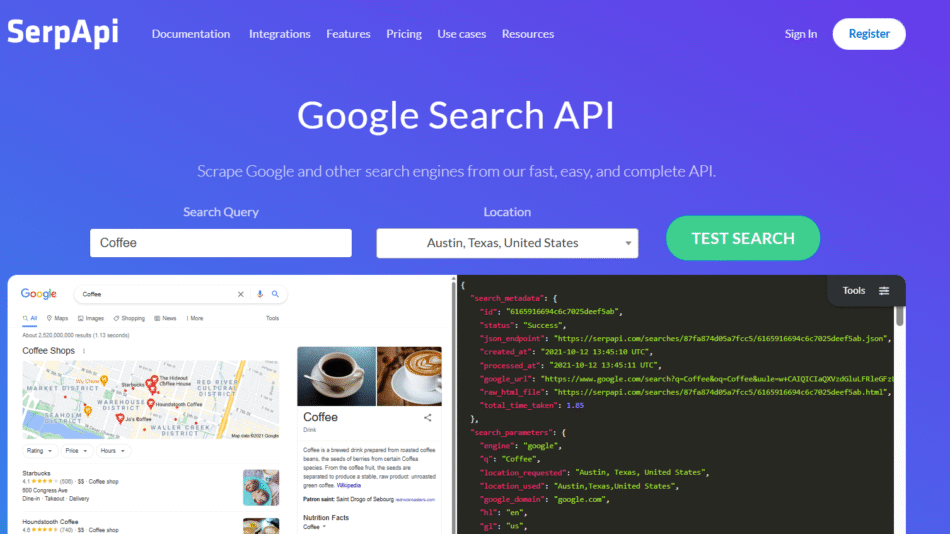
SerpAPI mirrors traditional search engines (e.g., Google) with full result sets and scraping-like output. Exa, by contrast, filters and formats results for AI and delivers embeddings, making it more useful for AI developers.
Exa’s main differentiator is its deep alignment with AI workflows, offering a powerful foundation for intelligent agents, assistants, and applications requiring web-grounded knowledge.
Exa: Customer Reviews and Testimonials
Exa has received positive attention from the AI and developer community, especially among builders working on LLM tools, RAG pipelines, and real-time search products.
Users report high satisfaction with the ease of integration and performance. One developer commented, “Exa was a game-changer for our chatbot. We plugged it into our LangChain setup and had live search results up and running in under an hour.”
Another review from a startup CTO noted, “We needed real-time news retrieval for our financial assistant. Exa delivered clean, summarized results with embeddings—no scraping or hacks required.”
Although public reviews are still limited as Exa targets a niche technical audience, early adopters praise its API-first design, LLM readiness, and support for production-scale workloads.
Conclusion
Exa is a robust, AI-native search engine designed specifically for developers who need real-time, reliable web data for large language model applications. Whether you’re building a retrieval-augmented generation system, a smart assistant, or an autonomous agent, Exa provides all the components you need to integrate trusted web content into your AI workflows.
With clean APIs, embeddings, citations, and fast infrastructure, Exa removes the complexity of web scraping or search aggregation and replaces it with a scalable, production-ready solution. It’s especially well-suited for developers who prioritize factual grounding, performance, and integration flexibility.
For any AI product that needs live access to the world’s information, Exa offers a future-proof foundation that merges the best of search and artificial intelligence.