
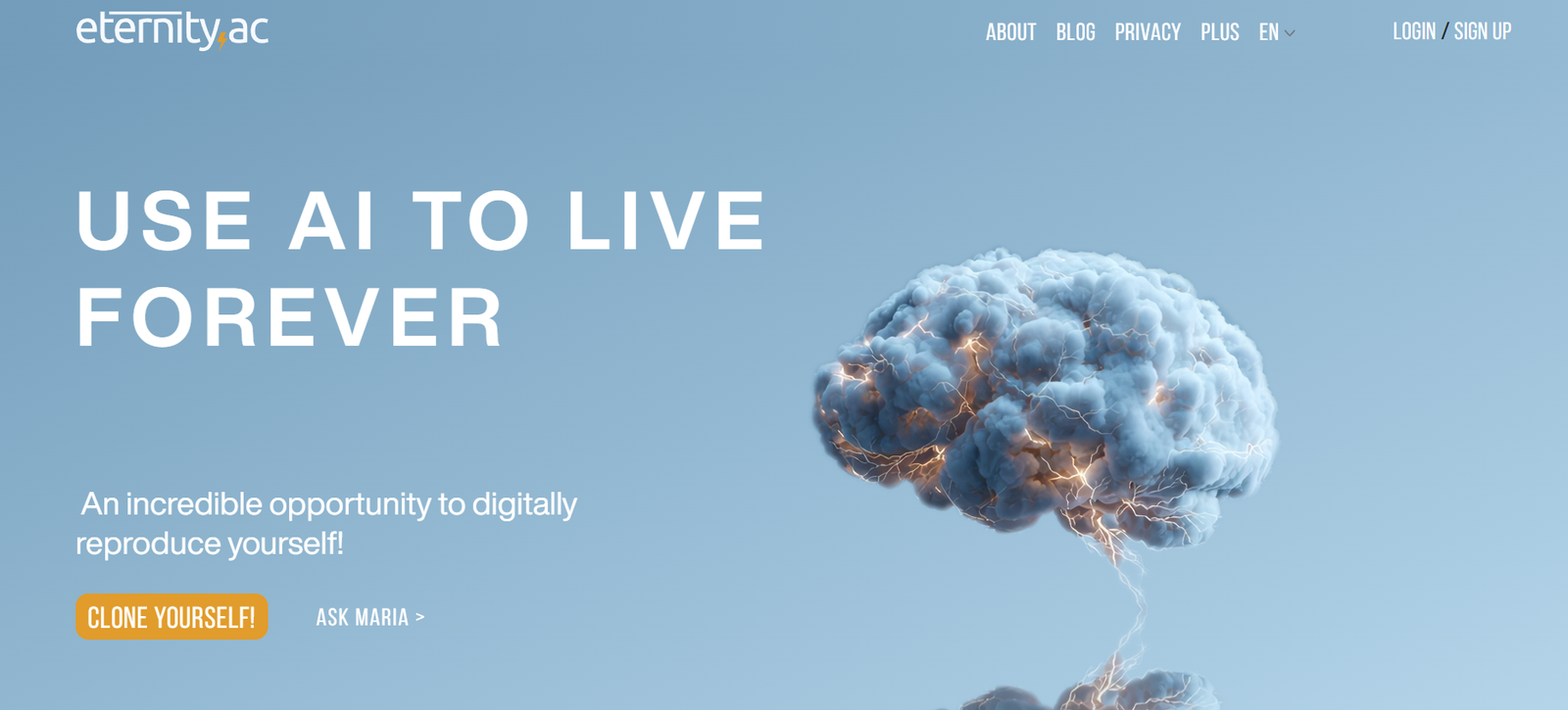
Eternity AI, available through Eternity.ac, is an AI platform designed to help people create interactive digital versions of themselves.
The central idea behind the platform is digital cloning. Users provide personal information, answers to questions and voice data that can be used to develop an AI powered representation capable of interacting with other people.
Rather than creating only a visual avatar, Eternity AI aims to capture aspects of a person’s knowledge, experiences, personality, voice and appearance. The resulting digital clone can respond to conversations based on information supplied by the original user.
Eternity AI positions this technology around digital legacy and long term preservation of personal experiences. A person could potentially create a digital representation that allows family members or other permitted users to interact with a version of their knowledge and personality in the future.
Users can keep information private or make a digital clone publicly accessible when they choose to do so. Public clone pages allow other people to interact with selected AI personalities.
The platform uses third party technologies for parts of its infrastructure, including AI language models, authentication, speech recognition, cloud storage and payments.
Because creating a digital clone involves highly personal information, users should carefully review Eternity AI’s privacy policy before providing voice recordings, biographical information or other sensitive personal material.
Features
Personal AI Digital Clone
Eternity AI allows users to build an AI based digital representation of themselves.
The goal is to create more than a generic chatbot. The digital clone is intended to respond using information and experiences provided by the person it represents.
Personality Preservation
Users answer personal questions that help Eternity AI understand their experiences, views and personality.
These answers become part of the information used by the digital clone during future interactions.
Personal Knowledge Capture
The platform can collect information about the user’s life, thoughts and experiences.
This information can help create a more personalized AI representation rather than relying entirely on general AI knowledge.
Voice Data
Eternity AI collects audio data as part of its digital cloning process.
Voice information can contribute to creating a digital representation that feels more closely connected with the original person.
3D Avatar
Eternity AI supports a visual avatar component for digital clones.
The company’s privacy information states that 3D avatar data can be stored through its cloud infrastructure.
Conversational AI
Digital clones are designed to interact through AI powered conversations.
When a person communicates with a digital clone, the system can use information previously supplied by the clone owner to formulate responses.
Public Digital Clones
Users can choose to make their digital clones publicly accessible.
This can allow other people to interact with the AI representation through a dedicated digital clone page.
Private Digital Identity
Users are not required to make their digital clone public.
Personal information can remain part of the user’s private digital experience according to the available privacy controls.
Digital Legacy
One of Eternity AI’s most distinctive ideas is the preservation of personal knowledge and experiences over time.
The platform is designed around the concept that aspects of a person’s memories, personality and life story could remain available digitally.
AI Powered Questions
Creating a digital clone involves answering questions about the user.
These questions help build a richer information base that the AI can use when representing the person.
Multilingual Availability
Eternity AI provides versions of its service in multiple languages.
The official website currently mentions Polish, Portuguese, Spanish, Turkish, Ukrainian and Belarusian as beta language options in addition to English.
Speech Recognition
The platform uses browser based speech recognition technologies to process spoken information in supported environments.
This can make interaction more natural than relying entirely on typed responses.
OpenAI Integration
Eternity AI uses OpenAI’s API as part of its conversational AI infrastructure.
Information supplied by the user may be reorganized and sent through the API when the user or another permitted person interacts with a digital clone.
Encrypted Personal Data
Eternity AI states that textual personal information is stored using encrypted storage and additional field level encryption.
This is important because the platform can contain highly personal information about users.
Encrypted Audio Storage
Audio information is stored using encrypted cloud storage.
The company states that its audio data is stored in an AWS European Union region with access controls.
Data Not Sold
Eternity AI states that it does not sell users’ personal information.
No AI Training on Personal Data
The company states that personal information supplied for digital cloning is not used to train its AI models and is intended specifically for creating and operating the user’s digital clone.
Profile Deletion
Users can request deletion of their profile through the website.
According to the privacy policy, this process removes information collected by Eternity AI, including personally identifiable information, audio files and authentication details.
Users may need to contact certain third party providers separately where applicable.
Download and Preservation
The privacy policy indicates that users can choose to accumulate information about themselves and download it without necessarily interacting with digital clones.
This provides another potential use for people interested primarily in preserving their personal information.
How It Works
Create an Account
Users begin by registering with Eternity AI.
Provide Basic Information
The platform may collect information such as name, email, date of birth, gender and preferred language.
Answer Personal Questions
Users respond to questions about themselves.
These answers help create the knowledge and personality foundation of the digital clone.
Provide Voice Information
Audio data can be collected to support the digital representation.
Build the Digital Identity
Eternity AI combines the information supplied by the user with its AI technologies to develop the digital clone.
Create the Visual Representation
A 3D avatar can become part of the user’s digital identity.
Interact With the Clone
Users can communicate with their digital clone and evaluate how effectively it reflects their information and personality.
Continue Adding Knowledge
Providing additional personal information and experiences can help develop the digital representation over time.
Control Visibility
Users can determine whether their digital clone remains private or is made publicly accessible.
Share the Clone
When a clone is public, other people can interact with the AI representation through its public page.
Manage Personal Data
Users can manage their profile and request deletion of stored personal information when required.
Use Cases
Digital Legacy
People can preserve personal stories, memories and experiences in an interactive AI format for future generations.
Family History
A digital clone could provide family members with an interactive way to explore a person’s experiences and life story.
Personal Knowledge Preservation
Professionals can preserve aspects of their knowledge, experiences and perspectives in a digital format.
Founders and Entrepreneurs
Business founders can potentially create AI versions that communicate their ideas, experience or company knowledge.
Experts
Professionals with specialized knowledge may use a digital clone as an interactive representation of their expertise.
Educators
Teachers and subject experts could potentially preserve explanations and experiences in an interactive format.
Authors and Thought Leaders
Writers and public thinkers can explore digital clones as another way for audiences to interact with their ideas.
Personal Reflection
The process of answering detailed questions about life and experiences may also provide users with a structured way to document their personal history.
Public AI Personas
Users who want a publicly accessible digital identity can make selected AI clones available for interaction.
Organizational Applications
Businesses may explore digital clones of appropriate experts or representatives for knowledge sharing and interactive communication, subject to privacy and consent requirements.
Pricing
Eternity AI maintains a dedicated pricing page and supports paid subscriptions.
However, the current public pricing page relies heavily on a JavaScript based application, and detailed plan names, current subscription prices and feature allowances are not reliably visible in the publicly accessible website information reviewed.
Therefore, pricing details are not clearly mentioned on the official website in a form that can be reliably verified.
Users should check the live Eternity AI pricing page after signing in or contact the company directly for the latest subscription information.
The official Terms and Conditions provide additional information about cancellation and refunds.
Users may cancel a subscription at any time and retain access to premium features until the end of the current paid subscription period.
The company provides a 14 day cooling off period for paid subscriptions when the associated paid services have not yet been used.
Once a user begins using the paid digital services during that period, the standard right to a refund may be forfeited.
Exceptional refund requests may be considered individually by Eternity AI.
Strengths
Distinctive Digital Clone Concept
Eternity AI goes beyond conventional chatbot creation by attempting to preserve aspects of a person’s appearance, voice, experiences and personality.
Personal Knowledge Preservation
The platform provides an unusual way to capture life experiences and personal information for future interaction.
Voice and Visual Identity
Combining conversational AI with voice information and a visual avatar creates a richer digital representation than a text only chatbot.
Public and Private Options
Users can decide whether their digital identity remains private or becomes available for other people to interact with.
Strong Privacy Emphasis
Eternity AI provides detailed public information explaining how personal and audio information is handled.
Encryption
The company states that personal information and audio data are protected using encryption and controlled storage systems.
No Sale of Personal Data
Eternity AI states that user data is not sold.
Data Deletion
Users can request deletion of their profile and information collected by the platform.
Multilingual Development
Support for additional languages expands the potential usefulness of digital clones beyond English speaking users.
Drawbacks
Requires Highly Personal Information
Creating an accurate digital clone may involve providing personal answers, voice recordings, biographical information and other private data.
Users should carefully consider how much information they are comfortable storing digitally.
Third Party Services Are Involved
Eternity AI uses external providers for AI processing, authentication, speech recognition, payment processing, avatar related functionality and cloud infrastructure.
Users with strict privacy requirements should review these arrangements carefully.
AI Cannot Fully Reproduce a Person
A digital clone is an AI generated representation based on supplied data. It should not be considered an exact continuation of a person’s consciousness, identity or judgment.
Responses May Be Inaccurate
Generative AI can misunderstand context or produce incorrect responses. A digital clone may therefore occasionally say something the original person would not have said.
Detailed Pricing Is Not Easily Verifiable
Current plan prices and feature limits are not clearly accessible through the public text version of the pricing page.
Significant Ethical Questions
Digital replicas of real people raise questions about identity, consent, ownership and how a person’s digital representation should be used after death.
Public Clones Require Care
Users making a clone publicly accessible should consider which personal information could become available through conversations with other people.
Comparison with Other Platforms
Eternity AI differs significantly from ordinary AI avatar and influencer generators.
Many AI avatar platforms focus primarily on creating photographs, spokesperson videos or virtual social media characters. Eternity AI places much greater emphasis on preserving the real person’s knowledge, experiences, personality and voice.
It also differs from standard AI chatbot builders. Conventional chatbot platforms are usually designed around customer support, documents or company knowledge. Eternity AI is centered on an individual human being as the source of the AI personality.
This makes the platform closer to a digital legacy or personal AI cloning service than a conventional AI content generator.
Its combination of personal questions, conversational AI, audio information and visual representation creates a more comprehensive digital identity concept.
However, this also introduces greater privacy and ethical considerations than a simple avatar generator. Users are potentially sharing information about their lives, personalities and voices rather than merely creating fictional images.
Eternity AI is therefore most relevant to people interested in digital identity, personal knowledge preservation and interactive digital legacy rather than users who simply need an AI influencer or social media image generator.
Customer Reviews and Testimonials
Customer reviews and testimonials are not clearly available on the official website.
The website provides examples of public digital clones that demonstrate how the technology can be used, but these should not be treated as independent customer testimonials.
Conclusion
Eternity AI is an unusual AI platform built around the idea of creating a persistent digital representation of a real person.
Instead of focusing only on avatars or synthetic photographs, Eternity AI attempts to capture multiple elements of identity, including personal experiences, knowledge, voice and visual appearance. These elements can then support an interactive AI clone capable of communicating with the user or, when permitted, other people.
The platform is particularly interesting for digital legacy, family history, personal knowledge preservation, experts, founders, authors and people who want to experiment with long term digital identity.
Its privacy measures are important because creating this type of AI clone requires substantially more personal information than most conventional AI tools. Users should therefore carefully review the privacy policy and decide what information they are comfortable providing.
It is also important to understand that an AI clone remains a technological representation. It cannot perfectly reproduce a person’s consciousness, judgment or identity, and generated responses may sometimes differ from what the real person would say.
Overall, Eternity AI offers a distinctive approach to personal AI by exploring how our stories, knowledge, voice and personality can be preserved as an interactive digital identity.


